Cursive alphabet · Letter L
L in Cursive: How to Write Capital L & Lowercase l
Last updated October 29, 2026
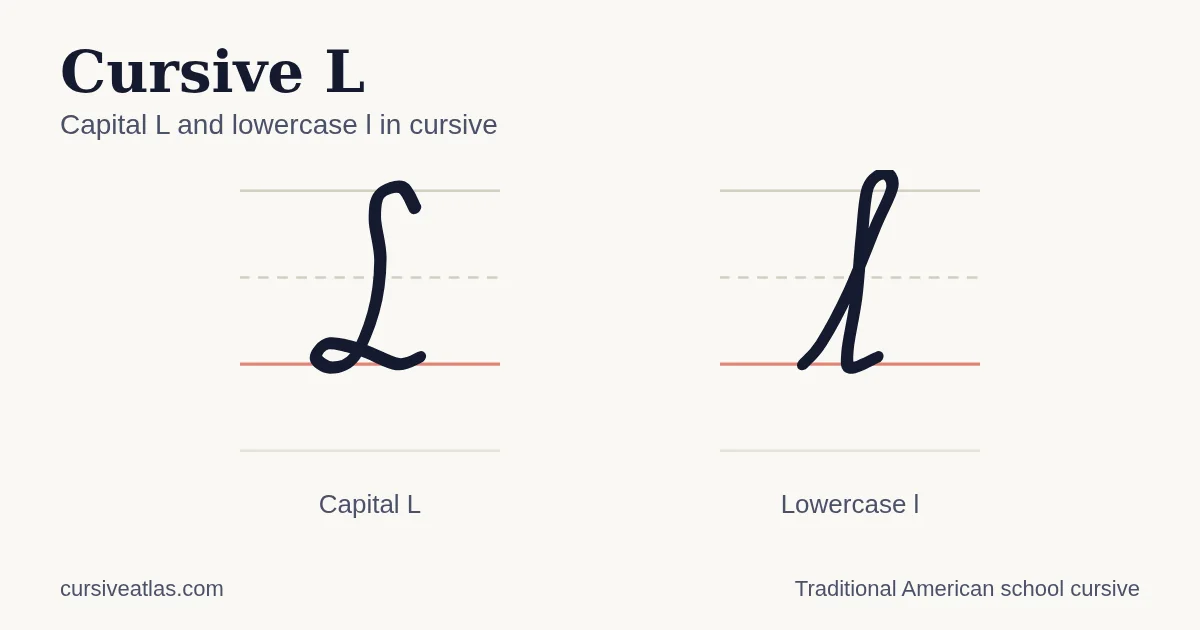
Cursive l is the loop that other tall letters borrow: b, h, k and f all begin with it. The capital L is a larger loop with a second loop at the base.
Cursive L at a glance
Capital L
Lowercase l
Numbered dots mark where each stroke begins. The red line is the baseline; the dashed line is the midline. Style: traditional American school cursive, simplified to a single line.
Capital L in cursive: step by step
- 1Start near the top line and make a loop, swinging left and then down.
- 2Draw the stem down to the baseline and make a second small loop to the left.
- 3Sweep out to the right in a long, low stroke.
Lowercase l in cursive: step by step
- 1Start on the baseline and swing up in a slanted line to the top line.
- 2Loop over at the top and come straight down to the baseline.
- 3Sweep up into a short exit stroke so l can join the next letter.
Capital L vs lowercase l in cursive
Lowercase l is a single tall loop. Capital L is larger and adds a second loop at the base and a long sweep along the baseline, so it is wider and usually stands on its own before the next letter.
Practice both forms on the same line: write the capital, then a row of lowercase letters, then a word that starts with L. The uppercase cursive letters and lowercase cursive letters pages show every letter of each set side by side.
Capital L in cursive: where you will use it
Capital L begins names such as Laura, London and Liam. It is a larger loop with a second loop at the base and a long low stroke, so leave room to the right of it.
Every capital is shown side by side in the uppercase cursive alphabet, and the printable cursive chart puts L next to l on one page.
Trace cursive L on screen
Use a finger, stylus or mouse. Start at the numbered dot, follow the dotted guide, then press Check to see how much of the guide you covered.
Capital L
Trace over the dotted guide with your finger, mouse or stylus.
Lowercase l
Trace over the dotted guide with your finger, mouse or stylus.
How cursive l joins other letters
In 'll' the exit of the first l turns straight up into the second. It is a good rhythm drill: up, loop, down, up, loop, down.
la
le
li
lo
ll
Trace the join: la
Trace over the dotted guide with your finger, mouse or stylus.
Common letter pairs with cursive l
These pairs appear in everyday English. Practice each one as a unit, because a join is a movement that you repeat rather than a gap you leave between letters.
- le: The exit of the l starts at the baseline and runs up into the loop of the e. See cursive E.
- li: The exit leads into the point of the i. Keep the i at the midline. See cursive I.
- ll: The exit of the first l turns straight up into the second loop. Keep both loops the same height.
- ly: The exit leads into the cup of the y, which drops below the baseline. See cursive Y.
Practice words with l
Capitalized names are written the way they would be on a card or label; lowercase words show how the letters link in a line.
Lucy
London
Laura
light
yellow
ball
family
Want a word of your own? The worksheet generator makes a practice sheet for any name.
Common mistakes with cursive l
A loop that fills with ink
The loop at the top should be open. If it fills in, the l looks like a stretched e.
A stem that does not reach the top
Lowercase l should be twice the height of an a. A short l is easy to mistake for e.
Cursive l vs e: Cursive l and e share the starting upstroke. The e stops at the midline and loops, but the l keeps going to the top line. See cursive E →
How to practice cursive L and l
- Write a row of tall loops from the baseline to the top line, keeping the slant even.
- Practice 'le', 'li' and 'll', then the words 'letter', 'hello' and 'yellow'.
- Write capital L in names and compare it with the lowercase l: the capital adds a second loop and a long sweep.
Print the cursive L worksheet for guided lines, or type your own words into the worksheet generator. For the next step, work through the full cursive alphabet.
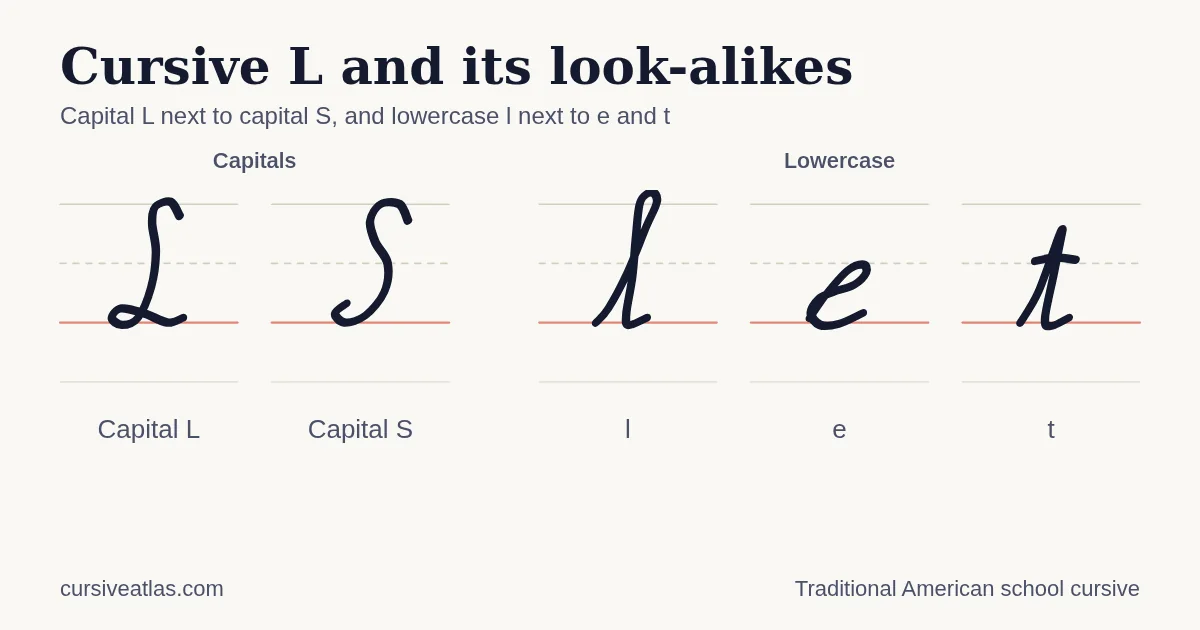
Cursive L next to S, e and t
The lowercase l is the simplest tall letter, a single loop, and it is the template for b, h, k and f. Most of its problems are about height and openness, and those are exactly what separates it from its neighbours.
- Lowercase l and e. The e has a small loop at the midline; the l has a tall loop to the top line. A short l is the most common reason it is read as an e. See cursive e.
- Lowercase l and t. The t is shorter, with a straight stem and a crossbar. The l is taller and loops over the top. If an l is too short and then crossed, the word "ball" becomes "batt". See cursive t.
- Capital L and capital S. The L is a loop at the top, a stem, a small loop at the base and a long low stroke to the right. The S ends with a small hook to the left. Check which way the last stroke goes.
- Capital L and lowercase l. The capital has two loops; the lowercase has one. A capital L written with one loop looks like a large lowercase l and will not read as the start of a name.
Write l, e, t in a row. The l should clearly be the tallest, and its loop should hold a clear gap.
Fixing a cursive l that does not look right
Height and loop width are the usual advice. Two problems are specific to l and appear as soon as the letter is doubled or joined.
| What you see | Likely cause | What to try |
|---|---|---|
| The two l's in "hello" run together | The loops are too wide for the space between them. | Narrow each loop and give the second l its own upstroke, leaving a gap about the width of a small o. |
| The l has a flat, pointed top | The pen changed direction sharply at the top line. | Round the turn at the top. The loop should be a smooth oval, not a roof. |
| My l leans more than the letters around it | The long upstroke pulls the slant forward. | Check the downstroke against the other tall letters in the line; it should be parallel to them. |
| The exit stroke of the l is too long and drops below the baseline | The sweep after the downstroke is too deep. | Swing out along the baseline instead of curving down, so the next letter starts level. |
| The capital L has no second loop | The base was drawn as a plain horizontal stroke, as in print. | Make a small loop at the foot of the stem, then sweep the long low stroke to the right. |
Where cursive l shows up: love, hello and Liam
Capital L begins love, Liam and Lucas, and because it has a loop at the top and one at the foot, it needs more space than most capitals. The lowercase l is in hello, family, beautiful and Isabella, where the double l creates two tall loops side by side.
The double l is the best test of control. Each loop must reach the top line, and the two downstrokes should be parallel. The second loop is not a copy of the first one in a hurry; it starts from the baseline exit of the first l. A well-spaced "ll" gives a line of cursive its rhythm.
The l also gives its shape to b, h, k and f, so the lowercase cursive alphabet page is a good place to compare them. The alphabet worksheets include a row of l loops, and the handwriting guide explains how to use them as warm-up strokes.
Cursive L questions
How do you write L in cursive?
Lowercase l: swing up from the baseline to the top line, loop over and come straight down, then sweep out. Capital L: a loop at the top, the stem down, a second small loop at the base and a long low stroke to the right.
How tall should a cursive l be?
Twice the height of a small letter such as a or e: up to the top line. A short l is the most common reason it gets read as an e.
Is there a printable cursive L worksheet?
Yes. The cursive L worksheet (PDF) has capital L, lowercase l, joins and words to trace. For a sheet with your own words, use the worksheet generator.
How do you write a capital L in cursive?
Make a loop at the top, draw the stem down, add a second small loop at the base and finish with a long low stroke to the right. See all the uppercase cursive letters.
How do you write a lowercase l in cursive?
Swing up from the baseline to the top line, loop over and come straight down, then sweep out into the exit. See all the lowercase cursive letters.
Why do many cursive letters start with the l loop?
Tall letters such as b, h, k and f all begin with the same loop. If your l is smooth and even, those letters improve too.
How do I write "ll" in cursive?
Write the first l as a tall loop that finishes with an exit stroke at the baseline, then start the second l from that stroke. Both loops should reach the top line with the same slant. Practise it in hello.
Why does a capital L in cursive have two loops?
The top loop starts the letter and the small loop at the base turns the stem into the long low stroke. Together they let the capital be written in one flowing movement.
Free printable worksheet: cursive L
One page with capital L, lowercase l, joins and words to trace, plus blank lines for your own writing. Print it on US Letter or A4.
More practice: the full alphabet practice sheets, or all cursive worksheets.