Cursive alphabet · Letter A
A in Cursive: How to Write Capital A & Lowercase a
Last updated October 29, 2026
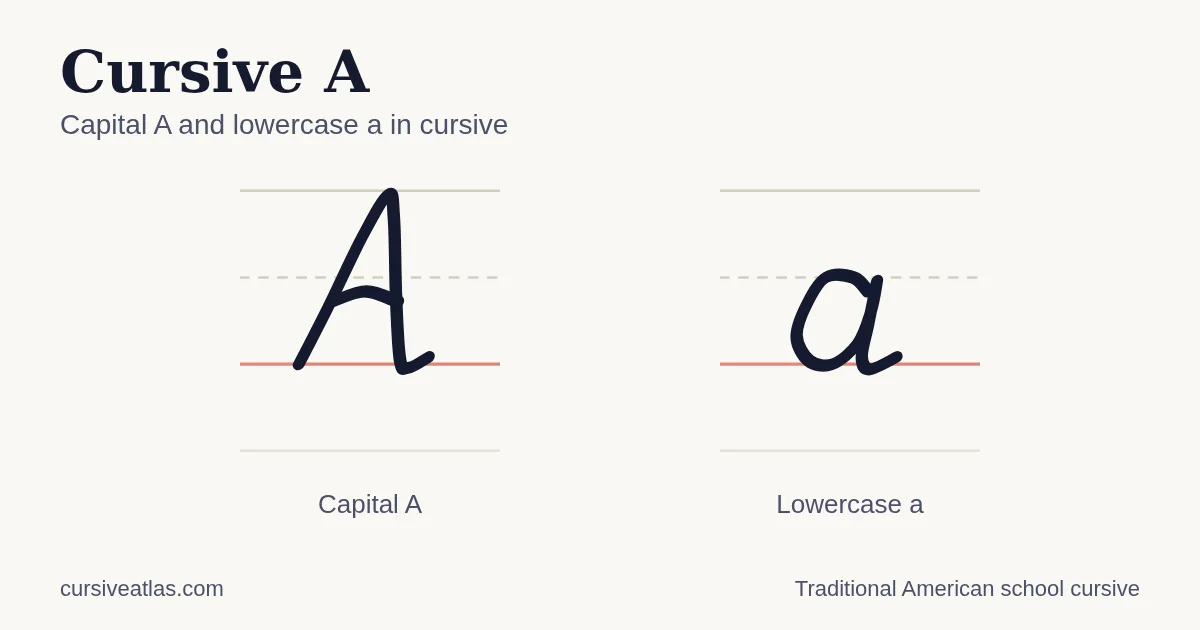
Cursive a is an oval with a stem, and that same oval sits inside d, g and q. The capital A is a different shape entirely: a slanted arch with a crossbar.
Cursive A at a glance
Capital A
Lowercase a
Numbered dots mark where each stroke begins. The red line is the baseline; the dashed line is the midline. Style: traditional American school cursive, simplified to a single line.
Capital A in cursive: step by step
- 1Start on the baseline at the left and draw a slanted line up to a rounded peak at the top line.
- 2Curve over the peak and slide back down to the baseline on the right, finishing with a small exit flick.
- 3Lift your pen and add a short crossbar at about the midline.
Lowercase a in cursive: step by step
- 1Start just below the midline on the right side of the letter's space.
- 2Curve up and over to the left, down around the bottom and back up, closing the oval where you began.
- 3Without lifting, pull a straight line down the right side of the oval to the baseline.
- 4Sweep up into a small exit stroke so the a can join the next letter.
Capital A vs lowercase a in cursive
The two forms share almost nothing. Capital A is a tall slanted arch with a crossbar that reaches the top line; lowercase a is a small oval with a stem that stays below the midline. Only the lowercase a carries the oval you reuse in d, g and q.
Practice both forms on the same line: write the capital, then a row of lowercase letters, then a word that starts with A. The uppercase cursive letters and lowercase cursive letters pages show every letter of each set side by side.
Capital A in cursive: where you will use it
Capital A opens names such as Anna, April and Alice, and the first word of a sentence. Finish the slanted arch first and add the crossbar last, so the peak keeps its shape.
Every capital is shown side by side in the uppercase cursive alphabet, and the printable cursive chart puts A next to a on one page.
Trace cursive A on screen
Use a finger, stylus or mouse. Start at the numbered dot, follow the dotted guide, then press Check to see how much of the guide you covered.
Capital A
Trace over the dotted guide with your finger, mouse or stylus.
Lowercase a
Trace over the dotted guide with your finger, mouse or stylus.
How cursive a joins other letters
The a's exit stroke rises from the baseline, so it flows straight into the upstroke of letters like n, t and l.
an
at
ad
al
ar
Trace the join: an
Trace over the dotted guide with your finger, mouse or stylus.
Common letter pairs with cursive a
These pairs appear in everyday English. Practice each one as a unit, because a join is a movement that you repeat rather than a gap you leave between letters.
- an: The a's exit rises from the baseline straight into the first upstroke of the n, so the two letters share one smooth motion. See cursive N.
- at: The exit lifts into the stem of the t. Keep that stem short and cross it after the whole word is written. See cursive T.
- ar: The join is short because the r also starts with an upstroke. Keep the shoulder of the r level instead of letting it droop. See cursive R.
- ay: The a leads into the cup of the y. Give the y a long stem so it drops below the baseline. See cursive Y.
Practice words with a
Capitalized names are written the way they would be on a card or label; lowercase words show how the letters link in a line.
Anna
April
Alice
banana
again
magic
cat
Want a word of your own? The worksheet generator makes a practice sheet for any name.
Common mistakes with cursive a
An oval that stays open
If the oval does not close at the top, the a reads like a u. Let the pen touch its starting point before you drop down the stem.
A stem that drifts
The stem should lean at the same angle as the rest of the line. Letting it slide right at the bottom makes the a look unfinished.
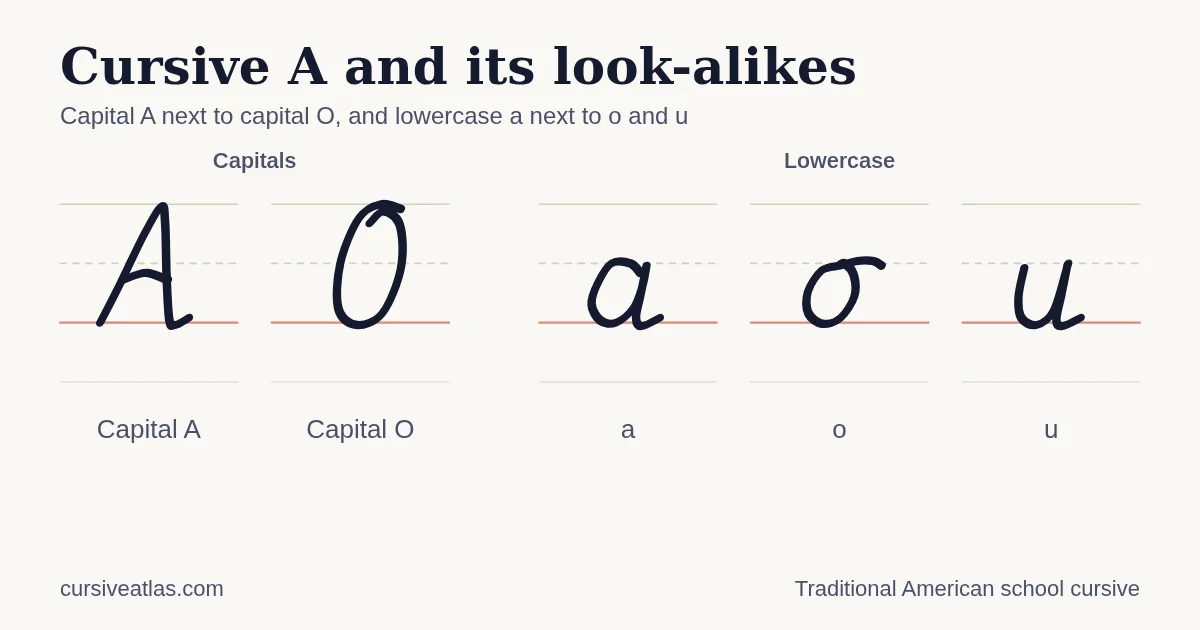
Cursive a vs o: Cursive a and o look alike at a glance. The tell is the stem: a has a straight line down its right side, o closes at the top and exits across. See cursive O →
How to practice cursive A and a
- Write a line of lowercase a and close every oval at the top before pulling the stem down.
- Add the joins: 'an an an', then 'at at at', then the words 'banana' and 'again'.
- Write capital A in 'Anna' and 'April' on its own line, so you can compare the arch of the capital with the oval of the lowercase a.
Print the cursive A worksheet for guided lines, or type your own words into the worksheet generator. For the next step, work through the full cursive alphabet.
Cursive a next to o, d and u
The lowercase a is the first letter many learners get wrong, because it is an oval that other letters borrow. Put it beside its neighbours and the differences come down to what happens on the right-hand side of the oval.
- a and o. Both are closed counterclockwise ovals. The o closes at the top and leaves from the midline; the a goes on to pull a stem down its right side to the baseline. Leave the stem out and "cat" turns into "cot". See cursive o.
- a and d. The oval is identical. The only difference is height: the stem of an a stays at the oval, while the stem of a d climbs to the top line. In "dad" and "and" the two sit next to each other, so check the a against the d beside it. The cursive d page explains the tall stem.
- a and u. A u has a cup at the bottom and two open tops. An a is closed at the top. If you can see daylight between the oval and the stem, the letter is drifting toward a u.
- Capital A and lowercase a. They share almost nothing. The capital is a tall slanted arch with a crossbar added last, the small letter is a closed oval. Treat them as two different letters that happen to have the same name.
Reading your own a back is the best test: copy "ado", "add" and "aud" in a row. If the three first letters look the same, the oval and the stem are working.
Fixing a cursive a that does not look right
Closing the oval and keeping the stem short are the usual advice. These are the symptoms that appear when a is written at speed in real words.
| What you see | Likely cause | What to try |
|---|---|---|
| My a reads as an o | The stem down the right side was left out, or it stopped at the midline. | Pull the stem all the way down to the baseline before you leave the letter. The o leaves from the midline, the a leaves from the baseline. |
| "Cat" looks like "cut" | The oval stays open at the top, so the a looks like a u. | Bring the pen back to the point where the oval began, then pull the stem. The top of the letter should be closed. |
| The a in "and" looks like a d | The stem has crept up towards the top line. | Hold the stem to the height of the oval. Compare it with the l or the d in the same line; only they reach the top line. |
| The oval leans backwards or looks like an egg | The oval was started on the wrong side, or drawn clockwise as in print. | Begin at the top and travel to the left first. A counterclockwise oval is the same movement as the c. |
| The crossbar of my capital A floats off to one side | It was added before the arch was finished, or without lifting the pen. | Finish the arch down to the baseline, lift, and add the crossbar last, starting inside the left leg and ending just past the right. |
Where cursive a shows up: the oval inside d, g and q
Because a, d, g and q all begin with the same oval, a good a improves four letters at once. In names it appears everywhere: Ava opens and closes with it, and Emma, Mia and Noah all depend on it. Capital A is the odd one out, because it has no oval at all and is not meant to join to the next letter.
When you write a word such as family or dream, slow down on the a and let it set the size for everything after it. The lowercase cursive alphabet shows the oval letters as a group, and the guide to reading cursive explains why a closed oval is the first thing a reader looks for.
For practice, trace the letter on this page, then build a line of "aaa" before adding "ad", "ag" and "aq" to feel how the oval passes into the next letter. A custom sheet with your own words takes a minute in the cursive worksheet generator.
Cursive A questions
How do you write A in cursive?
Lowercase a: draw a counterclockwise oval starting just below the midline, close it, pull a stem down its right side and sweep out. Capital A: a slanted line up to a rounded peak, back down to the baseline, then lift and add the crossbar.
Why does my cursive a look like a u?
The oval is not closing at the top. Bring the pen back to the point where the oval started before you pull the stem down, and the a stops reading as a u.
Is there a printable cursive A worksheet?
Yes. The cursive A worksheet (PDF) has capital A, lowercase a, joins and words to trace. For a sheet with your own words, use the worksheet generator.
How do you write a capital A in cursive?
Draw the slanted stroke up to a rounded peak, come back down to the baseline, then lift the pen and add the crossbar. A capital usually stands alone, so start the next lowercase letter fresh. See all the uppercase cursive letters.
How do you write a lowercase a in cursive?
Start just below the midline, draw a counterclockwise oval, close it, pull a stem down the right side and sweep out. The whole letter stays below the midline. See all the lowercase cursive letters.
What is the difference between a cursive a and a cursive o?
Both begin as a counterclockwise oval. The a closes its oval, adds a stem on the right and exits from the baseline; the o closes at the top and leaves across the midline to join the next letter.
Is the cursive a closed at the top?
Yes. The oval must close before the stem is drawn, and the stem then runs down the right side of it. An open top is the commonest reason a cursive a is read as a u.
Why does a capital A look so different from a lowercase a in cursive?
The capital is taught as a slanted arch with a separate crossbar, which is closer to the printed capital, while the lowercase is built from an oval. Only the lowercase a joins to the next letter. See the whole set in the uppercase cursive alphabet.
Free printable worksheet: cursive A
One page with capital A, lowercase a, joins and words to trace, plus blank lines for your own writing. Print it on US Letter or A4.
More practice: the full alphabet practice sheets, or all cursive worksheets.