En español: Abecedario en cursiva
26 letters · capital and lowercase
Cursive Alphabet A–Z
Last updated November 15, 2026
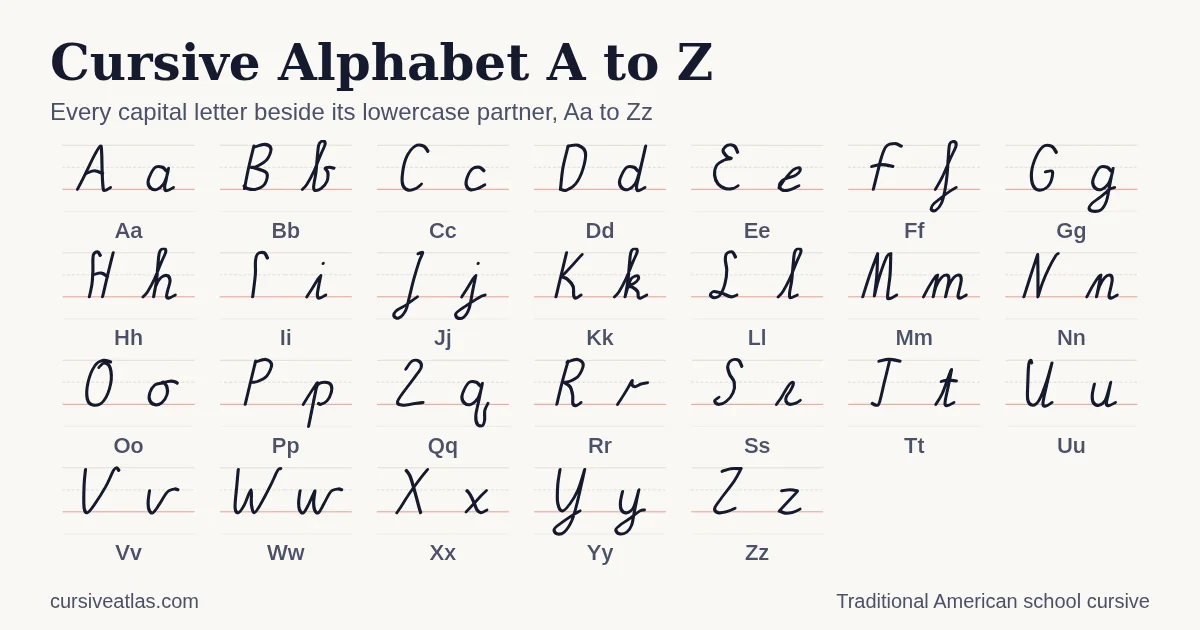
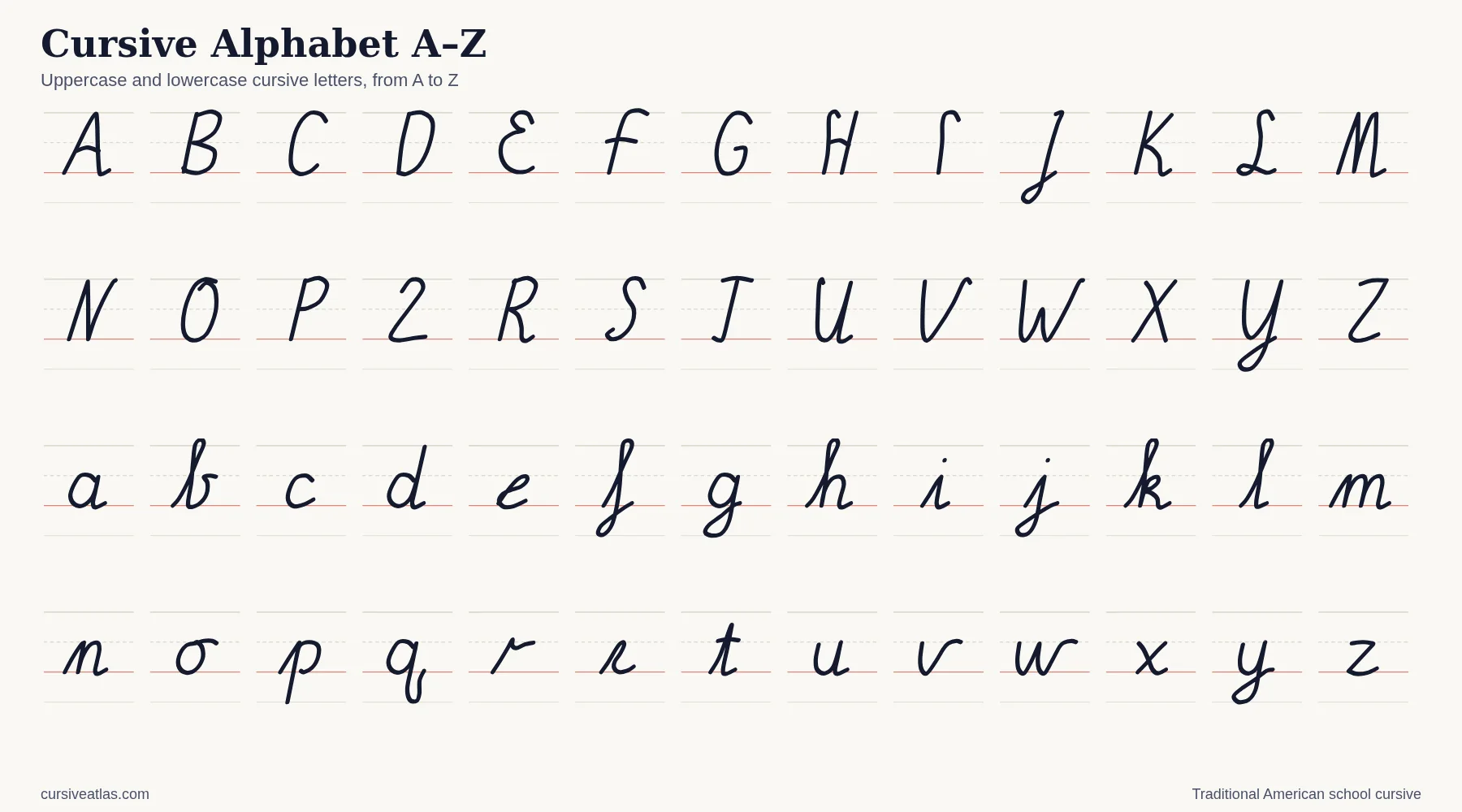
The cursive alphabet has 26 letters, each with an uppercase (capital) and a lowercase form, written with a slight forward slant so the letters join into words. The chart below shows all 52 cursive letters A–Z. Tap any letter to watch it drawn stroke by stroke, trace it on screen, see how it joins its neighbors and print a free worksheet.
Cursive alphabet chart: uppercase and lowercase A–Z
Each card shows the capital and lowercase letter together. Every one is a link to a full lesson for that letter.
Style: traditional American school cursive, simplified to a single line. Capitals differ between school programs. Want a one-page reference? See the printable cursive writing chart.
Printable chart or step-by-step lessons?
This page is the lesson route. Every letter in the grid above opens its own page with stroke order, joins, common mistakes and a worksheet, so it is the right place if you want to learn how each letter is built.
If you only need the whole alphabet on one sheet to keep beside you while you write, use the printable cursive chart. It has no lessons, only both alphabets on writing lines, and it is made to be printed.
- Learning the shapes from scratch: start with the letter pages here, beginning with cursive a.
- A quick reference at your desk: print the cursive chart.
- Only the capitals: see cursive capital letters, where they are grouped by shape.
- Only the small letters: see the lowercase cursive alphabet.
- Practice sheets: use the cursive worksheet generator or the alphabet worksheets.
Learn the cursive alphabet by letter shape
Cursive letters share building blocks. Practicing them in families is faster than going strictly from a to z.
Uppercase and lowercase cursive
How to learn the cursive alphabet, step by step
- Warm up with the basic strokes: the upstroke, the oval and the loop. Almost every cursive letter is built from them.
- Learn the lowercase oval letters a, c, d, g and o, then the tall loop letters b, e, f, h, k and l.
- Practice joins early. Write pairs such as an, ed and oa so the connecting strokes become automatic.
- Add the capitals once the lowercase letters feel steady, starting with C, G and O.
- Write real words and your own name. Short daily sessions of 10 to 15 minutes beat one long session a week.
The beginner guide sets out a full plan, the cursive words pages show how letters join in common words, and the cursive translator turns any text into cursive so you can see a sentence before you write it.
Learning as a grown-up? Follow the plan for adult learners. Teaching a child? See how to teach kids cursive, and if your writing is legible but untidy, how to improve messy handwriting.
Practice the whole alphabet
- Warm up with the basic strokes sheet: loops, ovals, humps and cups.
- Take three or four letters from one family above and trace each on its page until it feels smooth.
- Join them: write pairs and short words from the letters you know, using the join examples on each page.
- Print the sheets from the alphabet practice sheets and work through a few lines each day.
Copy and paste the cursive alphabet
Need the letters as text? These cursive-style Unicode letters are ready to select and copy into a document, bio or message. They are special characters rather than a font, so they work in most apps, but screen readers may read them oddly, so use them for decoration rather than for important information.
𝒜 ℬ 𝒞 𝒟 ℰ ℱ 𝒢 ℋ ℐ 𝒥 𝒦 ℒ ℳ 𝒩 𝒪 𝒫 𝒬 ℛ 𝒮 𝒯 𝒰 𝒱 𝒲 𝒳 𝒴 𝒵
𝒶 𝒷 𝒸 𝒹 ℯ 𝒻 ℊ 𝒽 𝒾 𝒿 𝓀 𝓁 𝓂 𝓃 ℴ 𝓅 𝓆 𝓇 𝓈 𝓉 𝓊 𝓋 𝓌 𝓍 𝓎 𝓏
For 12 more styles from one text box, use cursive font copy and paste. To learn how the letters are actually written by hand, work through the lessons above or print the cursive chart to keep beside you.
Cursive alphabet vs print alphabet
Cursive and print use the same 26 letters, but many shapes change so that letters can join. This table shows the letters that learners most often find different. For a deeper comparison, see cursive vs print handwriting.
| Letter | In print | In cursive |
|---|---|---|
| a | A circle with a separate vertical stick, written in two strokes. | One counterclockwise oval with the stem retraced, ready to join to the next letter. |
| b | A vertical line with a separate bowl on the right. | A loop up to the top line, back down, then a bowl that ends in a small tail at the midline. |
| e | A horizontal bar closed with a curve. | A small loop at the midline, drawn upward from the baseline. |
| f | A hook with a crossbar. | A tall loop that, in many school models, also dips below the baseline. |
| k | A stick with two diagonal arms. | A tall loop followed by a small loop and a bump on the right. |
| r | A stem with a short arm. | A small pointed shoulder that finishes at the midline and flows into the next letter. |
| s | A curved S shape. | A small pointed peak that slopes down to the baseline. |
| z | Three straight strokes in a zigzag. | A short flat stroke, a straight diagonal and a curved base, all sitting on the baseline. |
| Capital Q | An O with a short tail. | A shape that looks like a large number 2. |
American cursive, D'Nealian and Zaner-Bloser: how the alphabets differ
Schools in the United States teach more than one cursive model, and the differences are mostly in the capital letters. The lowercase letters are much closer to each other, so the lessons on this site work with any of them.
| Program | How print leads into cursive | What differs in cursive |
|---|---|---|
| Traditional American (Palmer-style) | Print and cursive are learned as separate hands. | Plain, rounded forms from the early 1900s, the basis of the capitals shown on this site. |
| Zaner-Bloser | Upright print first, then a separate cursive alphabet. | Classic rounded capitals, with more loops and ovals in some capitals. |
| D'Nealian | Slanted print letters with small exit strokes, so print and cursive share shapes. | Simpler capitals that look closer to their print forms; lowercase letters are very similar to the other programs. |
Programs and editions change over time, so if a teacher has handed out a model sheet, follow it for the capitals. For the history behind these models, see a short history of cursive handwriting.
For a closer comparison of the two styles, read D'Nealian vs Zaner-Bloser. To see how letters connect, see connecting letters in cursive.
Cursive alphabet questions
How many letters are in the cursive alphabet?
Twenty-six, the same as print: 26 capitals and 26 lowercase letters. Cursive also has its own numerals, which you can practice on the cursive numbers page.
Which cursive letters are the hardest?
Most learners struggle with the lowercase s, r and z, and the capitals Q, G and Z, because the shapes differ most from their print versions. Give them extra time and practice them in pairs before using them in words.
Do all schools teach the same cursive?
No. Zaner-Bloser, D'Nealian and Palmer-style programs differ, mostly in the capitals. The lowercase letters are much closer. If a teacher has given you a model, follow that for capitals and use these pages for the lowercase flow.
Where should I start?
Start with the lowercase letters built on an oval: a, c, d, g and o. Then add the tall loop letters. The beginner guide lays out a full order.
What is the cursive alphabet?
It is the set of 26 letters written in cursive, a joined handwriting style in which most letters connect to the next one. Each letter has a capital and a lowercase form, so the full cursive alphabet has 52 shapes.
How long does it take to learn the cursive alphabet?
Most learners can write every letter recognizably within two to four weeks of short daily practice. Writing fluently in joined words takes longer, usually a few months.
Can I print the cursive alphabet?
Yes. The printable cursive chart puts the whole alphabet on one page, and the alphabet practice sheets give you a tracing page for every letter.
Can I copy and paste the cursive alphabet?
Yes. The copy-and-paste section above has the full cursive-style A–Z in capitals and lowercase, and cursive font copy and paste offers 12 more styles. They are special Unicode characters rather than a handwriting font.
How is the cursive alphabet different from the print alphabet?
It has the same 26 letters, but many are drawn differently so that they connect: loops on b, f, k and l, a pointed shoulder on r and s, and a joined oval on a. The comparison table above shows the main differences, and the cursive vs print guide covers speed and legibility.
What is the difference between D'Nealian and Zaner-Bloser cursive?
Mostly the capital letters. D'Nealian uses slanted print with exit strokes and simpler cursive capitals, while Zaner-Bloser teaches upright print first and a separate cursive alphabet with more traditional capitals. Lowercase letters are very similar. Check which program your school uses and follow its capitals.