Cursive alphabet · Letter R
R in Cursive: How to Write Capital R & Lowercase r
Last updated October 29, 2026
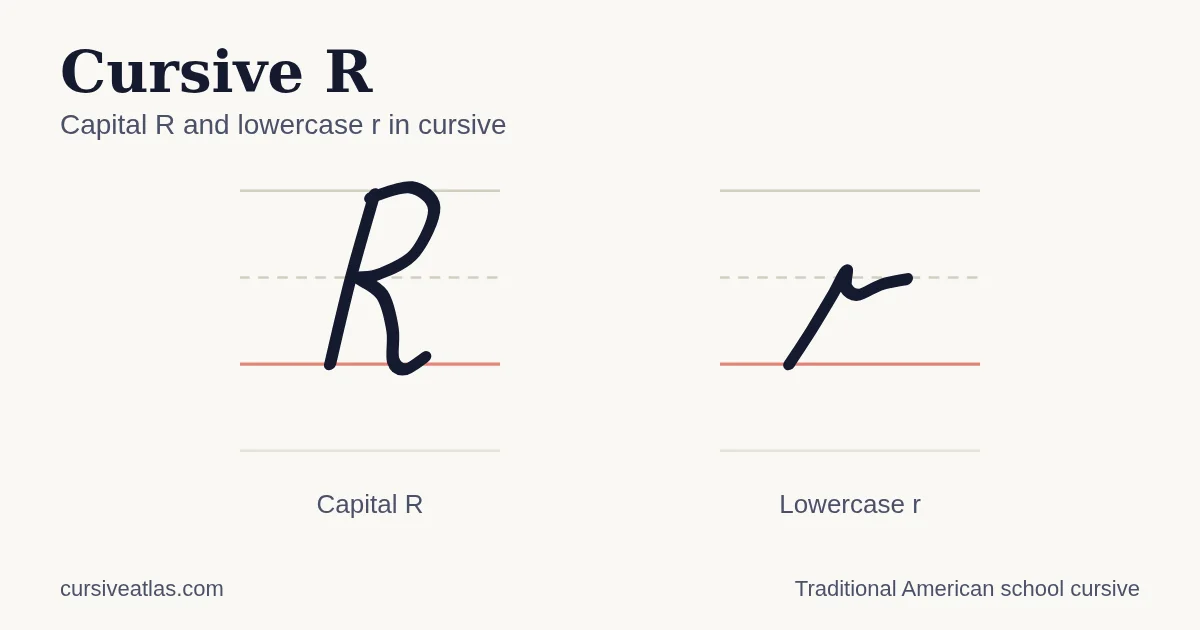
Cursive r is a short upstroke with a small shoulder, and it is one of the most variable lowercase letters. The shoulder is what separates it from i.
Cursive R at a glance
Capital R
Lowercase r
Numbered dots mark where each stroke begins. The red line is the baseline; the dashed line is the midline. Style: traditional American school cursive, simplified to a single line.
Capital R in cursive: step by step
- 1Start near the top line and draw a straight stem down to the baseline.
- 2Lift your pen and return to the top of the stem.
- 3Draw a bowl to the right and back to the stem at the midline, then continue with a leg out to the baseline.
Lowercase r in cursive: step by step
- 1Start on the baseline and swing up to a point just above the midline.
- 2Dip down slightly and curve right to form the shoulder.
- 3Finish with a short stroke at the midline, ready to join the next letter.
Capital R vs lowercase r in cursive
Capital R is a stem, a bowl and a leg, much like print. Lowercase r is just an upstroke and a shoulder, it is one of the most variable letters between school styles, and it exits at the midline.
Practice both forms on the same line: write the capital, then a row of lowercase letters, then a word that starts with R. The uppercase cursive letters and lowercase cursive letters pages show every letter of each set side by side.
Capital R in cursive: where you will use it
Capital R begins names such as Robert, Rachel and Russia. It is a stem, a bowl and a leg, much like print, and it is usually followed by a pen lift.
Every capital is shown side by side in the uppercase cursive alphabet, and the printable cursive chart puts R next to r on one page.
Trace cursive R on screen
Use a finger, stylus or mouse. Start at the numbered dot, follow the dotted guide, then press Check to see how much of the guide you covered.
Capital R
Trace over the dotted guide with your finger, mouse or stylus.
Lowercase r
Trace over the dotted guide with your finger, mouse or stylus.
How cursive r joins other letters
The r exits at the midline, so it joins smoothly to letters that start high, like a, c and o. For letters that start at the baseline, the stroke dips.
ra
re
ri
ro
ar
Trace the join: ra
Trace over the dotted guide with your finger, mouse or stylus.
Common letter pairs with cursive r
These pairs appear in everyday English. Practice each one as a unit, because a join is a movement that you repeat rather than a gap you leave between letters.
- re: A very common pair. The r exits at the midline, so dip slightly into the loop of the e. See cursive E.
- ra: The r joins across the midline into the oval of the a. Keep the shoulder level. See cursive A.
- ri: The r leads into the point of the i. Dot the i after the word. See cursive I.
- ar: The a exits at the baseline and the r starts with an upstroke. Keep the shoulder of the r at the midline. See cursive A.
Practice words with r
Capitalized names are written the way they would be on a card or label; lowercase words show how the letters link in a line.
Robert
Rachel
Russia
river
carry
write
rainbow
Want a word of your own? The worksheet generator makes a practice sheet for any name.
Common mistakes with cursive r
A shoulder that droops
Keep the shoulder level with the midline. A drooping shoulder makes r look like an n that has run out of ink.
Joining at the baseline
Lowercase r joins to the next letter at the midline, not the baseline. A low join makes 'ra' and 're' look squashed.
Cursive r vs s: Cursive r and s both start with an upstroke. The r stops at the midline and goes sideways, while the s peaks and drops back down to the baseline. See cursive S →
How to practice cursive R and r
- Write a line of lowercase r with a small level shoulder at the midline.
- Practice 're', 'ra' and 'ar', then the words 'river', 'carry' and 'rainbow'.
- Write capital R in names and check that the bowl returns to the stem at the midline.
Print the cursive R worksheet for guided lines, or type your own words into the worksheet generator. For the next step, work through the full cursive alphabet.
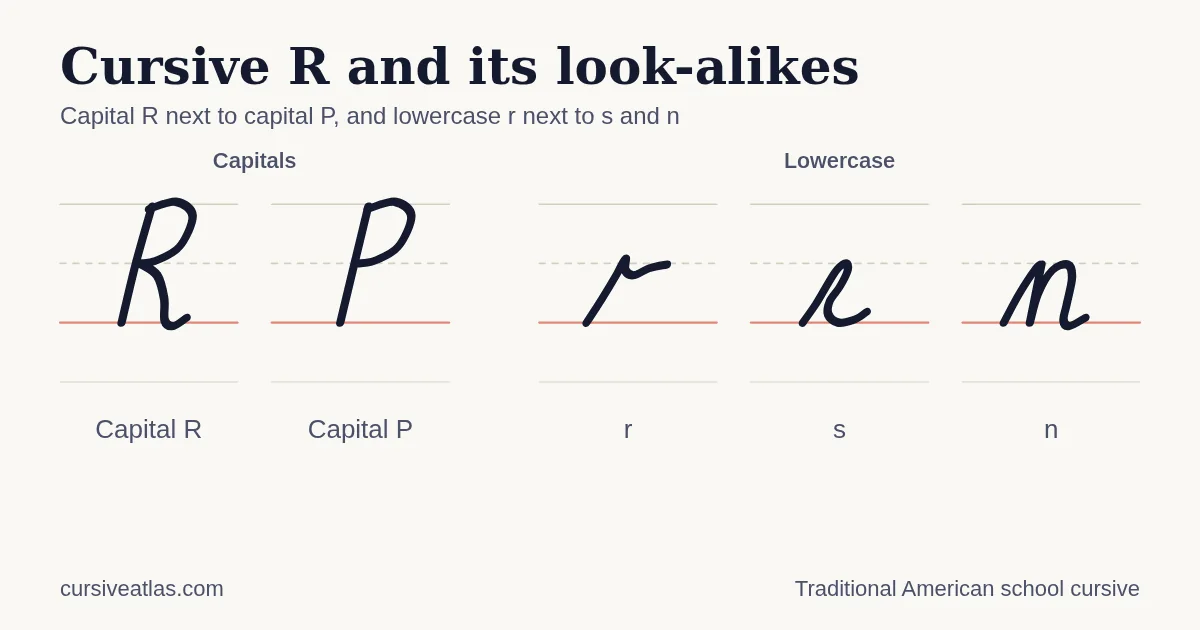
Cursive R next to P, s and n
The lowercase r is the smallest letter in the alphabet, a short upstroke and a shoulder, and it is the one where school styles differ the most. The version shown here is the simple one, a pointed shoulder with a flat finish, so the useful question is what makes it different from s and n.
- Lowercase r and s. The two are the most commonly confused letters in cursive, because each has a small pointed top. The r finishes with a flat shoulder at the midline. The s drops from its point down to the baseline and sweeps out from there. See cursive s.
- Lowercase r and n. The n has a full arch with a downstroke to the baseline. If the right side of the arch never comes down, the n has become an r.
- Capital R and capital P. The R is the P with a leg. Both start with a stem, then a lift, then a bowl that returns to the stem at the midline; the R adds a leg out to the baseline. Compare capital P.
- Capital R and capital K. Both have a stem and a leg. The K has an arm and a small loop; the R has a closed bowl.
A habit worth building is to treat the exit as the difference: the r leaves from the midline, the s from the baseline, and the following letter has to be ready for that.
Fixing a cursive r that does not look right
Most trouble with the r comes from its small size. The table covers the faults that show up in words and in pairs like ri and rr.
| What you see | Likely cause | What to try |
|---|---|---|
| The r looks like an s | The shoulder drops and curves back instead of staying flat. | Keep the shoulder level and finish at the midline. No downstroke to the baseline is needed. |
| "ri" looks like "n" or "u" | The exit of the r runs straight into the i with no gap. | Let the r finish at the midline, then start the i from there with a pointed upstroke, and add the dot after the word. |
| The r in "dream" disappears | It was shrunk into a short tick between the d and e. | Give the r a visible shoulder, about the same width as the e after it. |
| The two r's in "forever" are different sizes | The second one is drawn faster. | Compare them in the word; each should have a pointed rise and a level shoulder. |
| The capital R has no leg and reads as a P | The pen stopped after the bowl. | After the bowl returns to the stem, carry the leg out to the baseline in one movement. |
Where cursive r shows up: dream, forever and birthday
Capital R begins names such as Rose, Ryan and Rachel and words like "Remember" and "Rain". The lowercase r is hidden in the middle of the words people practise most: dream, forever and happy birthday. In "forever" it appears twice, and the two shoulders should be level.
The r is useful in pairs. In "or" and "er" the shoulder leaves from the midline, which is the same height at which the next letter starts. In "ry" and "rs" it hands over to a letter with a different starting point, and the exit has to adjust. Writing "ri" at a slow speed is the best way to see how much space an r needs.
The cursive s and cursive n pages show the two letters r gets mistaken for. The guide to reading cursive explains how to tell them apart in other people's handwriting, and the worksheet generator can make a sheet of r words.
Cursive R questions
Why does cursive r have a shoulder?
The shoulder makes the letter distinct from i and gives the pen a flat stroke at the midline to launch into the next letter.
How do you write R in cursive?
Lowercase r: swing up to just above the midline, dip slightly and curve right into the shoulder, and finish with a short stroke at the midline. Capital R: a stem, lift, then a bowl back to the stem at the midline and a leg out to the baseline.
Is there a printable cursive R worksheet?
Yes. The cursive R worksheet (PDF) has capital R, lowercase r, joins and words to trace. For a sheet with your own words, use the worksheet generator.
How do you write a capital R in cursive?
Draw a stem, lift the pen, draw a bowl back to the stem at the midline and finish with a leg to the baseline. See all the uppercase cursive letters.
How do you write a lowercase r in cursive?
Swing up to just above the midline, dip slightly, curve right into the shoulder and finish with a short stroke at the midline. See all the lowercase cursive letters.
Why do different cursive alphabets show different lowercase r shapes?
The r is one of the most variable letters between school programs. The one shown here is the simplest: an upstroke, a shoulder and a midline exit.
How do I write "ri" in cursive?
Finish the r with its flat shoulder at the midline, then start the i from the end of the shoulder with a short pointed upstroke. Keep the dot for after the word. The two shoulders should not run together.
Why is the cursive r so different from one school to another?
Because its small size leaves room for variation: some styles use a pointed shoulder, others a rounder one. The version on this page is the simple pointed form. Use whichever one you were taught, and keep it distinct from the s.
Free printable worksheet: cursive R
One page with capital R, lowercase r, joins and words to trace, plus blank lines for your own writing. Print it on US Letter or A4.
More practice: the full alphabet practice sheets, or all cursive worksheets.