Cursive alphabet · Letter T
T in Cursive: How to Write Capital T & Lowercase t
Last updated November 15, 2026
Cursive t is a short stem with a crossbar. It is shorter than l or b, which helps it stay distinct in words like 'tot' and 'tall'.
Cursive T at a glance
Capital T
Lowercase t
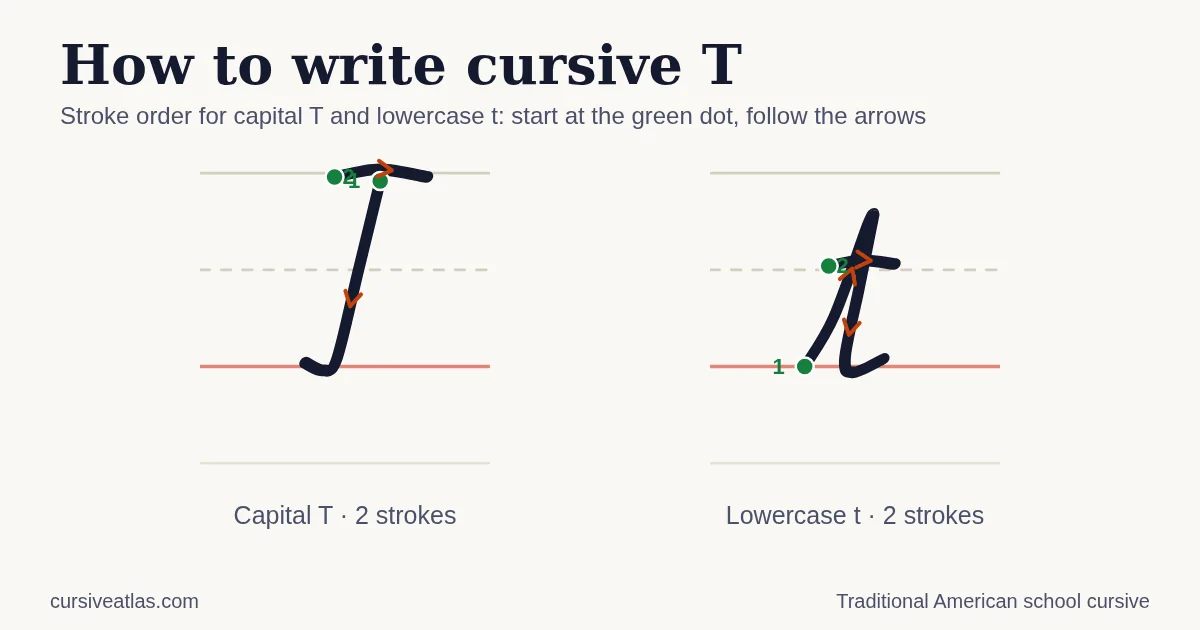
Numbered dots mark where each stroke begins. The red line is the baseline; the dashed line is the midline. Style: traditional American school cursive, simplified to a single line.
Capital T in cursive: step by step
- 1Start near the top line and draw a straight stem down toward the baseline.
- 2Curl left at the bottom to finish the stem with a small hook.
- 3Lift your pen and add a crossbar across the top line from left to right.
Lowercase t in cursive: step by step
- 1Start on the baseline and swing up to about two-thirds of the way to the top line.
- 2Come straight back down to the baseline.
- 3Sweep up into a small exit stroke.
- 4Finish the word, then go back and cross the t with a short horizontal line.
Capital T vs lowercase t in cursive
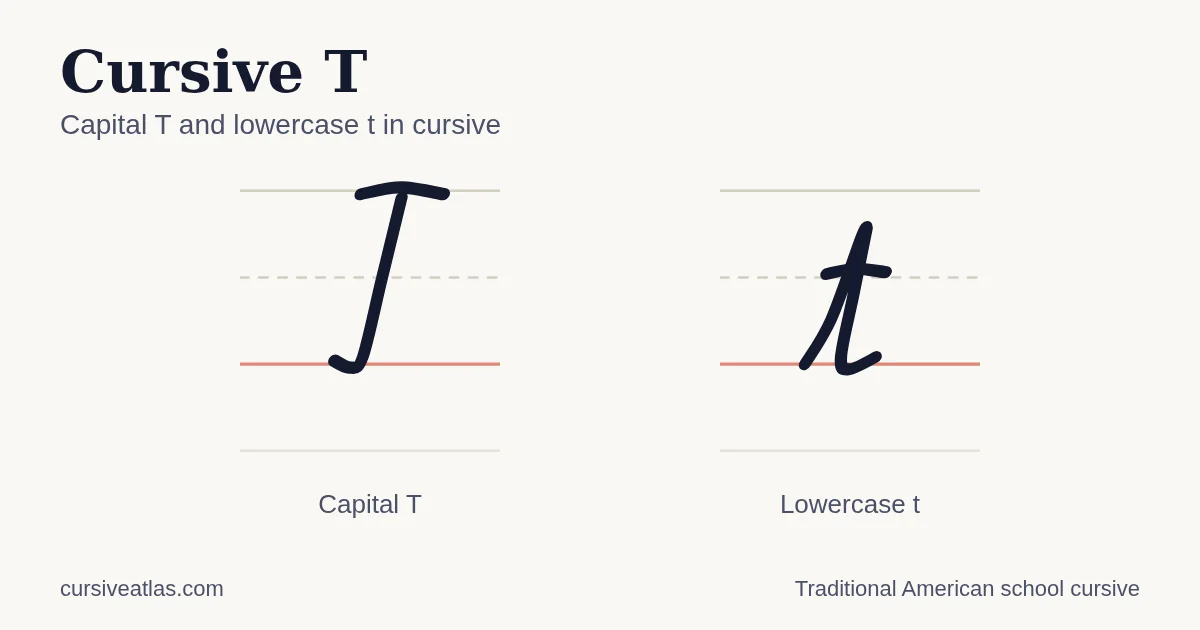
Capital T has its crossbar at the top line and a curl at the foot of the stem. Lowercase t is shorter than l and gets a short crossbar near the top of its stem after the word is finished.
Practice both forms on the same line: write the capital, then a row of lowercase letters, then a word that starts with T. The uppercase cursive letters and lowercase cursive letters pages show every letter of each set side by side.
Capital T in cursive: where you will use it
Capital T begins names such as Tom, Texas and Tuesday. Its stem curls left at the foot and the crossbar goes across the top line, and the next letter starts fresh.
Every capital is shown side by side in the uppercase cursive alphabet, and the printable cursive chart puts T next to t on one page.
Trace cursive T on screen
Use a finger, stylus or mouse. Start at the numbered dot, follow the dotted guide, then press Check to see how much of the guide you covered.
Capital T
Trace over the dotted guide with your finger, mouse or stylus.
Lowercase t
Trace over the dotted guide with your finger, mouse or stylus.
How cursive t joins other letters
In 'tt' one long crossbar can cross both stems at once, which is how most writers do it. In 'th', the crossbar often leads straight into the h.
ta
te
th
ti
tt
Trace the join: ta
Trace over the dotted guide with your finger, mouse or stylus.
Common letter pairs with cursive t
These pairs appear in everyday English. Practice each one as a unit, because a join is a movement that you repeat rather than a gap you leave between letters.
- th: The most common pair. The crossbar of the t often leads straight into the loop of the h. See cursive H.
- ti: The t ends with a flick that leads into the point of the i. Add the crossbar and the dot at the end of the word. See cursive I.
- te: The exit leads into the loop of the e. Keep the t short. See cursive E.
- to: The t ends at the baseline and the o starts higher, so lift the exit stroke before closing the o. See cursive O.
Practice words with t
Capitalized names are written the way they would be on a card or label; lowercase words show how the letters link in a line.
Tom
Texas
Tuesday
time
letter
better
street
Want a word of your own? The worksheet generator makes a practice sheet for any name.
Common mistakes with cursive t
A stem too tall
Lowercase t stops at about two-thirds of the way up. If it reaches the top line it is easily mistaken for l.
Crossing too low
Cross the t near the top of the stem, not the middle. A low crossbar makes the letter look like a plus sign.
Cursive t vs l: Cursive t and l both rise from the baseline. The t stops partway and gets a crossbar; the l continues to the top line and loops. See cursive L →
How to practice cursive T and t
- Write a line of lowercase t and stop each stem about two-thirds of the way to the top line.
- Practice 'th', 'ti' and 'te', then the words 'time', 'letter' and 'street', crossing every t at the end of the word.
- Write capital T in names and place its crossbar on the top line.
Print the cursive T worksheet for guided lines, or type your own words into the worksheet generator. For the next step, work through the full cursive alphabet.
Cursive t, l and i: three heights
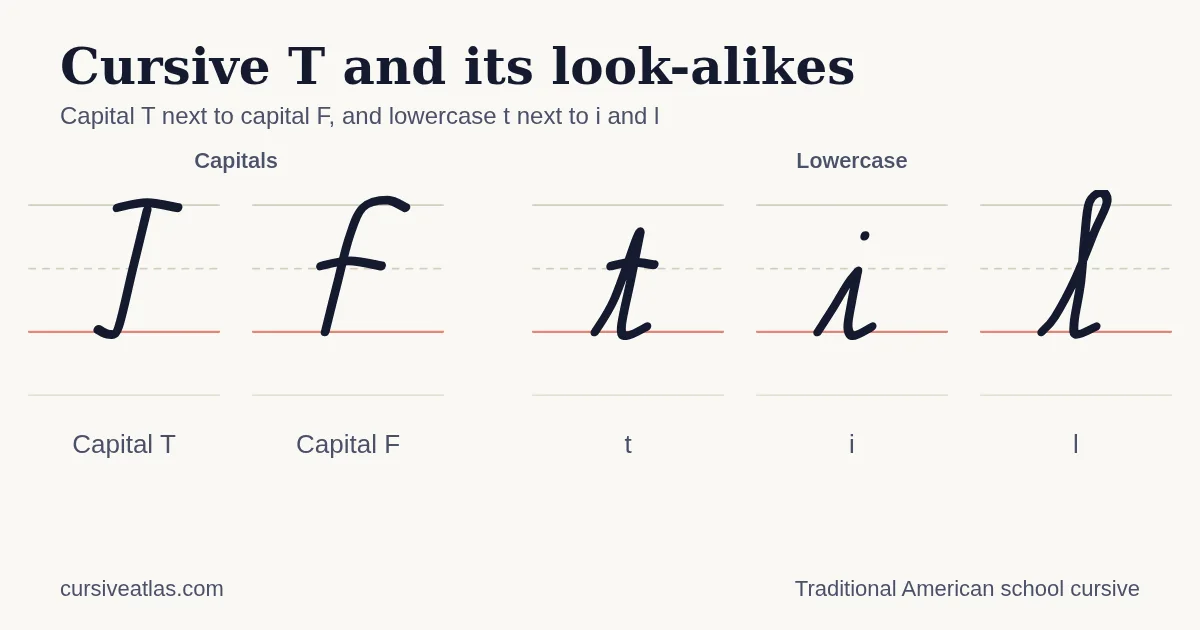
Lowercase t, l and i all rise from the baseline, so most mix-ups come down to height. The picture puts them side by side: the i is the shortest, the t reaches about two-thirds of the way up, and the l goes all the way to the top line with a loop.
- t and l. If your t reaches the top line it will be read as an l. Stop the t early and cross it. See cursive l for the full-height loop.
- t and i. A t that is cut too short, with a small crossbar, looks like a dotted i. The t should be clearly taller than the i beside it. Cursive i stays at the midline.
- Capital T and capital F. The T carries its bar on the top line and curls the stem to the left at the bottom. The F opens with a swooping curve and has its bar at the midline. The capital F in cursive is worth writing next to it.
- Capital T and lowercase t. The capital is not just a taller lowercase: it is a stem that curls left at the foot, with a bar added by lifting the pen, whereas the lowercase is a single upstroke that you cross later.
Try a short test: write "til" three times at normal speed. If the t, i and l blur into each other, make the height difference larger.
Fixing a cursive T that does not look right
A stem that is too tall and a low crossbar are the obvious faults. These are the quieter ones.
| What you see | Likely cause | What to try |
|---|---|---|
| The crossbar runs into the next letter in "th" or "tt" | The bar is longer than the letter is wide. | Keep the bar about as long as the t is wide, plus a little. For "tt", one bar can cross both stems. |
| The crossbar slopes downward | The wrist drops at the end of the stroke. | Draw the bar left to right with a slight upward angle, in a quick flick. |
| The t has a big hook at the bottom | The turn into the join is too wide. | Make the base curve tight and low, so the exit stroke sits on the baseline. |
| My capital T leans away from the rest of the word | The stem is straight while the rest of the writing is slanted. | Tilt the stem to the common slant and then add the bar across the top line. |
| The word "little" reads as "litlle" | The two t's and the l are the same height. | Cross each t at about two-thirds height and let the l loop higher. |
Where cursive T appears: thank you, days of the week and signatures
After e, t is the most common letter in English text, so a t that is quick to write pays off in everything you do by hand. It starts words you are likely to write on cards, such as thank you, and it appears in faith and happy birthday. Two days of the week, Tuesday and Thursday, start with a capital T, and many names do too, from Tom to Teresa.
The crossbar is a small habit with a big effect on speed. Cross all the t's at the end of a word in one motion, together with the dots on any i and j in the same word. The common cursive mistakes guide has a drill for this.
If you have a capital T in your signature, try it in the cursive signature generator and compare the simple version with the looped version. The worksheet generator will make a tracing sheet of any word that contains t.
Cursive T questions
When do I cross the t in cursive?
After you finish the whole word, in the same pass as the dots on i and j. This keeps the pen moving and the letters connected.
How do you write T in cursive?
Lowercase t: swing up about two-thirds of the way to the top line, come straight back down, flick out, and cross it after the word. Capital T: a stem that curls left at the bottom, then a crossbar along the top line.
Is there a printable cursive T worksheet?
Yes. The cursive T worksheet (PDF) has capital T, lowercase t, joins and words to trace. For a sheet with your own words, use the worksheet generator.
How do you write a capital T in cursive?
Draw a stem down from near the top line, curl left at the bottom, then lift the pen and add a crossbar along the top line. See all the uppercase cursive letters.
How do you write a lowercase t in cursive?
Swing up about two-thirds of the way to the top line, come straight back down, flick out and cross the t after the word. See all the lowercase cursive letters.
Should the crossbar of a cursive t touch the top of the stem?
No. Cross the t near the top of the stem, not at the very top and not in the middle, so the letter stays clearly different from l.
Why does my cursive t look like an l?
Because the stem is too tall or the crossbar is missing. The lowercase t should stop about two-thirds of the way up and be crossed; the l goes to the top line and ends in a loop.
Is a capital T in cursive like a capital F?
They are related but not the same. The T has its bar on the top line and curls to the left at the bottom of the stem. The F has its bar at the midline and no curl. Writing them side by side makes the difference obvious.
Free printable worksheet: cursive T
One page with capital T, lowercase t, joins and words to trace, plus blank lines for your own writing. Print it on US Letter or A4.
More practice: the full alphabet practice sheets, or all cursive worksheets.