Cursive alphabet · Letter V
V in Cursive: How to Write Capital V & Lowercase v
Last updated October 29, 2026
Cursive v is a down-and-up stroke that connects across the top. It looks like a printed v with a rounded bottom and a small flick at the end.
Cursive V at a glance
Capital V
Lowercase v
Numbered dots mark where each stroke begins. The red line is the baseline; the dashed line is the midline. Style: traditional American school cursive, simplified to a single line.
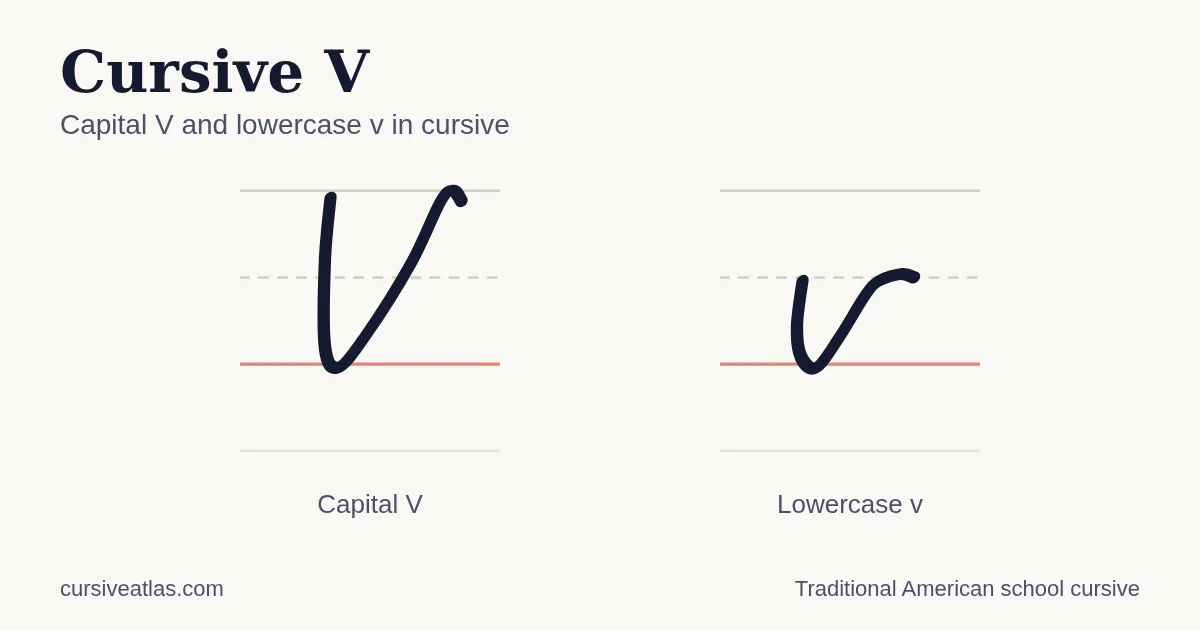
Capital V in cursive: step by step
- 1Start near the top line and curve down to the baseline.
- 2Round the bottom and swing up to the top line.
- 3Finish with a small curl at the top. Lift before the next letter.
Lowercase v in cursive: step by step
- 1Start at the midline and curve down to the baseline.
- 2Round the bottom and swing up to the midline.
- 3Flick to the right in a short horizontal stroke at the midline.
Capital V vs lowercase v in cursive
Both forms are the same rounded valley. Capital V reaches the top line and ends with a curl and a pen lift; lowercase v ends with a flat stroke at the midline that joins the next letter.
Practice both forms on the same line: write the capital, then a row of lowercase letters, then a word that starts with V. The uppercase cursive letters and lowercase cursive letters pages show every letter of each set side by side.
Capital V in cursive: where you will use it
Capital V begins names such as Victor, Venice and Violet. It is one rounded valley from the top line that ends in a small curl, and the next letter starts fresh.
Every capital is shown side by side in the uppercase cursive alphabet, and the printable cursive chart puts V next to v on one page.
Trace cursive V on screen
Use a finger, stylus or mouse. Start at the numbered dot, follow the dotted guide, then press Check to see how much of the guide you covered.
Capital V
Trace over the dotted guide with your finger, mouse or stylus.
Lowercase v
Trace over the dotted guide with your finger, mouse or stylus.
How cursive v joins other letters
The v exits at the midline, so it joins smoothly to letters that start high: a, c, o and e. The stroke is a flat horizontal.
va
ve
vi
vo
ov
Trace the join: va
Trace over the dotted guide with your finger, mouse or stylus.
Common letter pairs with cursive v
These pairs appear in everyday English. Practice each one as a unit, because a join is a movement that you repeat rather than a gap you leave between letters.
- ve: The v exits across the midline into the loop of the e. This is the most common v join. See cursive E.
- va: The high exit runs into the oval of the a. Close the oval before you continue. See cursive A.
- vi: The exit leads into the point of the i. Keep the exit flat. See cursive I.
- ov: The o exits across the midline and runs straight into the first stroke of the v. See cursive O.
Practice words with v
Capitalized names are written the way they would be on a card or label; lowercase words show how the letters link in a line.
Victor
Venice
Violet
voice
seven
river
love
Want a word of your own? The worksheet generator makes a practice sheet for any name.
Common mistakes with cursive v
A sharp bottom
Round the bottom of the v. A sharp point breaks the flow of the stroke and looks like a print v.
Joining from the baseline
Like o and r, the v joins at the midline. Taking the exit from the bottom pulls the next letter out of line.
Cursive v vs u: Cursive v and u start the same way. The u rounds back up and retraces down to the baseline, while the v flicks out sideways at the midline. See cursive U →
How to practice cursive V and v
- Write a line of lowercase v and round the bottom of every valley.
- Practice 've', 'va' and 'ov', then the words 'voice', 'seven' and 'love'.
- Write capital V in names and compare it with the lowercase v.
Print the cursive V worksheet for guided lines, or type your own words into the worksheet generator. For the next step, work through the full cursive alphabet.
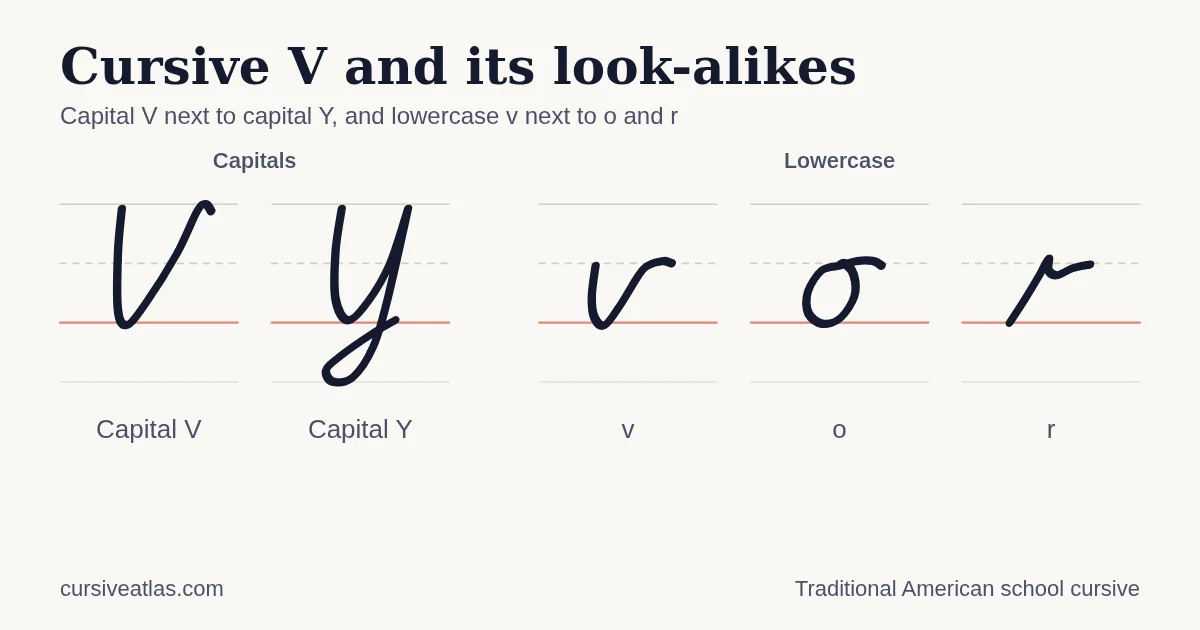
Cursive V next to Y, o and r
The lowercase v is one rounded valley that exits high. It looks like very little, which is why it gets confused with the letters around it, and the exit is what to check.
- Lowercase v and u. The u has a retraced stem and exits at the baseline; the v has no stem and exits at the midline with a flick. See cursive u.
- Lowercase v and o. The o and the v both leave at the midline, so they share the same high join. The o is a closed oval, the v an open valley. A v whose top gets closed up reads as an o.
- Lowercase v and r. The r is an upstroke with a shoulder, the v has a valley before the flick. If the valley is shallow the v reads as an r. See cursive r.
- Capital V and capital Y. Both begin near the top line and curve down. The V rounds the bottom, swings up to the top line and finishes with a curl; the Y goes up the right side and then drops below the baseline in a loop. See capital Y.
A v that is too wide and shallow loses its point, and a v that is too narrow turns into a sharp check mark, so aim for a valley about as wide as an o.
Fixing a cursive v that does not look right
The depth of the valley and the height of the exit decide most issues. Here are the faults that show up in words.
| What you see | Likely cause | What to try |
|---|---|---|
| The v looks like a u | The exit dropped to the baseline. | Flick up and to the right at the midline. The v never returns to the baseline. |
| The v looks like an r | The valley is too shallow. | Go down to the baseline, round the bottom and come up; the valley should touch the baseline. |
| "ve" in "love" has a gap | The flick of the v is too short to reach the e. | Let the flick travel on to the start of the e, which begins at the midline too. |
| The v in "Ava" is too tall | The valley starts above the midline. | Start the v at the midline, level with the top of the a before it. |
| My capital V has no curl | It was drawn as a print V. | Round the bottom, swing up to the top line and add the small curl at the end. |
Where cursive v shows up: love, Ava and forever
Capital V starts names such as Victoria, Violet and Vincent. The lowercase v is easiest to see in love, forever, Ava and Olivia. In "love" the o and the v both end at the midline, so the join "ov" is a short horizontal stroke, and the "ve" join into the e that follows is another.
The v has an exit unlike the one on most small letters. The a in "Ava" ends at the baseline, climbs into the v from there, and the v leaves at the midline. That makes "av" a rising join, from the baseline up to the midline, and "va" a level one, because the v leaves where the a starts.
The cursive o and cursive w pages show the other two letters that exit high. The lowercase cursive alphabet groups them together. The worksheet generator will make a sheet of v words like "very", "never" and "give".
Cursive V questions
How do you write V in cursive?
Lowercase v: start at the midline, curve down to the baseline, round the bottom, swing up to the midline and flick right. Capital V: curve down from the top line, round the bottom, swing up to the top line and finish with a small curl.
Does cursive v join at the top or the bottom?
At the top. The v ends with a flat horizontal stroke at the midline, like o, b and w, so the next letter starts from there.
Is there a printable cursive V worksheet?
Yes. The cursive V worksheet (PDF) has capital V, lowercase v, joins and words to trace. For a sheet with your own words, use the worksheet generator.
How do you write a capital V in cursive?
Curve down from the top line, round the bottom, swing up to the top line and finish with a small curl. See all the uppercase cursive letters.
How do you write a lowercase v in cursive?
Start at the midline, curve down to the baseline, round the bottom, swing up to the midline and flick to the right. See all the lowercase cursive letters.
Does a cursive v join at the top or the bottom?
At the top. The v ends at the midline with a flat stroke, so the next letter starts from there rather than from the baseline.
Is the cursive v pointed or rounded?
Rounded at the bottom, as taught here, with a flick at the top to the right. A sharp point at the bottom tends to break the join, so round the valley and keep it about as wide as an o.
How do I write "ov" in cursive?
Close the o at the top and leave straight into the start of the v, which also begins at the midline. The pen travels across the top in a short, level join, as in "love" and "over".
Free printable worksheet: cursive V
One page with capital V, lowercase v, joins and words to trace, plus blank lines for your own writing. Print it on US Letter or A4.
More practice: the full alphabet practice sheets, or all cursive worksheets.