Cursive alphabet · Letter I
I in Cursive: How to Write Capital I & Lowercase i
Last updated October 29, 2026
Cursive i is the simplest letter to write and the easiest to get wrong. It is one upstroke and one downstroke, with a dot added only after you finish the word.
Cursive I at a glance
Capital I
Lowercase i
Numbered dots mark where each stroke begins. The red line is the baseline; the dashed line is the midline. Style: traditional American school cursive, simplified to a single line.
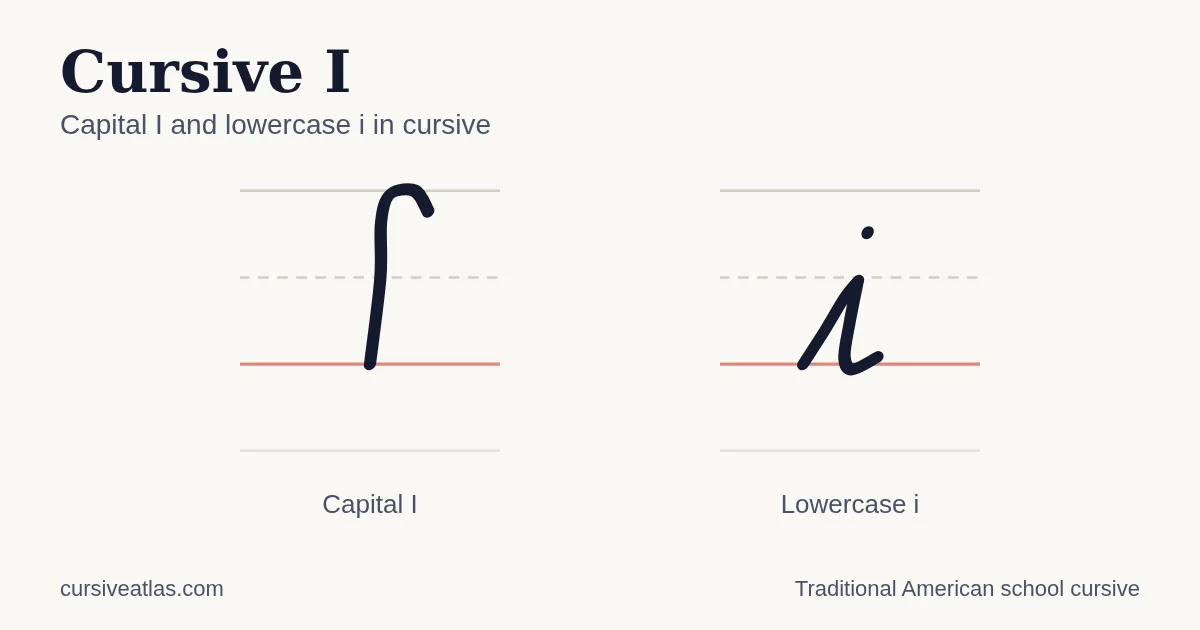
Capital I in cursive: step by step
- 1Start near the top line at the right and curl left into a small hook.
- 2Draw the stem straight down to the baseline.
- 3Lift your pen. Capital I is not usually connected to the next letter.
Lowercase i in cursive: step by step
- 1Start on the baseline and swing up to the midline in a slanted line.
- 2Come straight back down to the baseline.
- 3Sweep up into a small exit stroke.
- 4Finish the word, then go back and add the dot above the i.
Capital I vs lowercase i in cursive
Capital I reaches the top line and starts with a curl; it is not dotted and usually stands alone. Lowercase i is a short pointed stroke that stays at the midline and gets its dot at the end of the word.
Practice both forms on the same line: write the capital, then a row of lowercase letters, then a word that starts with I. The uppercase cursive letters and lowercase cursive letters pages show every letter of each set side by side.
Capital I in cursive: where you will use it
Capital I begins names such as Isabella, Ivy and Italy and is also the word 'I'. It reaches the top line with a small curl, and it has no dot.
Every capital is shown side by side in the uppercase cursive alphabet, and the printable cursive chart puts I next to i on one page.
Trace cursive I on screen
Use a finger, stylus or mouse. Start at the numbered dot, follow the dotted guide, then press Check to see how much of the guide you covered.
Capital I
Trace over the dotted guide with your finger, mouse or stylus.
Lowercase i
Trace over the dotted guide with your finger, mouse or stylus.
How cursive i joins other letters
The i has the same exit stroke as a and e, so it joins to nearly everything. Keep its height at the midline, not above it.
in
it
is
id
ni
Trace the join: in
Trace over the dotted guide with your finger, mouse or stylus.
Common letter pairs with cursive i
These pairs appear in everyday English. Practice each one as a unit, because a join is a movement that you repeat rather than a gap you leave between letters.
- in: A very common pair. The i exits at the baseline and runs up into the n, so keep the i at the midline height. See cursive N.
- it: The exit lifts into the stem of the t. Dot the i and cross the t after the word. See cursive T.
- is: The exit rises into the point of the s. Keep both letters small and even. See cursive S.
- ti: The t ends with a flick that leads into the point of the i; the crossbar and the dot are both added at the end. See cursive T.
Practice words with i
Capitalized names are written the way they would be on a card or label; lowercase words show how the letters link in a line.
Isabella
Ivy
Italy
time
island
pencil
lilies
Want a word of your own? The worksheet generator makes a practice sheet for any name.
Common mistakes with cursive i
Dotting too early
Dotting the i as you go breaks your rhythm and makes words look jumpy. Finish the word and then add all the dots and crosses.
A rounded top
The top of the i is a point, not an arch. A rounded top makes it look like a small u or an n.
Cursive i vs e: A lowercase i and e start identically. The i comes straight down; the e loops back to the left before it curves down. See cursive E →
How to practice cursive I and i
- Write a row of lowercase i and keep every one at the same height, with a pointed top.
- Practice 'in', 'it' and 'is', then the words 'time', 'island' and 'pencil', adding all the dots at the end of each word.
- Write capital I in 'Isabella' and 'Ivy' and compare it with the lowercase i.
Print the cursive I worksheet for guided lines, or type your own words into the worksheet generator. For the next step, work through the full cursive alphabet.
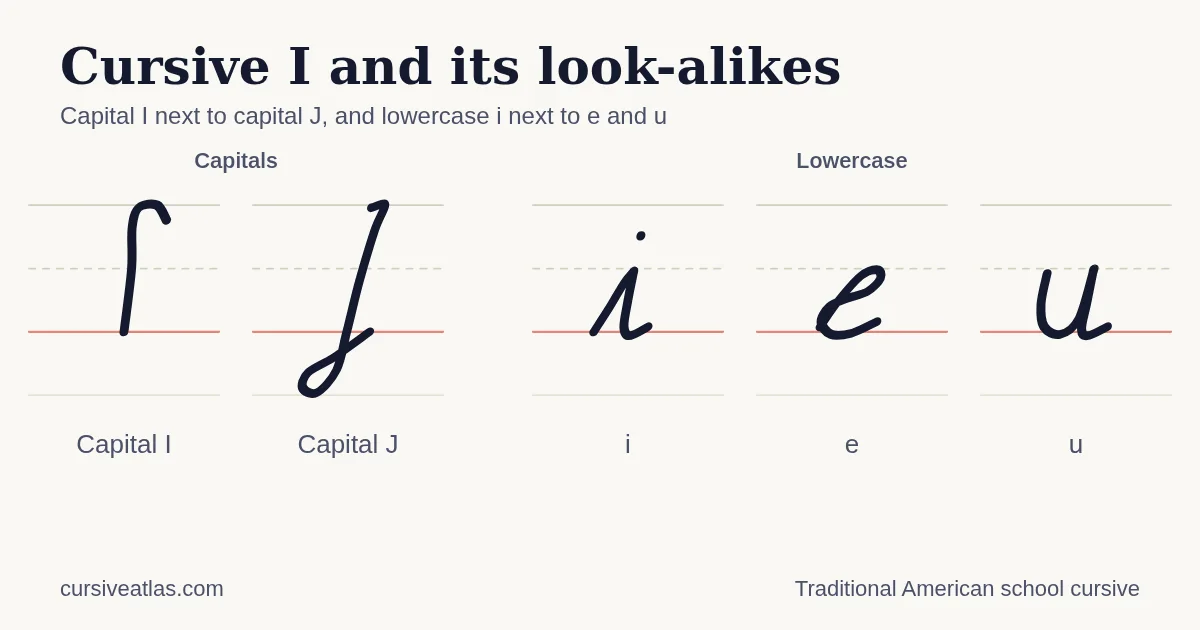
Cursive I next to J, e and u
Capital I and capital J are close relatives, and so are the lowercase i, e and u. The picture lines each group up so you can see where the shapes split.
- Capital I and capital J. They begin the same way. The I ends on the baseline; the J continues below it into a loop. The two letters really were the same letter once: English texts used I and J interchangeably well into the 1600s, which is why their handwritten forms still share a hook. See cursive capital J for the version with a tail.
- Lowercase i and e. Both start from the baseline with an upstroke. The e then loops at the midline; the i comes straight down to a point. The e needs a visible opening in its loop, and the i needs a point.
- Lowercase i and u. The u has two upstrokes joined by a cup. The i has one, so an i that picks up a second stroke becomes a u. Compare cursive e and cursive u.
- Capital I and the pronoun. When you write the word "I" by itself, it is the same capital I with no dot. There is nothing to add after it.
Writing the group "i e u" as one row, with the dots left until the end of the line, makes any rounded tops very easy to spot.
Fixing a cursive I that does not look right
The dot timing and the rounded top are covered above. These are the other things that make an i or I hard to read.
| What you see | Likely cause | What to try |
|---|---|---|
| "Minimum" is a row of identical strokes | The i, m, n and u all have the same height and rhythm. | Give the i a pointed top and the m and n rounded arches; the contrast is what makes the word readable. |
| My capital I looks like a lowercase l | The top hook is missing or too small to see. | Start with a small curl at the top line, then take the stem down. Without the curl, the capital is an l. |
| The dot lands on the next letter | Dotting at the end of the word with the dot too far right. | Place the dot directly above the stem, even if the neighbouring letter is crowded. |
| The i leans back | The pen is lifted too early at the baseline. | Finish the stroke on the baseline with a small flick toward the next letter, keeping the slant of the stem. |
| A capital I at the start of a word does not join | Trying to connect the I to the next letter. | It is acceptable to lift the pen after a capital I. Start the next letter fresh, just above the baseline. |
Where cursive I appears: the word "I", names and everyday words
Capital I is the one capital letter that is also a whole word, so it is probably the cursive capital you will write most often in letters and journals. It also starts names such as Isabella, Ivy and Ian.
Lowercase i appears in nearly every line of writing, and a few of the sample words on this site are a good test of it: faith, family and beautiful. Each has an i beside a letter that is easy to confuse with it.
The dot is the last thing you add to a word. If you want to see how capitals and lowercase letters fit together on a page, the cursive chart shows both forms on writing lines, and the cursive capital letters page explains where capitals belong.
Cursive I questions
When do I dot the i in cursive?
After you finish the whole word. Lifting your pen mid-word breaks the connection between letters, so the dots and crosses are added at the end.
Is capital I in cursive the same as capital J?
No, but they are close. Capital I stops on the baseline, while capital J drops below it into a loop.
How do you write I in cursive?
Lowercase i: swing up from the baseline to the midline in a slanted line, come straight back down and flick out, then dot it after the word. Capital I: curl left near the top line into a small hook and draw the stem down to the baseline.
Is there a printable cursive I worksheet?
Yes. The cursive I worksheet (PDF) has capital I, lowercase i, joins and words to trace. For a sheet with your own words, use the worksheet generator.
How do you write a capital I in cursive?
Curl left near the top line into a small hook, then draw the stem straight down to the baseline. There is no dot on a capital I. See all the uppercase cursive letters.
How do you write a lowercase i in cursive?
Swing up from the baseline to the midline in a slanted line, come straight back down and flick out. Add the dot after you finish the word. See all the lowercase cursive letters.
Why does my cursive i look like an e or a u?
The top of the i should be a point, not a rounded arch or a loop. Keep the height at the midline, add the dot at the end, and the three letters stay distinct.
Does a capital I in cursive get a dot?
No. A capital I never takes a dot. Only the lowercase i and j do. If you add a dot to the capital I, it is easy to read as a lowercase i.
How is the pronoun "I" written in cursive?
It is the capital I on its own: a small curl at the top, a stem down to the baseline, and nothing added afterwards. Leave a normal word space before and after it.
Free printable worksheet: cursive I
One page with capital I, lowercase i, joins and words to trace, plus blank lines for your own writing. Print it on US Letter or A4.
More practice: the full alphabet practice sheets, or all cursive worksheets.