Cursive alphabet · Letter E
E in Cursive: How to Write Capital E & Lowercase e
Last updated October 29, 2026
Cursive e is a small loop on the midline, and it is the most common letter in English, so it is worth getting smooth early. Capital E is built from two stacked curves.
Cursive E at a glance
Capital E
Lowercase e
Numbered dots mark where each stroke begins. The red line is the baseline; the dashed line is the midline. Style: traditional American school cursive, simplified to a single line.
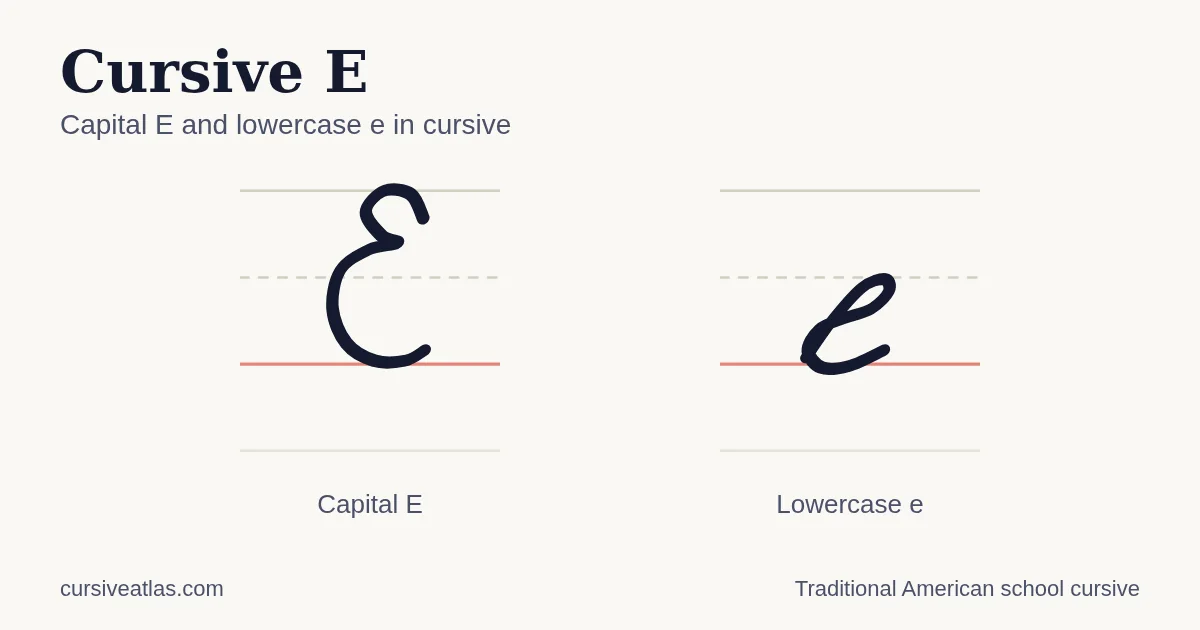
Capital E in cursive: step by step
- 1Start near the top line at the right and curve left to draw a small upper bowl.
- 2Make a small loop at the midline, then sweep out to the left.
- 3Draw a larger lower curve around to the baseline and finish with a short exit stroke.
Lowercase e in cursive: step by step
- 1Start on the baseline and swing up to the midline.
- 2Make a small loop: round the top and come back to the left.
- 3Curve down and around the bottom to the baseline.
- 4Flick up into an exit stroke to join the next letter.
Capital E vs lowercase e in cursive
Capital E is two stacked curves, like a backward 3, with a small loop where they meet. Lowercase e is a single small loop that stays below the midline. Both begin on the right side of the shape and curve left.
Practice both forms on the same line: write the capital, then a row of lowercase letters, then a word that starts with E. The uppercase cursive letters and lowercase cursive letters pages show every letter of each set side by side.
Capital E in cursive: where you will use it
Capital E begins names such as Emma, Eli and Easter. It is two stacked curves with a small loop where they meet, so keep the lower curve a little larger than the upper one.
Every capital is shown side by side in the uppercase cursive alphabet, and the printable cursive chart puts E next to e on one page.
Trace cursive E on screen
Use a finger, stylus or mouse. Start at the numbered dot, follow the dotted guide, then press Check to see how much of the guide you covered.
Capital E
Trace over the dotted guide with your finger, mouse or stylus.
Lowercase e
Trace over the dotted guide with your finger, mouse or stylus.
How cursive e joins other letters
The e exits at the baseline, so it connects to most letters, but it joins best when the next letter starts with an upstroke, like n, r and l.
ea
el
en
er
me
Trace the join: ea
Trace over the dotted guide with your finger, mouse or stylus.
Common letter pairs with cursive e
These pairs appear in everyday English. Practice each one as a unit, because a join is a movement that you repeat rather than a gap you leave between letters.
- er: Very common at the end of words. The e exits at the baseline and the r starts with an upstroke, so the join is short. See cursive R.
- en: The exit leads straight into the first upstroke of n. Keep the loop of the e open so the join stays clean. See cursive N.
- es: The exit of the e rises into the point of the s. Keep the s small. See cursive S.
- el: The exit leads into the tall loop of the l. Keep the loop of the e open and make the l reach the top line. See cursive L.
Practice words with e
Capitalized names are written the way they would be on a card or label; lowercase words show how the letters link in a line.
Emma
Eli
Easter
eagle
green
letter
yesterday
Want a word of your own? The worksheet generator makes a practice sheet for any name.
Common mistakes with cursive e
A loop that fills in
Make the loop open enough that you can see white inside. A closed, ink-filled loop turns e into a blob.
A flat top
The e should have a gentle peak at the midline. A flat top makes it look like an i without its dot.
Cursive e vs l: Cursive e and l both start with an upstroke. The e stops at the midline and loops, while l continues all the way to the top line. See cursive L →
How to practice cursive E and e
- Write a row of small open loops, making sure you can see white inside each one.
- Practice 'er', 'en' and 'es', then the words 'green', 'letter' and 'yesterday'.
- Write capital E in names and compare it with the lowercase e: the capital has two curves, the lowercase has one small loop.
Print the cursive E worksheet for guided lines, or type your own words into the worksheet generator. For the next step, work through the full cursive alphabet.
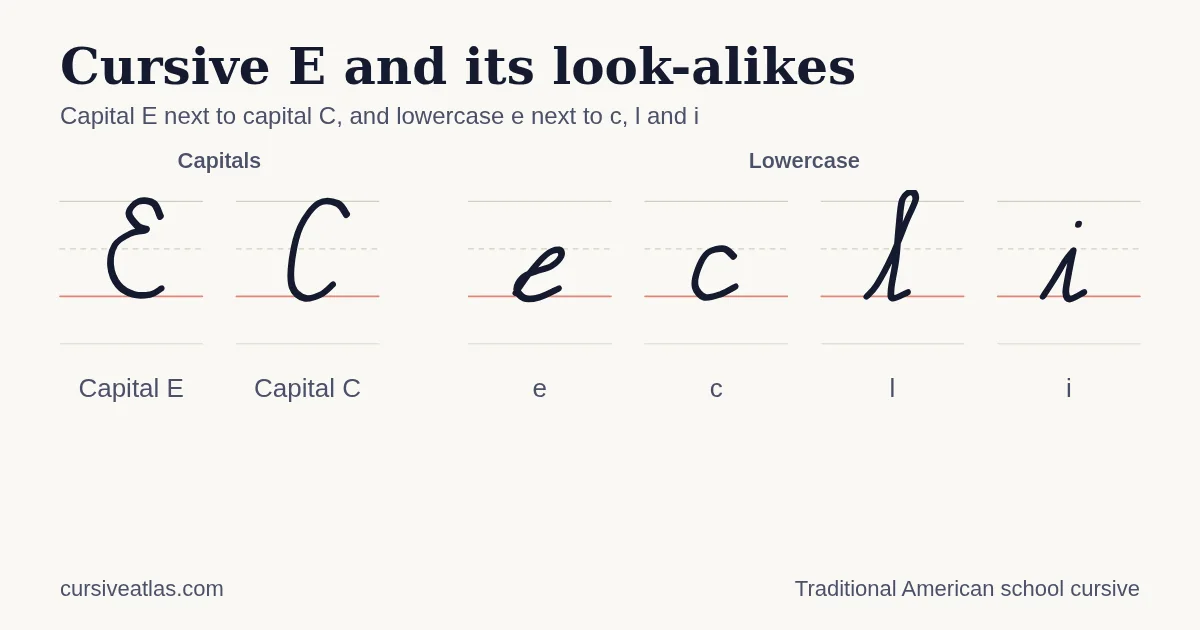
Cursive E next to C, l and i
The letter e is the most frequent letter in written English, so one slightly wrong e shows up many times on every page. In cursive it is built around a loop, and every look-alike is what happens when the loop grows, shrinks or disappears.
- Lowercase e and l. Both are loops. The l loop is tall and reaches the top line; the e loop is small and stays at the midline. If the loop of an e grows, the word "heel" starts to read "hell". See cursive l.
- Lowercase e and i. The i has no loop, only a point. A closed e is an i without its dot, and a very open i looks like an e. Keep a pocket of white space in every e. See cursive i.
- Lowercase e and c. The c is a single open curve; the e adds a loop at the midline. Keep both shapes distinct in "ec" and "ce".
- Capital E and capital C. The E is a small upper curve, a little loop at the midline and a larger lower curve, like a backward 3 with a loop. The C is one curve. The loop in the middle is what makes it an E.
Write a row of e, l, i, e, l, i. The e should be clearly smaller than the l and clearly rounder than the i.
Fixing a cursive e that does not look right
The loop is the whole letter, so most problems are about its size. These are the symptoms to watch for when you write words.
| What you see | Likely cause | What to try |
|---|---|---|
| Every e looks like an i | The loop closes before it forms, so there is no pocket inside it. | Let the upstroke curve over at the midline and come back to the left, leaving visible white space inside the loop. |
| The e is too big and sticks out above the line | The upstroke goes past the midline. | Stop the upstroke at the midline. The e belongs to the small letters, the same height as a or o. |
| In "ee" the two letters run together | The exit stroke of the first e is too long. | Keep the exit short and level so the second e starts from the same place as the first. |
| My e leans more than the letters around it | The loop is drawn against the slant. | Match the slant of the other letters; the loop opens down and to the left. |
| The capital E looks like a 3 | The small loop at the midline is missing. | Draw the upper curve, make the small loop at the midline, then sweep the larger curve round to the baseline. |
Where cursive e shows up: Emma, dream and forever
Capital E begins names such as Emma, Ethan and Eleanor, and Emma is a good test because its capital is followed by a double m. The lowercase e appears in nearly every word: dream, hello, blessed and forever each have at least one.
Because it is so common, the e is where handwriting drifts. A flat e makes a line look dull, and an e that is too big breaks the rhythm of the line. Compare the two e's in "forever"; they should look identical. In "blessed" the first e follows the l and the second sits between an s and the d, which exercises the exit strokes more than most letter pairs.
The cursive c page shows the open curve at the root of the e, and the common cursive mistakes guide explains the closed-loop problem for e and a. A word list with plenty of e's is easy to build in the worksheet generator.
Cursive E questions
How do you write E in cursive?
Lowercase e: swing up from the baseline to the midline, make a small open loop, curve down around the bottom and flick out. Capital E: a small upper curve, a little loop at the midline, then a larger lower curve to the baseline.
Why does my cursive e look like an i?
The loop is closing before it forms. Let the upstroke round over at the midline and come back to the left so there is visible white space inside the loop.
Is there a printable cursive E worksheet?
Yes. The cursive E worksheet (PDF) has capital E, lowercase e, joins and words to trace. For a sheet with your own words, use the worksheet generator.
How do you write a capital E in cursive?
Draw a small upper curve, add a little loop at the midline, then sweep a larger lower curve around to the baseline. It looks a little like a backward 3 with a loop. See all the uppercase cursive letters.
How do you write a lowercase e in cursive?
Swing up from the baseline to the midline, make a small open loop, curve down around the bottom and flick out. It stays below the midline. See all the lowercase cursive letters.
Why is the cursive e the first letter to polish?
The e is the most common letter in English, so it appears in almost every word you write. A clean, open loop makes every line look neater.
Why is the loop in a cursive e so small?
The e is a small letter, so its loop stays at the midline. It is small by design and a full tall loop would make it an l. Keep it about the same size as the loop inside a lowercase a.
How do I write "ee" in cursive?
Finish the first e with its small exit flick, then start the second loop from the end of that flick. Both loops should be the same size and both should keep a pocket of white space inside, as in "keep" and "sweet".
Free printable worksheet: cursive E
One page with capital E, lowercase e, joins and words to trace, plus blank lines for your own writing. Print it on US Letter or A4.
More practice: the full alphabet practice sheets, or all cursive worksheets.