Cursive alphabet · Letter W
W in Cursive: How to Write Capital W & Lowercase w
Last updated October 29, 2026
Cursive w is two v's side by side, ending in the same flat join at the midline. If you can write v, w is the same stroke repeated.
Cursive W at a glance
Capital W
Lowercase w
Numbered dots mark where each stroke begins. The red line is the baseline; the dashed line is the midline. Style: traditional American school cursive, simplified to a single line.
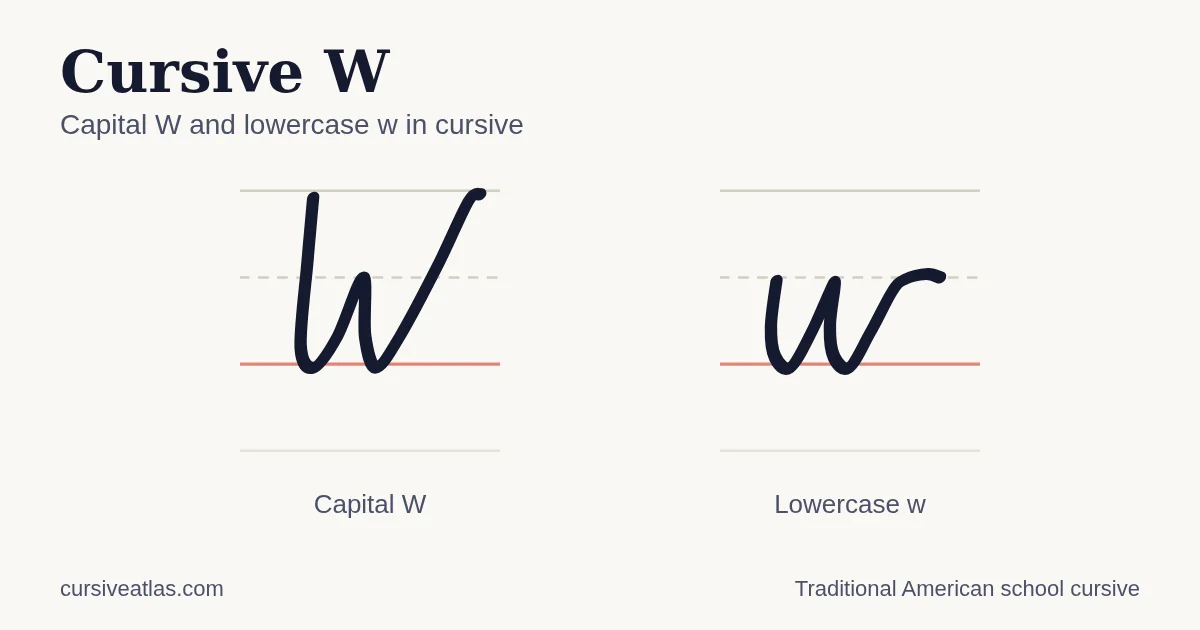
Capital W in cursive: step by step
- 1Start near the top line and curve down to the baseline.
- 2Swing up to the midline, then down to the baseline again.
- 3Swing up to the top line and finish with a small curl. Lift before the next letter.
Lowercase w in cursive: step by step
- 1Start at the midline and curve down to the baseline.
- 2Round the bottom and swing up to the midline.
- 3Repeat the down-and-up stroke a second time, one step to the right.
- 4Flick to the right in a short horizontal stroke at the midline.
Capital W vs lowercase w in cursive
Both are two valleys. In capital W the middle peak stops at the midline while the outer strokes reach the top line, and it ends with a curl and a lift; lowercase w is two equal valleys with a flat midline exit.
Practice both forms on the same line: write the capital, then a row of lowercase letters, then a word that starts with W. The uppercase cursive letters and lowercase cursive letters pages show every letter of each set side by side.
Capital W in cursive: where you will use it
Capital W begins names such as William, Wendy and Wales. It is two valleys, with the outer strokes reaching the top line and a small curl at the end.
Every capital is shown side by side in the uppercase cursive alphabet, and the printable cursive chart puts W next to w on one page.
Trace cursive W on screen
Use a finger, stylus or mouse. Start at the numbered dot, follow the dotted guide, then press Check to see how much of the guide you covered.
Capital W
Trace over the dotted guide with your finger, mouse or stylus.
Lowercase w
Trace over the dotted guide with your finger, mouse or stylus.
How cursive w joins other letters
The w exits at the midline, just like v. In 'ow' the high exit of the o runs straight into the first stroke of the w.
wa
we
wi
wo
ow
Trace the join: wa
Trace over the dotted guide with your finger, mouse or stylus.
Common letter pairs with cursive w
These pairs appear in everyday English. Practice each one as a unit, because a join is a movement that you repeat rather than a gap you leave between letters.
- we: The w exits at the midline and runs into the loop of the e. See cursive E.
- wa: The flat exit runs into the oval of the a. Close the oval before you continue. See cursive A.
- wi: The exit leads into the point of the i. Dot it after the word. See cursive I.
- ow: The o exits across the midline and runs straight into the first stroke of the w. See cursive O.
Practice words with w
Capitalized names are written the way they would be on a card or label; lowercase words show how the letters link in a line.
William
Wales
Wendy
window
water
flower
snow
Want a word of your own? The worksheet generator makes a practice sheet for any name.
Common mistakes with cursive w
Unequal valleys
Both valleys of the w should have the same width and depth. If one is narrower, the letter looks like a v with an extra stroke.
Joining low
Join across the top, like v, o and r. A low join pulls the next letter out of line.
Cursive w vs v: Cursive w is two v's. If your w keeps looking like a v with a bump, make the second valley as deep as the first. See cursive V →
How to practice cursive W and w
- Write a line of lowercase w and make both valleys equal in width and depth.
- Practice 'we', 'wa' and 'ow', then the words 'window', 'water' and 'snow'.
- Write capital W in names and compare it with the lowercase w.
Print the cursive W worksheet for guided lines, or type your own words into the worksheet generator. For the next step, work through the full cursive alphabet.
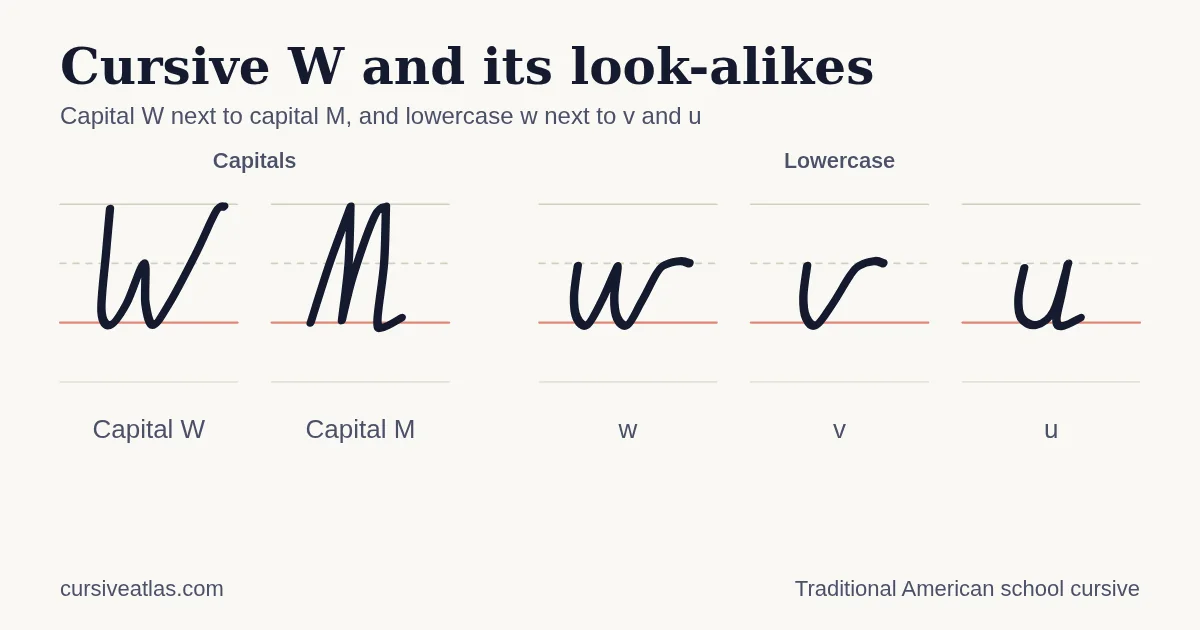
Cursive W next to M, v and u
The lowercase w is two v shapes side by side, with a flick on the right. Its look-alikes are either a single valley or the same shape turned over, so counting valleys settles it.
- Lowercase w and v. The v has one valley and the w has two. A w whose second valley is shallow turns into a v with a tail. See cursive v.
- Lowercase w and m. The m has two humps and the w two valleys, so one is the other turned over. The w begins at the midline and ends with a flick at the midline, the m begins with an upstroke from the baseline and ends at the baseline. See cursive m.
- Lowercase w and u. The u is one cup with a retraced stem. Two u's in a row look like a w, until you see the baseline exits between them.
- Capital W and capital M. The W goes down from the top line, up to the midline, down again and up to the top line, finishing with a curl. The middle peak stops at the midline, which is the opposite of the M, whose peaks all reach the top line.
If you are unsure of a w in your own writing, count the valleys and then check that both reach the baseline.
Fixing a cursive w that does not look right
The two valleys must be equal, and the final flick should stay at the midline. Here are the common faults.
| What you see | Likely cause | What to try |
|---|---|---|
| The w looks like "uv" or "vv" | The two valleys are separated by a gap. | Draw the two valleys in one movement with a shared middle stroke, not as two letters. |
| The second valley is bigger than the first | The pen speeds up and spreads. | Make the valleys the same width, about the width of an o each. |
| The w looks like a v with a hook | The first valley is too shallow. | Go down to the baseline in both valleys. |
| The flick at the end of the w drops to the baseline | The exit was drawn like a u. | The w leaves at the midline, just like o, v and b. Flick across the top to the next letter. |
| My capital W looks like two Vs | The middle peak reaches the top line. | Stop the middle peak at the midline, and keep the two outer strokes tall. |
Where cursive w shows up: words, names and signatures
The w is one of the less common letters in the words that people practise first, so it is easy to put off. It is in "when", "was", "with", "write", "now" and "wonderful", and capital W begins names such as William, Wyatt and Willow and weekdays like Wednesday. Because the letter is wide, it takes up space in a signature, which makes it worth practising once.
The w also ends at the midline, so the join into the next letter is level. In "we", "wa" and "wi" the next letter starts at a good height. In "ow" and "aw" the w follows another letter and begins from its exit, so the first valley starts where the previous stroke ended. The cursive o page shows the o that comes before a w in "now" and "show".
The lowercase cursive alphabet groups w with v, o and b, the four letters that exit at the midline. The cursive signature page explains why wide letters like W look good in a name, and the worksheet generator will make a sheet of w words.
Cursive W questions
How do you write W in cursive?
Lowercase w: start at the midline, curve down and up twice, one step to the right, and flick right at the midline. Capital W: down from the top line, up to the midline, down again, then up to the top line with a small curl.
How do you join w to the next letter?
Like v, the w ends at the midline, so the join is a short flat stroke. Letters that start high, such as a, e and o, follow it most smoothly.
Is there a printable cursive W worksheet?
Yes. The cursive W worksheet (PDF) has capital W, lowercase w, joins and words to trace. For a sheet with your own words, use the worksheet generator.
How do you write a capital W in cursive?
Draw down from the top line, up to the midline, down again and up to the top line, finishing with a small curl. See all the uppercase cursive letters.
How do you write a lowercase w in cursive?
Start at the midline, curve down and up twice, moving one step to the right, and flick right at the midline. See all the lowercase cursive letters.
How can I keep both halves of a cursive w the same size?
Think of it as two v shapes side by side. Start the second valley exactly where the first one finishes and keep the same depth.
How many humps does a cursive w have?
None: it has two valleys. The humps belong to m. The w goes down to the baseline twice, with a middle peak at the midline, and ends with a flick at the midline.
What is the best word to practise a cursive w?
Try "wow" or "window". The first and last w are both written at the midline, and the middle letter has to join them. You see right away if the valleys differ.
Free printable worksheet: cursive W
One page with capital W, lowercase w, joins and words to trace, plus blank lines for your own writing. Print it on US Letter or A4.
More practice: the full alphabet practice sheets, or all cursive worksheets.