Cursive alphabet · Letter N
N in Cursive: How to Write Capital N & Lowercase n
Last updated October 29, 2026
Cursive n is two downstrokes joined by a hump. It is the first letter many learners write with a rhythm, and the model for m, h and r.
Cursive N at a glance
Capital N
Lowercase n
Numbered dots mark where each stroke begins. The red line is the baseline; the dashed line is the midline. Style: traditional American school cursive, simplified to a single line.
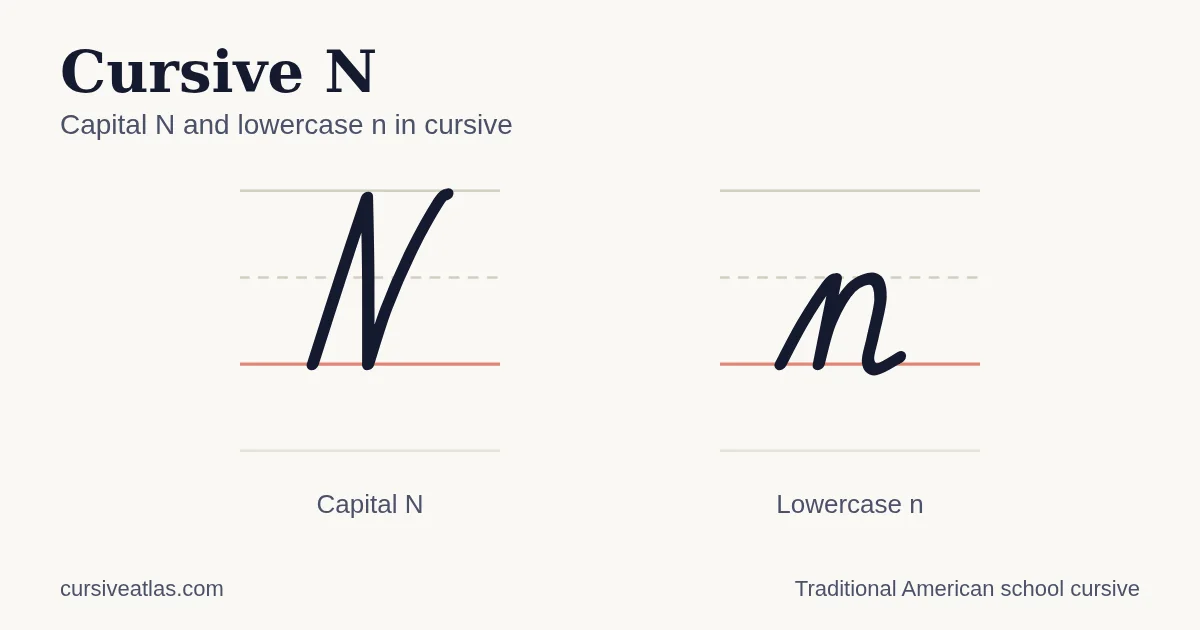
Capital N in cursive: step by step
- 1Start at the baseline and swing up to the top line.
- 2Come straight down to the baseline, leaving a narrow gap between the strokes.
- 3Swing up again to the top line and finish with a small curl.
Lowercase n in cursive: step by step
- 1Start on the baseline and swing up to the midline.
- 2Come back down to the baseline, then retrace up to the midline.
- 3Curve over to the right in a rounded hump and come down to the baseline.
- 4Sweep into a small exit stroke.
Capital N vs lowercase n in cursive
Capital N is tall and narrow and ends at the top line with a curl. Lowercase n is short, has one rounded hump and ends at the baseline with an exit stroke, so it joins on both sides.
Practice both forms on the same line: write the capital, then a row of lowercase letters, then a word that starts with N. The uppercase cursive letters and lowercase cursive letters pages show every letter of each set side by side.
Capital N in cursive: where you will use it
Capital N begins names such as Nora, Nathan and Nancy. It is tall and narrow and finishes with a small curl at the top, so keep both strokes upright.
Every capital is shown side by side in the uppercase cursive alphabet, and the printable cursive chart puts N next to n on one page.
Trace cursive N on screen
Use a finger, stylus or mouse. Start at the numbered dot, follow the dotted guide, then press Check to see how much of the guide you covered.
Capital N
Trace over the dotted guide with your finger, mouse or stylus.
Lowercase n
Trace over the dotted guide with your finger, mouse or stylus.
How cursive n joins other letters
The n ends at the baseline, so it joins like a, c and e. It is a good letter for practicing consistent spacing in a word.
na
ne
ni
no
nt
Trace the join: na
Trace over the dotted guide with your finger, mouse or stylus.
Common letter pairs with cursive n
These pairs appear in everyday English. Practice each one as a unit, because a join is a movement that you repeat rather than a gap you leave between letters.
- ne: The exit of the n starts at the baseline and runs up into the loop of the e. See cursive E.
- na: The exit leads into the oval of the a. Close the oval before pulling the stem down. See cursive A.
- ng: The n leads into the oval of the g, which then drops below the baseline. See cursive G.
- nt: The exit rises into the stem of the t. Cross the t after the word. See cursive T.
Practice words with n
Capitalized names are written the way they would be on a card or label; lowercase words show how the letters link in a line.
Nathan
Nina
Nevada
name
banana
number
sunny
Want a word of your own? The worksheet generator makes a practice sheet for any name.
Common mistakes with cursive n
A pointed hump
The hump should be round. A pointed top reads as a v, or as a u if the stroke is inverted.
A gap between the strokes
Retrace the first downstroke before you start the hump. If you leave a gap, the n looks like two separate lines.
Cursive n vs u: Cursive n and u are mirror shapes. The n has an arch on top, the u has a cup on the bottom, so check which way your curve turns. See cursive U →
How to practice cursive N and n
- Write a line of lowercase n and retrace the first downstroke so there is no gap.
- Practice 'ne', 'na' and 'ng', then the words 'noon', 'banana' and 'running'.
- Write capital N in names and compare it with the lowercase n: the capital is tall and ends at the top line.
Print the cursive N worksheet for guided lines, or type your own words into the worksheet generator. For the next step, work through the full cursive alphabet.
Cursive N next to M, m and u
The n is the shortest letter family in cursive: one arch and an exit. That simplicity makes it easy to confuse with the letters that have a similar arch.
- Lowercase n and m. The n has one hump and two downstrokes, the m has two humps and three downstrokes. See cursive m for the longer version.
- Lowercase n and u. The n is an arch that opens down, the u is a cup that opens up. A rounded n written upside down is a u, and a flat-topped n in a fast line can read the same way.
- Lowercase n and r. The r has a short upstroke and a flat shoulder; the n has a full arch and a downstroke to the baseline. A weak n that does not come down to the baseline loses its right side and looks like an r. See cursive r.
- Capital N and capital M. The N goes up to the top line, comes straight down, goes up again and finishes with a small curl. It is narrower than the M and has only one downward diagonal between two uprights.
Retracing the first downstroke is what turns an arch into an n; without it you get a spur that looks like a v.
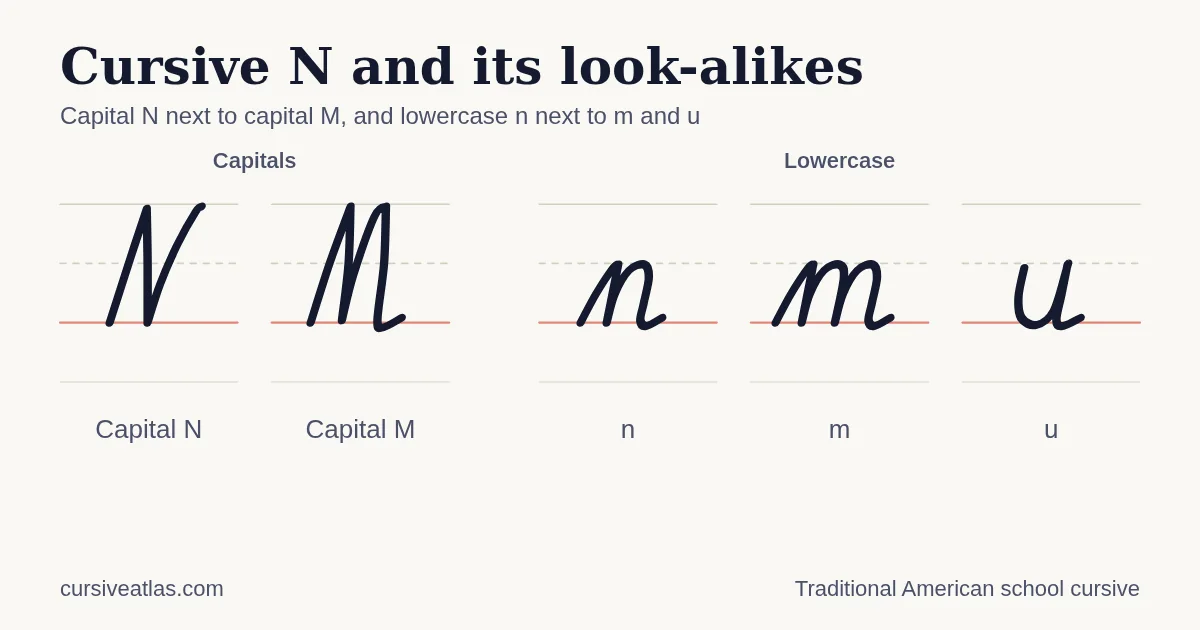
Fixing a cursive n that does not look right
The u-versus-n advice is the standard one. These are the problems that appear when the n is part of a word.
| What you see | Likely cause | What to try |
|---|---|---|
| "Noah" looks like "Uoah" | The capital N starts too low and its second stroke does not reach the top line. | Make both upstrokes reach the top line, with the diagonal between them straight. |
| My n looks like an r | The right side stops at the midline instead of coming down to the baseline. | After the hump, draw the downstroke all the way to the baseline before the exit. |
| The n is a spike with no arch | The first downstroke was not retraced. | Go down, retrace up the same line, and then curve over; the arch grows out of the retraced stroke. |
| "Thank" and "and" are crowded around the n | The exit stroke is long and flat. | Shorten the exit so the next letter starts close to the n. |
| The arch of the n is wider than the o beside it | The pen moves wide at the top. | Keep the arch about as wide as a small o. Use a lighter touch so it does not spread. |
Where cursive n shows up: Noah, thank you and and
Capital N is the first letter of Noah, Nina, Nathan and November. It is one of the capitals that begins with an upstroke, so you can start writing it from the baseline without a loop. The lowercase n is in some of the most frequent words in English, including "and", "on", "in" and "can", and inside thank you.
The n is a good diagnostic letter. In "thank" it comes right before a k, so its exit must rise to the top line. In "and" it comes between an a and a d, so its arch should be about the width of the a. In "no" the n hands over to an o, which starts high.
Because the n is half of an m, practising it first makes the cursive m easier. The lowercase cursive alphabet shows n with the other arch letters (h, m and r), and the alphabet worksheets include a page with plain n arches in a row.
Cursive N questions
How do you write N in cursive?
Lowercase n: swing up to the midline, come down, retrace up, curve over in one round hump and come down into the exit. Capital N: up to the top line, straight down, up again to the top line and finish with a small curl.
How do I keep cursive n from looking like a u?
Check which way the curve turns. The n has a rounded arch on top that opens down; the u has a cup at the bottom that opens up. Retrace the first downstroke before starting the hump.
Is there a printable cursive N worksheet?
Yes. The cursive N worksheet (PDF) has capital N, lowercase n, joins and words to trace. For a sheet with your own words, use the worksheet generator.
How do you write a capital N in cursive?
Go up to the top line, come straight down, go up again to the top line and finish with a small curl. See all the uppercase cursive letters.
How do you write a lowercase n in cursive?
Swing up to the midline, come down, retrace up, curve over in one round hump and come down into the exit. See all the lowercase cursive letters.
What is the difference between a cursive n and a cursive u?
They are mirror images built from the same two strokes. The n starts with a downstroke and has a hump on top; the u starts with a cup and finishes with a retraced stem.
Why does the capital N in cursive start at the baseline?
The capital N begins with an upstroke from the baseline to the top line, so it needs no entry loop. It then comes straight down, goes up again and finishes with a small curl.
Free printable worksheet: cursive N
One page with capital N, lowercase n, joins and words to trace, plus blank lines for your own writing. Print it on US Letter or A4.
More practice: the full alphabet practice sheets, or all cursive worksheets.