Cursive alphabet · Letter Q
Q in Cursive: How to Write Capital Q & Lowercase q
Last updated November 15, 2026
Cursive q is an a that continues below the baseline. Capital Q looks nothing like it: in most school styles it resembles a numeral 2.
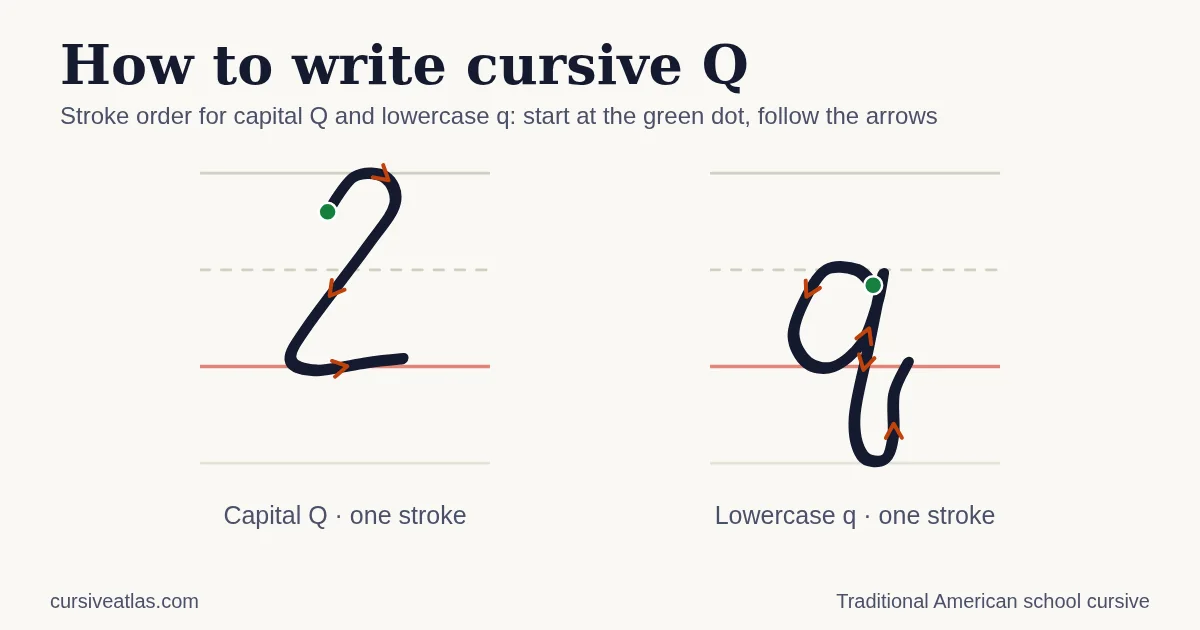
Cursive Q at a glance
Capital Q
Lowercase q
Numbered dots mark where each stroke begins. The red line is the baseline; the dashed line is the midline. Style: traditional American school cursive, simplified to a single line.

Capital Q in cursive: step by step
- 1Start near the top line on the left and curve up and over to the right, as if you were drawing the top of a 2.
- 2Sweep down and to the left in a long diagonal to the baseline.
- 3Finish with a long, low stroke out to the right.
Lowercase q in cursive: step by step
- 1Start just below the midline on the right and curve counterclockwise to draw an oval.
- 2Pull a straight line down the right side, past the baseline to the descender line.
- 3Curve right at the bottom and sweep back up.
- 4Finish with a short exit stroke at the baseline.
Capital Q vs lowercase q in cursive
The two forms look unrelated. Capital Q is drawn like a numeral 2 and stays on the baseline; lowercase q is an a-shaped oval whose stem drops below the line and hooks to the right.
Practice both forms on the same line: write the capital, then a row of lowercase letters, then a word that starts with Q. The uppercase cursive letters and lowercase cursive letters pages show every letter of each set side by side.
Capital Q in cursive: where you will use it
Capital Q begins names such as Quinn and Quebec. It is drawn like a numeral 2, so context does most of the work, and a flat tail helps it look different from a 2.
Every capital is shown side by side in the uppercase cursive alphabet, and the printable cursive chart puts Q next to q on one page.
Trace cursive Q on screen
Use a finger, stylus or mouse. Start at the numbered dot, follow the dotted guide, then press Check to see how much of the guide you covered.
Capital Q
Trace over the dotted guide with your finger, mouse or stylus.
Lowercase q
Trace over the dotted guide with your finger, mouse or stylus.
How cursive q joins other letters
In English q is almost always followed by u. Practice 'qu' as a pair: the q's hook rises into the u's first stroke.
qu
qui
que
aq
eq
Trace the join: qu
Trace over the dotted guide with your finger, mouse or stylus.
Common letter pairs with cursive q
These pairs appear in everyday English. Practice each one as a unit, because a join is a movement that you repeat rather than a gap you leave between letters.
- qu: Almost every q is followed by u. The hook of the q rises into the first stroke of the u. See cursive U.
- que: Words like queen, quiet and question. Write qu as one unit, then add the e. See cursive U.
- qui: The u leads into the point of the i. Dot it after the word. See cursive U.
- eq: Words like equal and sequence. The e leads into the oval of the q. See cursive E.
Practice words with q
Capitalized names are written the way they would be on a card or label; lowercase words show how the letters link in a line.
Quinn
Quebec
Queen
queen
quiet
square
equal
Want a word of your own? The worksheet generator makes a practice sheet for any name.
Common mistakes with cursive q
Looping left like a g
The tail of q hooks to the right. A left-hand loop makes it a g.
Mistaking Q for 2
Because capital Q is drawn like a numeral 2, readers rely on context. Keep the top curve open and finish with a longer, flatter tail than you would on a 2.
Cursive q vs g: Cursive q and g share the same oval and stem. The g loops to the left under the line; the q hooks to the right. See cursive G →
How to practice cursive Q and q
- Write a line of lowercase q, hooking the tail to the right every time.
- Practice 'qu', 'que' and 'qui', then the words 'queen', 'quiet' and 'square'.
- Write capital Q in names and compare it with a numeral 2.
Print the cursive Q worksheet for guided lines, or type your own words into the worksheet generator. For the next step, work through the full cursive alphabet.
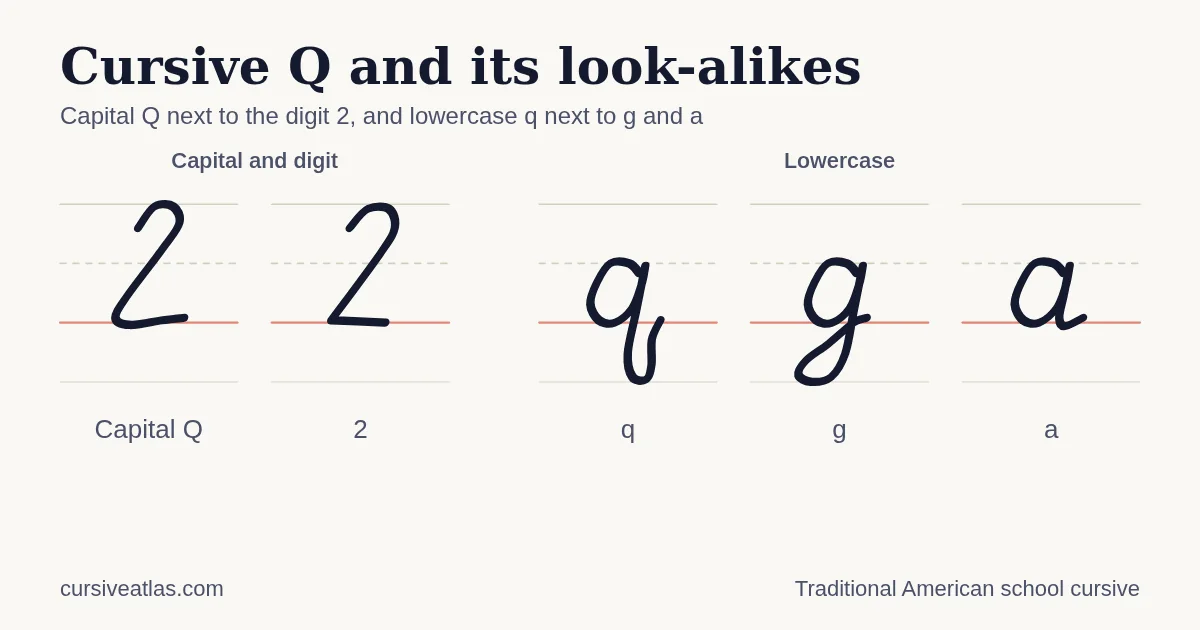
Cursive Q next to 2, g and a
The q is the rarest letter in everyday English, so many writers have never settled how it should look. Its shape is simple, though: an a-shaped oval with a long tail, and the tail is the thing to get right.
- Lowercase q and g. Both are an oval with a tail that drops below the baseline. The g loops its tail to the left; the q hooks it to the right. A tail that wavers between the two is where q and g mix up. See cursive g.
- Lowercase q and a. The a stops its stem at the baseline; the q carries it down past the line. A q with a short tail is an a with a stray hook.
- Lowercase q and p. The p has its stem on the left and the q on the right, so they are mirror images. See cursive p.
- Capital Q and the numeral 2. In traditional school cursive the capital Q is drawn like a large 2: a curve at the top, a long diagonal and a long low stroke along the baseline. That is why the printed number 2 and a capital Q look so alike, and why context decides which one you are reading. The number is covered on the cursive numbers page.
A simple test for the lowercase q: the oval and the stem should add up to an a, and then the tail should continue the stem downward and turn right.
Fixing a cursive q that does not look right
The direction of the tail and the join into u are the two problems that appear in actual words.
| What you see | Likely cause | What to try |
|---|---|---|
| The q looks like a g | The tail was looped to the left at the bottom. | Turn the tail to the right and sweep up into the exit. A q has no left-hand loop. |
| The q looks like an a with a hook | The stem stops at the baseline. | Carry the stem down to the descender line before the turn; the tail should be as deep as in a g or p. |
| The q and u collide in "queen" | The tail of the q rises too steeply into the u. | Sweep up in a gentle curve to the baseline and start the u from there, with a clear gap in between. |
| The oval of the q is open at the top | The pen did not return to the start of the oval. | Close the oval at the top, as in a and d, before the stem goes down the right side. |
| My capital Q is read as a 2 | The long low stroke is the same on both letters. | Use the capital Q where a name or sentence begins, and keep the 2 for numbers; the shape itself is the same in this model. |
Where cursive q shows up: queen, quiet and quick
Almost every q in English is followed by a u: queen, quiet, quick, question, square, equal. That makes the pair "qu" the thing to practise rather than the q on its own. The q finishes with its tail below the line, rises to the baseline and the u starts there, so the join is a long, curved upstroke, quite unlike the short high joins of o, v and w.
Capital Q is a rarer sight, found in a handful of names such as Quinn and Quentin and in words that begin a sentence, such as "Quite" or "Quickly". Because it looks like a 2, it is worth reading it against the cursive z page, which compares Z, Q and the numeral 2 side by side.
The cursive u page explains the cup that follows the q. The lowercase cursive alphabet shows q with the other descenders, and the common cursive mistakes guide lists the g and q mix-up among the errors to avoid.
Cursive Q questions
Why does the capital Q look like a 2 in cursive?
Many school cursive styles draw capital Q with a top curve and a diagonal sweep that resembles a numeral 2. It is a quirk of the style rather than a mistake.
How do you write Q in cursive?
Lowercase q: draw an oval, pull the stem down past the baseline, curve right at the bottom and sweep back up into the exit. Capital Q: a top curve like the top of a 2, a long diagonal down to the baseline and a long low stroke to the right.
Is there a printable cursive Q worksheet?
Yes. The cursive Q worksheet (PDF) has capital Q, lowercase q, joins and words to trace. For a sheet with your own words, use the worksheet generator.
How do you write a capital Q in cursive?
Draw a top curve like the top of a 2, a long diagonal down to the baseline and a long low stroke to the right. See all the uppercase cursive letters.
How do you write a lowercase q in cursive?
Draw an oval, pull the stem down past the baseline, curve right at the bottom and sweep back up into the exit. See all the lowercase cursive letters.
Is a cursive q always followed by u?
In English words, nearly always. A few borrowed words such as Iraq and qat break the rule, so learn qu as a pair first.
Does a cursive q always need a u after it?
In English, almost always: the pair "qu" appears in nearly every word with a q. Practise it as a unit: the tail of the q rises to the baseline and the u starts from there.
Why does the capital Q look like a number 2 in cursive?
In the traditional school model the capital Q is drawn as a 2-shaped letter: a curve at the top, a long diagonal down and a long low stroke to the right. Context shows whether it is a letter or a number. Look at the cursive z page for a side-by-side.
Free printable worksheet: cursive Q
One page with capital Q, lowercase q, joins and words to trace, plus blank lines for your own writing. Print it on US Letter or A4.
More practice: the full alphabet practice sheets, or all cursive worksheets.