Cursive alphabet · Letter S
S in Cursive: How to Write Capital S & Lowercase s
Last updated November 15, 2026
Cursive s starts with an upstroke to a point, then drops back down and finishes with a small sweep along the baseline. It is often the hardest lowercase letter to write smoothly.
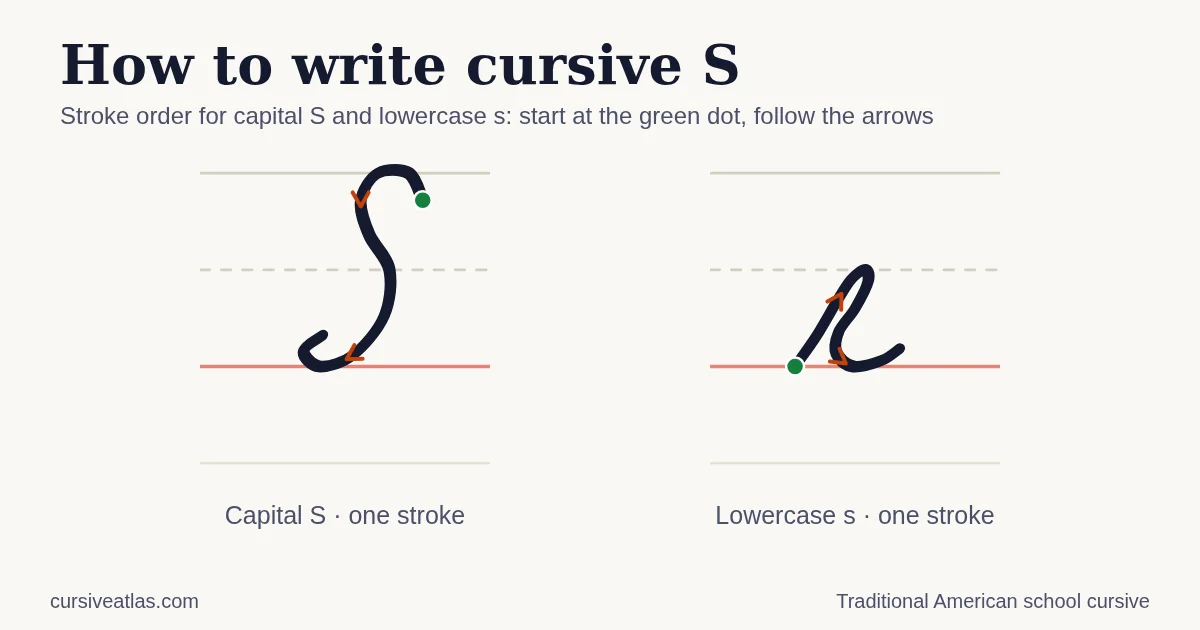
Cursive S at a glance
Capital S
Lowercase s
Numbered dots mark where each stroke begins. The red line is the baseline; the dashed line is the midline. Style: traditional American school cursive, simplified to a single line.
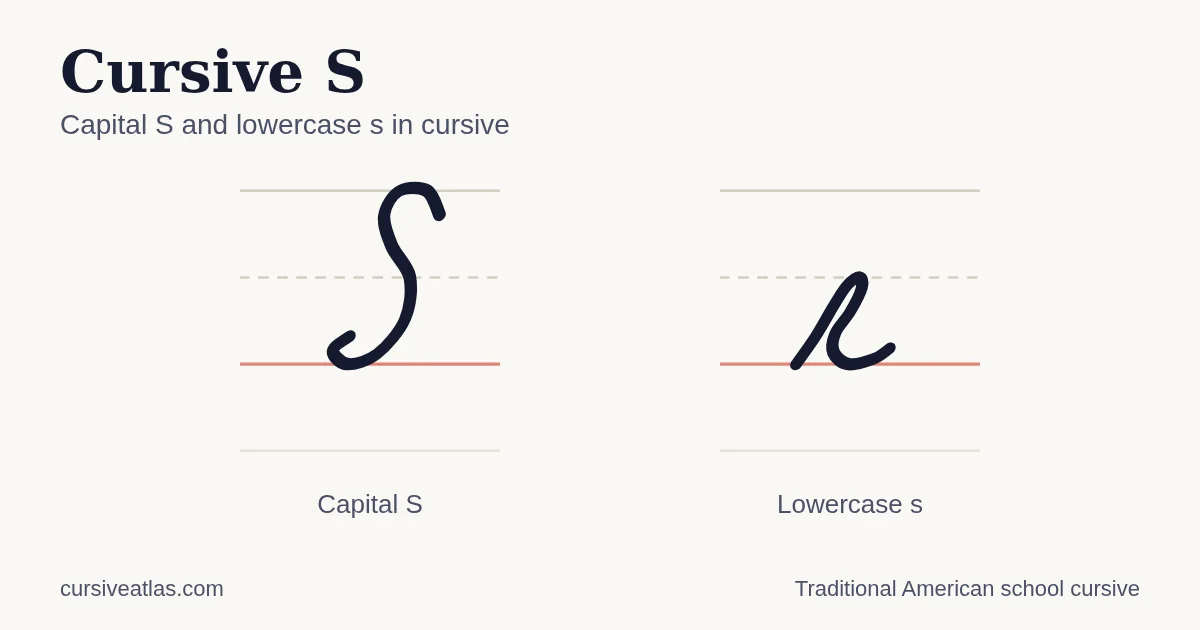
Capital S in cursive: step by step
- 1Start near the top line at the right and curve left and down in an S shape.
- 2Cross the midline and come around the lower curve toward the baseline.
- 3Finish with a small hook to the left. Lift before the next letter.
Lowercase s in cursive: step by step
- 1Start on the baseline and swing up to a point just above the midline.
- 2Turn at the peak and curve down and slightly left toward the baseline.
- 3Round the bottom and sweep to the right in an exit stroke.
Capital S vs lowercase s in cursive
Capital S is a large S curve that ends with a hook and is followed by a pen lift. Lowercase s is small and pointed at the top and ends in an exit stroke so it joins the next letter.
Practice both forms on the same line: write the capital, then a row of lowercase letters, then a word that starts with S. The uppercase cursive letters and lowercase cursive letters pages show every letter of each set side by side.
Capital S in cursive: where you will use it
Capital S begins names such as Sarah, Spain and Sunday. It is a large S curve that ends in a small hook, and the next letter starts fresh.
Every capital is shown side by side in the uppercase cursive alphabet, and the printable cursive chart puts S next to s on one page.
Trace cursive S on screen
Use a finger, stylus or mouse. Start at the numbered dot, follow the dotted guide, then press Check to see how much of the guide you covered.
Capital S
Trace over the dotted guide with your finger, mouse or stylus.
Lowercase s
Trace over the dotted guide with your finger, mouse or stylus.
How cursive s joins other letters
The s exits from the baseline, so it joins to most letters. In 'st', the t's stem picks up straight from the exit.
sa
se
si
so
st
Trace the join: sa
Trace over the dotted guide with your finger, mouse or stylus.
Common letter pairs with cursive s
These pairs appear in everyday English. Practice each one as a unit, because a join is a movement that you repeat rather than a gap you leave between letters.
- st: The exit rises into the stem of the t. Cross the t after the word. See cursive T.
- se: The exit of the s leads into the loop of the e. Keep the e open. See cursive E.
- so: The exit runs into the oval of the o. Close the o before you continue. See cursive O.
- es: The e ends at the baseline and leads into the point of the s. See cursive E.
Practice words with s
Capitalized names are written the way they would be on a card or label; lowercase words show how the letters link in a line.
Sarah
Spain
Sunday
sun
sister
classes
yes
Want a word of your own? The worksheet generator makes a practice sheet for any name.
Common mistakes with cursive s
A peak that is too high
The point of the s should rise only slightly above the midline. A tall peak makes it look like a b without its bowl.
A flat bottom
Round the curve at the bottom. A flat base makes the s look like a tilted r.
Cursive s vs r: Cursive s and r both start with an upstroke and can look alike when written quickly. The s curves down and sweeps right; the r goes sideways at the midline. See cursive R →
How to practice cursive S and s
- Write a line of lowercase s, keeping the point just above the midline and rounding the bottom.
- Practice 'st', 'se' and 'so', then the words 'sun', 'sister' and 'classes'.
- Write capital S in names and compare it with the lowercase s.
Print the cursive S worksheet for guided lines, or type your own words into the worksheet generator. For the next step, work through the full cursive alphabet.
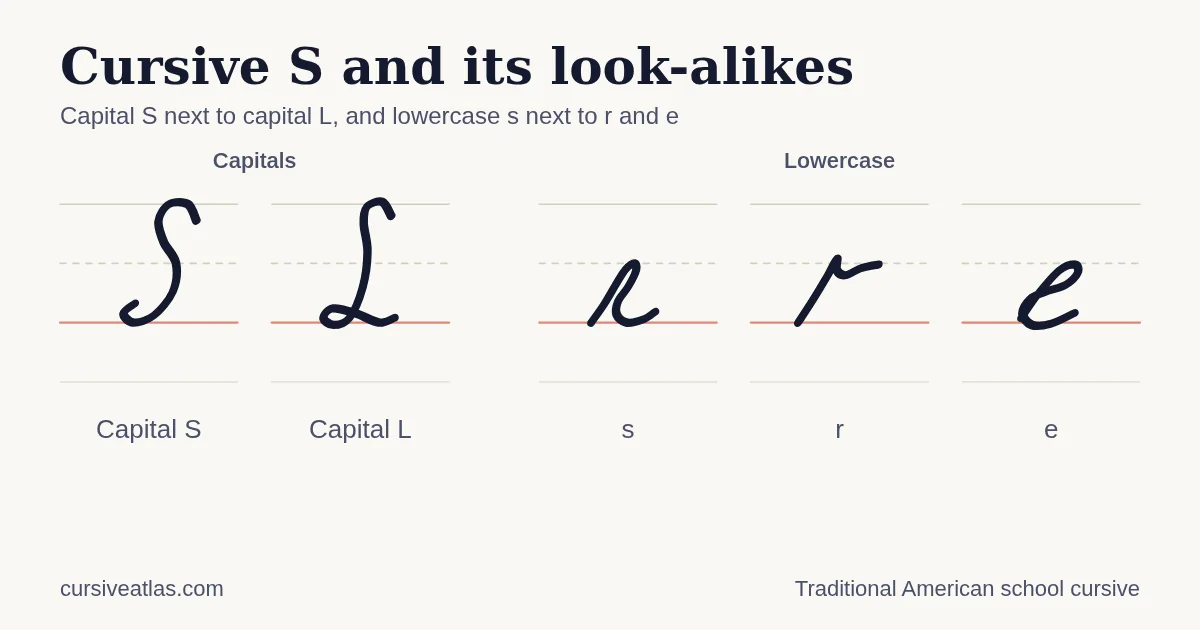
Cursive S next to L, r and e
Lowercase s is an upstroke to a small point, a drop to the baseline and a sweep out. The point at the top is the part that is easy to lose, and the baseline sweep is the part that gives the letter its join.
- Lowercase s and r. Both have a small pointed top. The r ends there with a flat shoulder; the s drops to the baseline, rounds the bottom and sweeps out. See cursive r.
- Lowercase s and e. A small s with a rounded top looks like an e whose loop never opened. The s has a pointed top and the e a loop with white space inside. Compare cursive e.
- Capital S and capital L. Both are drawn in a single flowing movement. The S makes a curve with a hook to the left at the bottom; the L ends with a long stroke to the right. See capital L.
- Capital S and lowercase s. The capital S is large and shaped like a printed S, finishing with a hook, and it is followed by a pen lift. The lowercase s is small and joins on both sides.
If you are unsure about an s in your own writing, look at its exit. The s always leaves from the baseline, and the letters that follow it must start there.
Fixing a cursive s that does not look right
The point at the top and the sweep at the bottom are the two features. The table covers common problems.
| What you see | Likely cause | What to try |
|---|---|---|
| The s looks like an r | The point at the top is too flat and the base of the s is missing. | Finish the s with a rounded bottom and a sweep out to the right. |
| The s looks like a loop-free e | The top is rounded, not pointed. | Make a distinct point at the top before the stroke goes down; the s has an angle where the e has a loop. |
| The two s's in "blessed" blend together | The sweeps of the first s run into the second. | Shorten the exit of the first s and start the second from its end, as in the word blessed. |
| The s is bigger than the letters beside it | The point rises above the midline too far. | Keep the point just above the midline, not up to the top line. |
| The capital S is a loose scribble | The curve is not guided by a top and a bottom. | Start near the top line, curve to the left, cross at the midline and finish with a small hook at the baseline. |
Where cursive s shows up: blessed, Sophia and Lucas
Capital S begins names such as Sophia, Samuel and Sarah, and starts words such as "Sunday" and "September". The lowercase s is found in blessed, where the double s makes a good drill, Isabella and James, and it ends Lucas, a final position in which it needs no exit.
The most common job of an s is to make plurals, which means that it often lands at the end of a word: books, dreams, friends. A final s has no join to make, so it can finish with a soft flick. That relaxes the shape, and it is easy to let it become an r or an e.
The s also takes part in the "st", "sh" and "se" pairs. The cursive t page covers the join into a crossed stem. The lowercase cursive alphabet shows the s alongside the other pointed letters (i, r, t), and the worksheet generator will make a sheet of s words.
Cursive S questions
Why is the lowercase s so hard to write in cursive?
The s changes direction twice in a small space: up, then down, then sideways. Practice it slowly on its own and then in pairs like 'st' and 'ss' before writing it in words.
How do you write S in cursive?
Lowercase s: swing up to a point just above the midline, curve down and slightly left to the baseline, round the bottom and sweep out to the right. Capital S: curve left and down in an S shape from near the top line, cross the midline and finish with a small hook to the left.
Is there a printable cursive S worksheet?
Yes. The cursive S worksheet (PDF) has capital S, lowercase s, joins and words to trace. For a sheet with your own words, use the worksheet generator.
How do you write a capital S in cursive?
Curve left and down in an S shape from near the top line, cross the midline and finish with a small hook to the left. See all the uppercase cursive letters.
How do you write a lowercase s in cursive?
Swing up to a point just above the midline, curve down and slightly left to the baseline, round the bottom and sweep out to the right. See all the lowercase cursive letters.
How do I make my cursive s smoother?
Slow down on the turn at the top and the curve at the bottom. A pointed peak and a rounded base fix most wobbly s shapes.
How do I write a capital S in cursive?
Start near the top line, curve to the left and down, cross the midline and sweep to the right at the bottom, finishing with a small hook to the left. The pen lifts after the capital S before the next lowercase letter. See Sophia.
How do I write "ss" in cursive?
Write the first s with its baseline sweep, keep the exit short and start the second s from the end of it. Both points should reach the same height. Practise it in blessed.
Free printable worksheet: cursive S
One page with capital S, lowercase s, joins and words to trace, plus blank lines for your own writing. Print it on US Letter or A4.
More practice: the full alphabet practice sheets, or all cursive worksheets.