Cursive alphabet · Letter J
J in Cursive: How to Write Capital J & Lowercase j
Last updated November 15, 2026
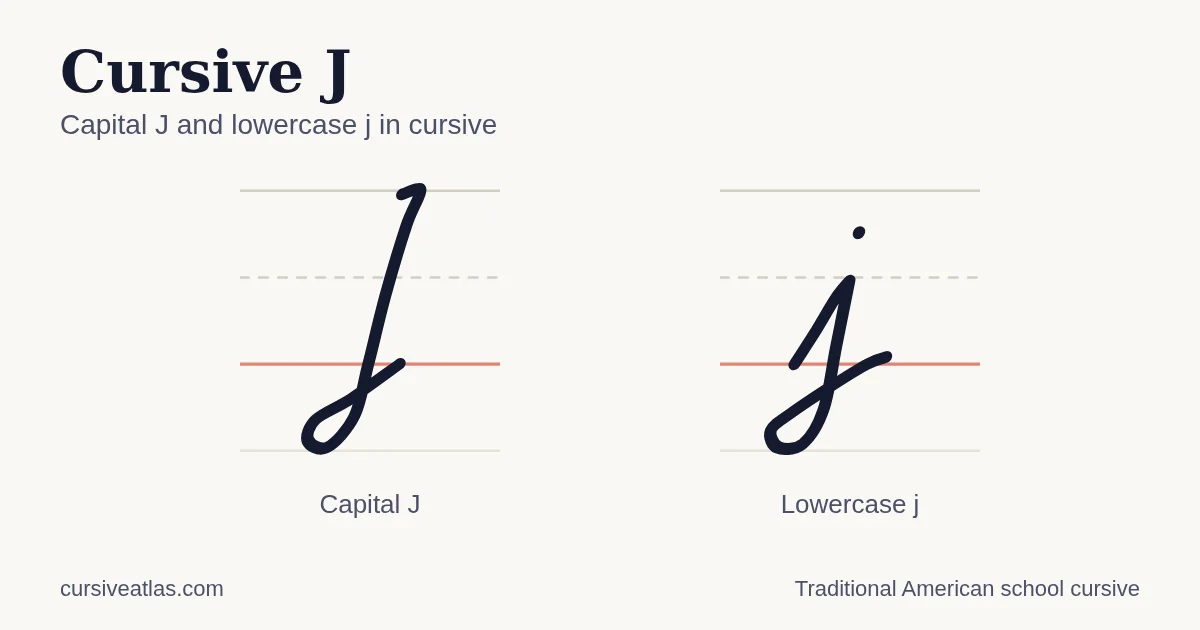
Cursive j is an i that continues below the baseline into a loop. The capital J drops below the line the same way, which is why j and J feel related.
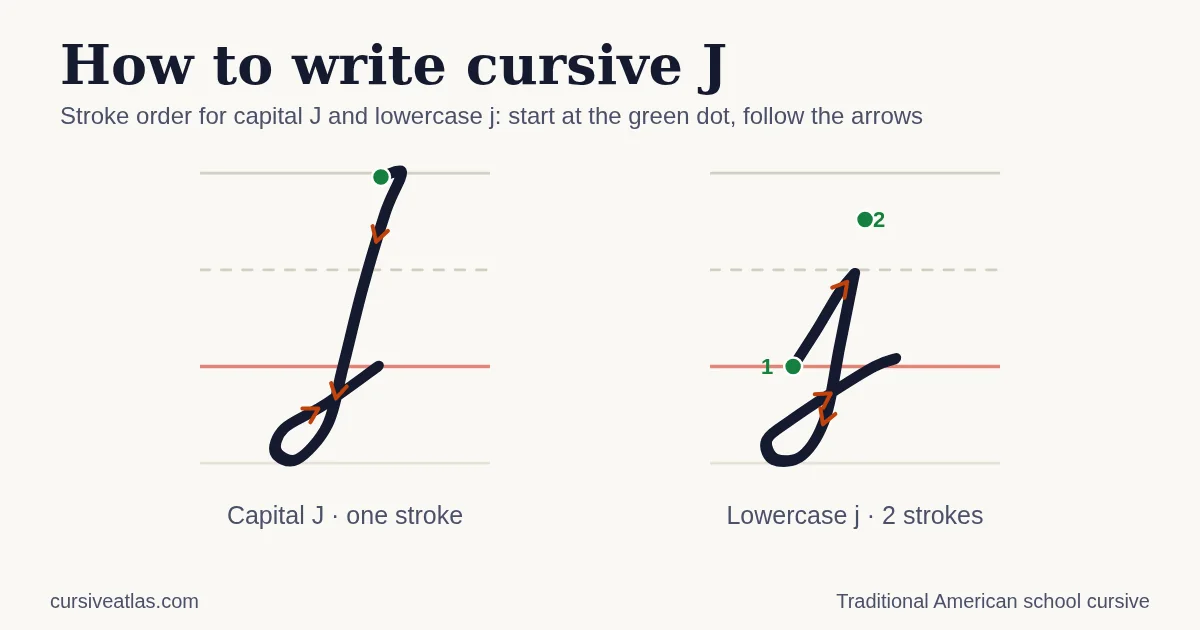
Cursive J at a glance
Capital J
Lowercase j
Numbered dots mark where each stroke begins. The red line is the baseline; the dashed line is the midline. Style: traditional American school cursive, simplified to a single line.
Capital J in cursive: step by step
- 1Start near the top line and draw a stem down, leaning slightly left at the top.
- 2Continue through the baseline to the descender line.
- 3Loop to the left and sweep back up to the right, crossing the stem near the baseline.
Lowercase j in cursive: step by step
- 1Start on the baseline and swing up to the midline.
- 2Come straight down through the baseline to the descender line.
- 3Loop to the left at the bottom.
- 4Swing back up to the right and finish with an exit stroke. Add the dot after the word is done.
Capital J vs lowercase j in cursive
Both forms drop below the baseline and loop to the left, which is why they feel related. Capital J starts at the top line and has no dot; lowercase j starts at the midline and is dotted like an i.
Practice both forms on the same line: write the capital, then a row of lowercase letters, then a word that starts with J. The uppercase cursive letters and lowercase cursive letters pages show every letter of each set side by side.
Capital J in cursive: where you will use it
Capital J begins names such as James, Julia and January. It starts near the top line, drops below the baseline and loops to the left, and it has no dot.
Every capital is shown side by side in the uppercase cursive alphabet, and the printable cursive chart puts J next to j on one page.
Trace cursive J on screen
Use a finger, stylus or mouse. Start at the numbered dot, follow the dotted guide, then press Check to see how much of the guide you covered.
Capital J
Trace over the dotted guide with your finger, mouse or stylus.
Lowercase j
Trace over the dotted guide with your finger, mouse or stylus.
How cursive j joins other letters
The j exits from the sweep after the loop, so the connecting stroke rises from below the baseline. Keep the rise gradual so the next letter starts at the right height.
ja
je
jo
ju
aj
Trace the join: ja
Trace over the dotted guide with your finger, mouse or stylus.
Common letter pairs with cursive j
These pairs appear in everyday English. Practice each one as a unit, because a join is a movement that you repeat rather than a gap you leave between letters.
- ju: The sweep from the lower loop rises into the cup of the u. Keep the rise gradual. See cursive U.
- jo: The exit climbs into the oval of the o. Close the o before you continue. See cursive O.
- ja: The sweep leads into the oval of the a. Pull the stem of the a down cleanly. See cursive A.
- nj: The n exits at the baseline and leads into the first stroke of the j; put the dot on the j after the word. See cursive N.
Practice words with j
Capitalized names are written the way they would be on a card or label; lowercase words show how the letters link in a line.
James
Julia
January
jump
enjoy
jelly
major
Want a word of your own? The worksheet generator makes a practice sheet for any name.
Common mistakes with cursive j
A dot in the wrong place
Place the dot directly above the stem, at the same height as the dot on an i. A dot that drifts right looks like a stray mark.
A loop that is too small
A tight loop at the bottom turns into a hook. Give it the same room you give the loop on a g.
Cursive j vs i: Cursive j and i share the first two strokes. Only the j continues below the baseline into a loop, and both get a dot. See cursive I →
How to practice cursive J and j
- Write a line of lowercase j and make the lower loop as big as the one you use for a g.
- Practice 'ju', 'jo' and 'ja', then the words 'jump', 'enjoy' and 'jelly', adding the dots at the end.
- Write capital J in names and check that it drops below the baseline and loops to the left.
Print the cursive J worksheet for guided lines, or type your own words into the worksheet generator. For the next step, work through the full cursive alphabet.
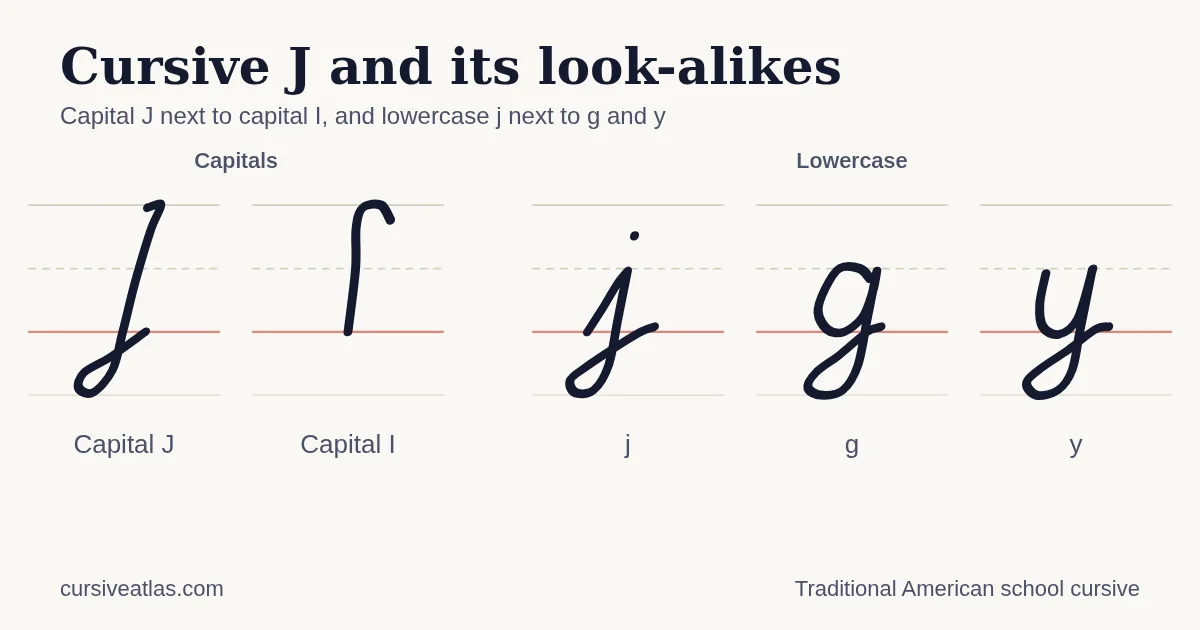
Cursive J next to the letters it gets mistaken for
A cursive J usually goes wrong in one of two ways: the capital J turns into an I, or the lowercase j turns into a g or a y. The picture above puts each pair side by side. In every case the answer is the same: look at what the pen does after it crosses the baseline.
- Capital J and capital I. Both start near the top line (the I with a small curl) and come straight down. The I stops on the baseline. The J keeps going, drops below it and curls back to the left. If you can read your J as an I in a word like "Jan" or "Ian", the bottom curl is too short or missing. Compare it with the capital I in cursive.
- Lowercase j and g. Both loop to the left under the line, but they begin differently. A g starts as a round oval; a j starts as a plain upstroke and takes a dot. If your j has a closed circle at the top, it is a g.
- Lowercase j and y. The y starts with a small cup and then retraces down through the baseline to its tail. The j begins with a single upstroke. Read how to write a cursive y and cursive g next to this page and the three tails will stop looking the same.
- The dot. Only i and j are dotted in cursive. A dot on a g is a stray mark and a missing dot on a j leaves a bare stem with a tail.
A useful habit is to write the three descending letters in one row: j, g, y, j, g, y. The tails should all reach the same depth, and only the j should carry a dot.
Fixing a cursive J that does not look right
The usual mistakes (a drifting dot, a tight loop) are listed above. These are the less obvious symptoms that show up once you start writing J in real words.
| What you see | Likely cause | What to try |
|---|---|---|
| My capital J reads as an I | The stem stops at the baseline, so the loop never forms. | Slow down at the baseline and keep the pen moving down for about the same distance as the letter is tall above it. |
| The tail of my J runs into the next line of writing | Lines are too close together for a letter that drops below the baseline. | Use wider-ruled paper, or leave a blank line between lines of text when you write capital J in names and headings. |
| My lowercase j looks like a g | It began with an oval instead of an upstroke. | Start the j on the baseline with a plain upstroke to the midline, then come straight down. Save the oval for g. |
| The j in "enjoy" does not join to the o | The loop swings out to the left and the exit stroke starts too far away. | Bring the loop back up to the baseline, and let that upstroke become the join into the next letter. |
| My capital J leans differently to the rest of the word | The top hook is drawn upright while the rest is slanted. | Tilt the hook to the same slant as the rest of the word before the first stroke goes down. |
Where cursive J appears: names, months and signatures
Capital J starts some of the most common first names in English, among them James, John, Jack, Julia and Jessica, and three months: January, June and July. Because of the loop below the baseline, J is the capital most likely to collide with whatever is written underneath it, which matters when you sign a form with a J initial. Our page on writing James in cursive shows the capital J inside a whole name.
Lowercase j is one of the rarest letters in English, so it gets little practice in everyday writing. That is why the words in the practice section are worth writing out on purpose, and why a J that was fine in the lesson tends to wobble when it finally turns up in a sentence.
Try your initials in the cursive signature generator to see how a capital J looks in a signature, then use the cursive worksheet generator to trace a name that starts with J. If you want to see how the two forms of the same letter relate, the guide to cursive capital letters compares them across the alphabet.
Cursive J questions
Does cursive j get a dot?
Yes. The lowercase j is dotted like an i, after the word is finished. The capital J has no dot.
How do you write J in cursive?
Lowercase j: swing up to the midline, come straight down through the baseline, loop left and sweep back up, then dot it after the word. Capital J: a stem from near the top line through the baseline, then a loop to the left.
Does capital J in cursive go below the line?
Yes. The stem of capital J continues through the baseline to the descender line, loops left and sweeps back up across the stem near the baseline.
Is there a printable cursive J worksheet?
Yes. The cursive J worksheet (PDF) has capital J, lowercase j, joins and words to trace. For a sheet with your own words, use the worksheet generator.
How do you write a capital J in cursive?
Start near the top line, draw a stem straight down through the baseline and loop to the left. Do not add a dot. See all the uppercase cursive letters.
How do you write a lowercase j in cursive?
Swing up to the midline, come straight down through the baseline, loop to the left and sweep back up. Add the dot after the word. See all the lowercase cursive letters.
How is a cursive j different from a cursive i?
Both are dotted. The j continues below the baseline into a loop to the left; the i stops on the baseline with an exit stroke.
Why does my cursive J look like an I?
The stem of your J stops at the baseline. The I stops there; the J carries on below it and curls back to the left. Draw the stem down for roughly the same distance below the baseline as the letter rises above it, then turn the pen back to the left.
Which cursive letters go below the line?
Free printable worksheet: cursive J
One page with capital J, lowercase j, joins and words to trace, plus blank lines for your own writing. Print it on US Letter or A4.
More practice: the full alphabet practice sheets, or all cursive worksheets.