Christmas worksheets
Christmas Cursive Practice Sheets for Kids and Adults
These three free PDFs take you from easy Christmas words to full holiday sentences, in the order a cursive learner can actually manage. Each sheet shows the gray word to trace and an empty ruled line to write it again. Instead of one long list, the words are sorted by the joins they need, so you always know why a word is in a level and what it is practicing.
By Salah eddine · Last updated November 3, 2026 · Editorial policy
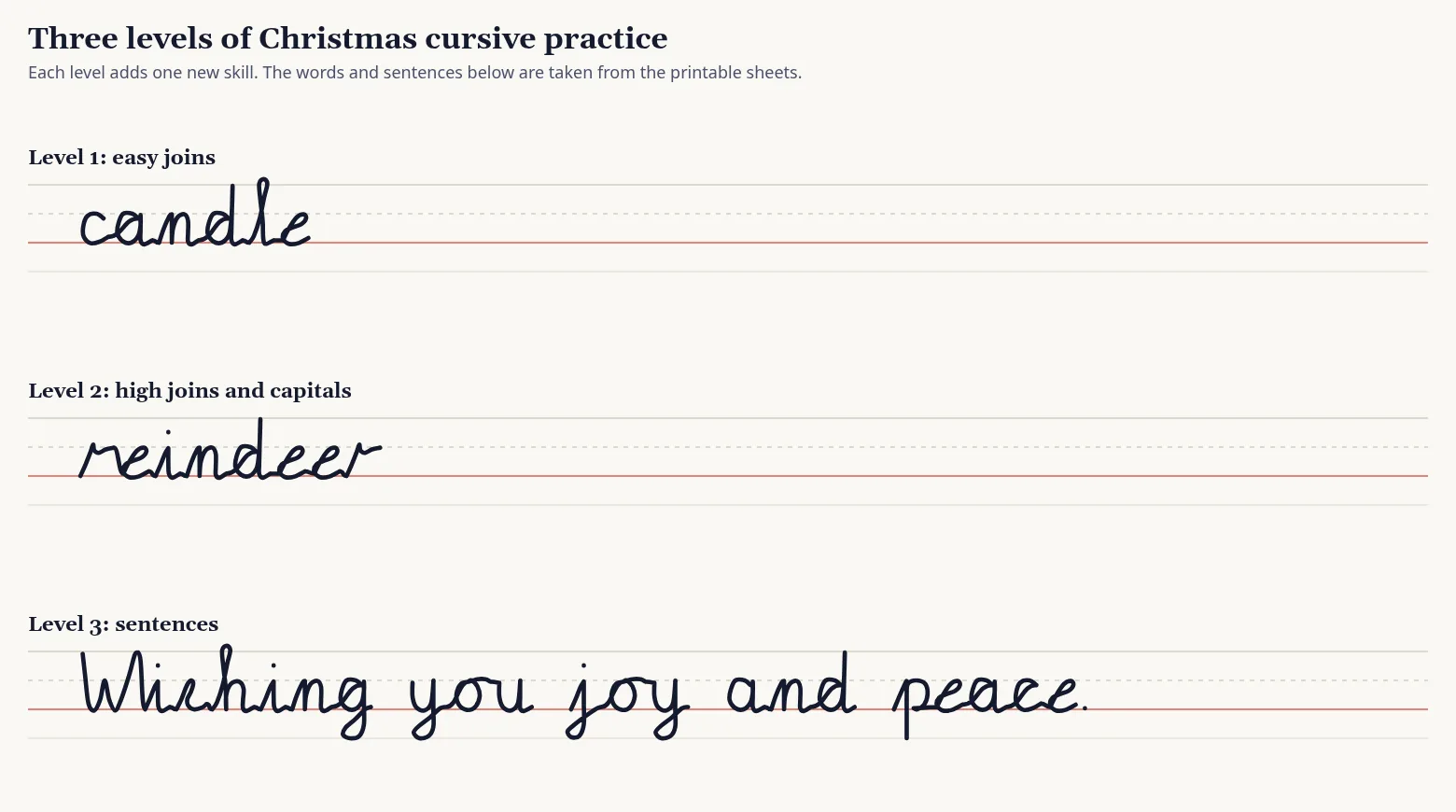
The three levels at a glance
| Level | What it practices | Content | |
|---|---|---|---|
| 1. Easy joins | Baseline joins only, lowercase, no high exits | 8 words: santa, star, sled, candle, tinsel, mittens, nutmeg, silent | Level 1 PDF (2 pages) |
| 2. High joins and capitals | Letters that leave at the midline (b, o, v, w, r), tails, loops and three capitals | 12 words: wreath, holly, garland, reindeer, snowman, ornament, presents, stocking, cookies, Christmas, December, Rudolph | Level 2 PDF (3 pages) |
| 3. Holiday sentences | Spacing, punctuation and writing a whole line | 8 sentences, from Merry Christmas! to Happy New Year! | Level 3 PDF (2 pages) |
If you are not sure where to begin, try the first word of Level 2 on a blank line. If it takes you under a minute and the joins look even, start at Level 2 or 3. If the letters wobble, start at Level 1. A beginner who has not yet learned the alphabet should first see the cursive alphabet and the letter-by-letter guides.
Print each PDF at 100% on US Letter or A4. Every page has the same layout: a gray word to trace, an empty row for your own copy, and a short tip at the bottom of the page.
Level 1: easy joins
Level 1 words were chosen because every join in them travels along the baseline: the pen leaves a letter at the bottom, flicks up and enters the next letter. The only r (in star) ends its word, so no join follows it, and none of the other letters leaves at the midline, so there is no high bridge to judge. That makes the movement the same each time, which is the right thing to rehearse first.
| Word | Why it is in Level 1 |
|---|---|
| santa | Four baseline joins and one tall t, crossed after the word. |
| star | Short, with a tall t. Good for the first cross of a t. |
| sled | A tall l and a tall d in one word. Keep both loops narrow. |
| candle | Round letters (a, d) and a tall l after a baseline join. |
| tinsel | Two tall letters (t, l) and an i to dot after the word. |
| mittens | Two t’s to cross, and i, n and e in a row. A good test of consistent height. |
| nutmeg | Ends in a g, so it is the first word with a tail below the baseline. |
| silent | A tall l and a tall t next to each other, with i and e between. |
Nothing in Level 1 is easy to get perfect, but all of it is easy to repeat. Trace each word twice, then write it three times on the empty line without looking at the gray. When all three copies look alike, move to the next word. If your letters look uneven, our guide on common cursive mistakes explains the usual causes.
Level 2: high joins and capitals
This is where cursive starts to feel like handwriting. The letters b, o, v, w and r leave at the midline instead of the baseline, so the pen travels across in a flat bridge before the next letter begins. In Level 2 every word contains at least one of these joins, plus loops, tails and, for three of the words, a capital letter that is written on its own. The table names each one.
| Word | High joins | Other features |
|---|---|---|
| wreath | wr, re | tall t/h |
| holly | ol | tail on y, tall h/l |
| garland | rl | tail on g, tall l/d |
| reindeer | re | tall d |
| snowman | ow, wm | none |
| ornament | or, rn | tall t |
| presents | re | tail on p, tall t |
| stocking | oc | tail on g, tall t/k |
| cookies | oo, ok | tall k |
| Christmas | ri | capital, tall h/t |
| December | be | capital, tall d/b |
| Rudolph | ol | capital, tail on p, tall d/l/h |
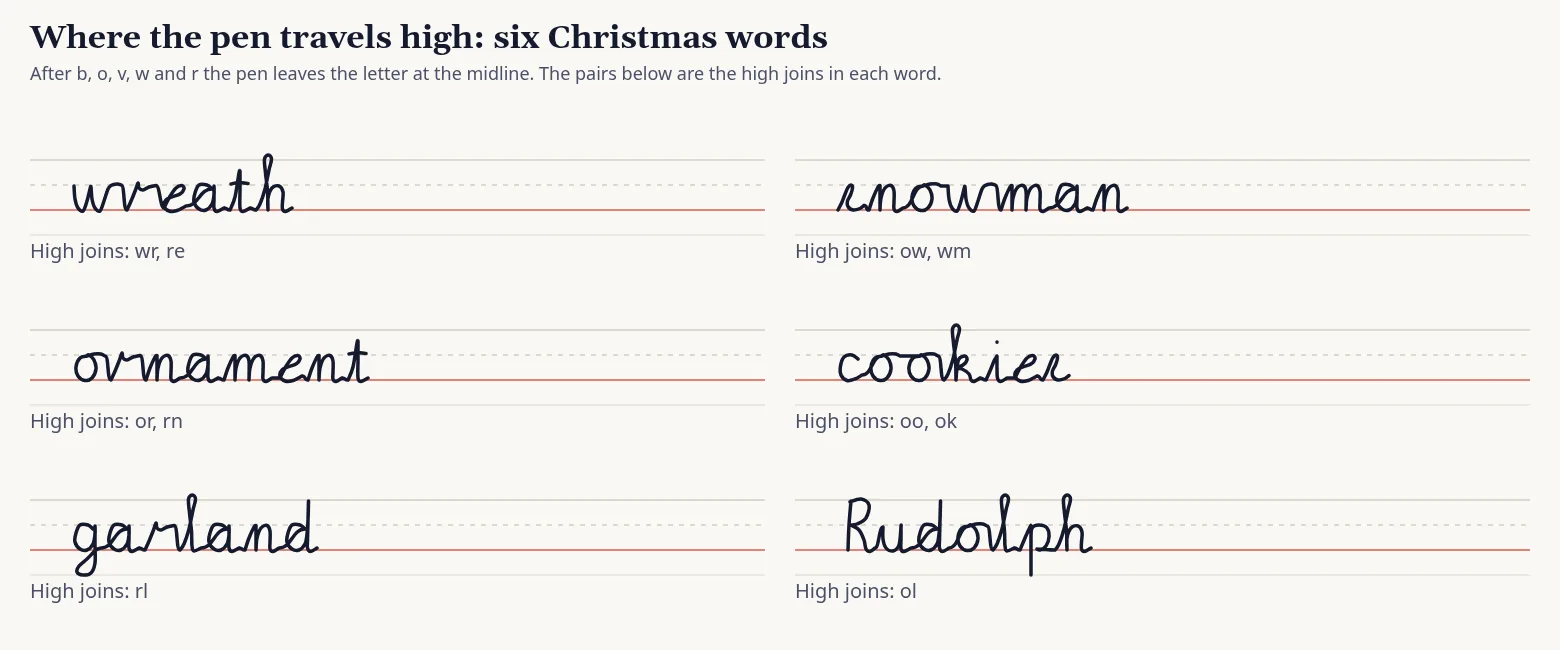
The join pairs are worked out from the rule on the cursive joins page: a join leaves at the midline after b, o, v, w and r, and the capital at the start of a word does not count because it is written alone. A double high join, as in snowman (o to w, then w to m), is the toughest: the bridge must stay level twice in a row, so use the repeated pair ow as a drill before you write the whole word.
December and Rudolph are the two capitals most children will want next, since they are the start of a date and the best-known reindeer. If you want more capitals, see cursive capital letters and cursive days and months.
Level 3: holiday sentences
A sentence is a different skill from a word. Letters are inside words, but the pen also has to leave a clear gap between words, keep one slant across the line and place punctuation. The eight Level 3 sentences are short on purpose: the shortest, “Happy New Year!”, has 15 characters including spaces and punctuation, and the two longest, “Snow fell softly all night.” and “The tree is full of lights.”, have 27 each.
- Merry Christmas!
- Wishing you joy and peace.
- Snow fell softly all night.
- We hung the stockings.
- The tree is full of lights.
- Thank you for the gift.
- Silent night, holy night,
- Happy New Year!
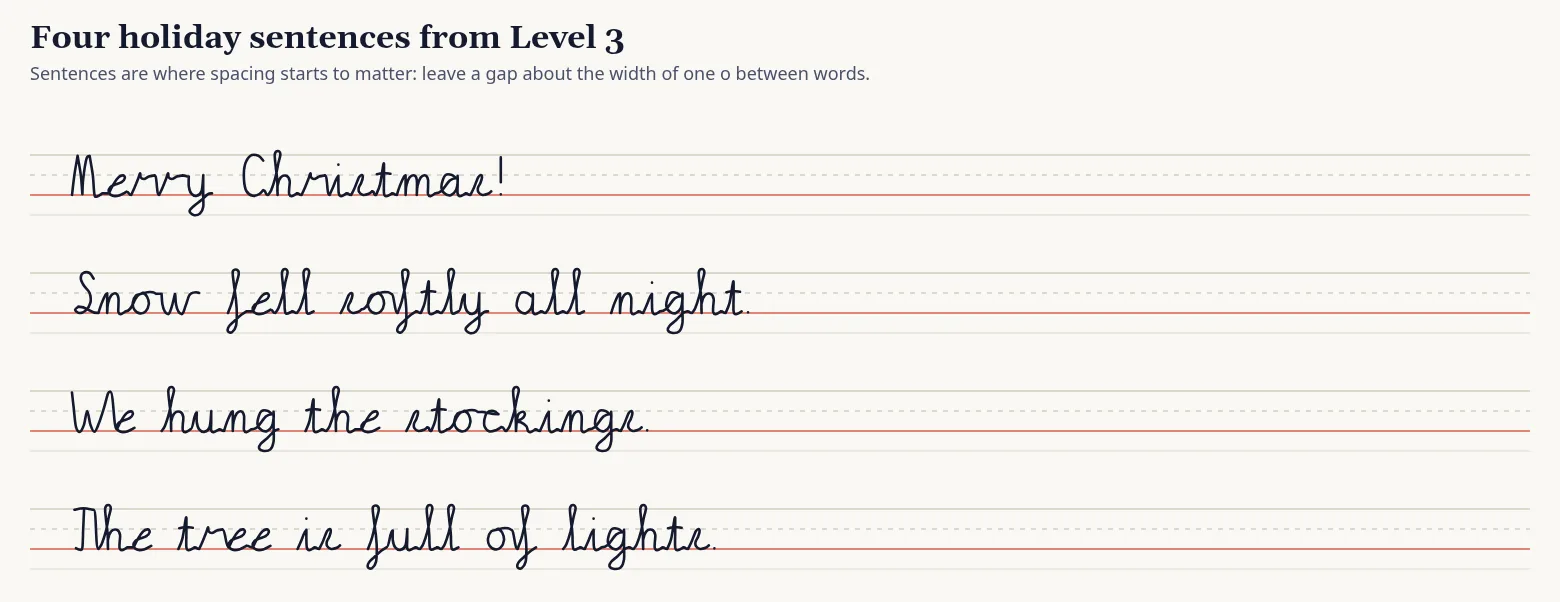
Two habits help the most. First, leave a gap about the width of one o between words, so the words neither run together nor float. Second, wait until the end of the sentence to dot every i, cross every t and add punctuation, working left to right. For more sentence practice on different themes, see cursive sentences.
A 20-minute Christmas practice session
- Warm-up (3 minutes). A line of rolling ovals and a line of upward loops on lined paper.
- Trace (7 minutes). Two or three words from your level, tracing in pencil, then ink.
- Copy (7 minutes). The same words on the empty rows without the gray guide. Compare each copy with the first.
- One real thing (3 minutes). Write the sentence, the card message or the tag you actually need this month. Use the Merry Christmas sheet for cards and tags or the Santa letter template for a letter.
Short regular sessions work better than one long one. Four sessions of twenty minutes across a week are easier on a young writer’s hand than a single hour, and the printable pages are sized so that one page is about one session.
Using the sheets at home or in a classroom
- At home. Print one level at a time. Use a pencil for tracing so mistakes can be erased. Have a child say the word aloud while they trace it.
- In a classroom. Level 1 and Level 2 make a station activity, and Level 3 works as a quiet-time sheet. All three are free to print for classroom use. For a suggested teaching order, see how to teach kids cursive.
- For adults. Adults relearning cursive often prefer Level 2 first, because the high joins are the main thing that has to be relearned. See cursive for adults.
- With a different school style. The letter shapes follow a simplified American school style. If your school teaches D’Nealian or Zaner-Bloser, the joins are the same, and this comparison shows where letter shapes differ.
For more worksheets, including the alphabet, numbers and names, browse the worksheets collection, or build your own sheet from any holiday words with the worksheet generator.
Common problems on Christmas words, and fixes
| Problem | Likely cause | Try this |
|---|---|---|
| The i looks like an e in Christmas | The i’s upstroke is too wide, or the dot is missing | Keep the i narrow and dot it at the end of the word |
| The r after o in ornament is a hook | The pen dropped to the baseline instead of crossing at the midline | Level the bridge and write the pair or a few times as a drill |
| Tall letters are uneven (stocking, candle) | No clear top line to aim at | Write on the ruled row and touch the top line on every l, k and t |
| Words lean in different directions | Slant changes within the line | Use the slant guides on cursive lined paper for a few lines |
| Spaces between words are uneven | No fixed gap in mind | Leave about the width of one o, and check against the gray line |
Frequently asked questions
What are the best Christmas words to practice in cursive?
Short words with simple joins are best at first: santa, star, sled, candle and tinsel. Move on to wreath, snowman, ornament and reindeer once the high joins feel steady, then to full sentences.
How long should a Christmas cursive practice session be?
Around 20 minutes is plenty. A short session of tracing followed by copying on the empty rows is more useful than an hour of copying with tired hands.
What age are these worksheets for?
There is no fixed age. They suit anyone who knows the alphabet and wants to practice joins: typically children from second or third grade, and adults relearning cursive. A beginner who does not know the letters should start with the alphabet pages.
Why are some words only in Level 2?
Because they use the high joins (after b, o, v, w and r), where the pen leaves a letter at the midline. That join takes more control than a baseline join, so it comes second.
Which cursive style do the sheets use?
A simplified single-line American school cursive, drawn from the same stroke engine as the rest of the site. Teachers who use D’Nealian or Zaner-Bloser may notice small differences in capital shapes.
Can I print the sheets for my class?
Yes. They are free for home and classroom use. Please do not resell them.
Is there a sheet for a card or a letter?
Yes. The Merry Christmas sheet has a practice page, four mini cards and eight gift tags, and the letter to Santa template has tracing plus blank lines.
Keep going
Merry Christmas in cursive
Copy and paste, write it stroke by stroke, and print cards and tags.
Letter to Santa in cursive
A printable letter template and how to mail it.
Printable worksheets
Tracing sheets for letters, numbers and words.
Connecting letters in cursive
Why high joins are different, and how to practice them.
How we write and check pages: editorial policy.