Beyond single words
Cursive Sentences for Practice
Writing letters and words correctly is only half of cursive. The other half is what happens when you keep going: the space between words, a steady baseline across a whole line, capitals at the start, punctuation at the end. This page gives you practice sentences chosen for a purpose, four pangrams that use every letter, rules for spacing and punctuation, a three-pass method for practicing, and a free printable PDF made entirely of sentences. If you are still working on single words, start with cursive words and come back.
By Salah eddine · Last updated October 29, 2026 · Editorial policy
Why practice sentences, not just letters?
A sentence is the first place where several handwriting skills have to work at once. You need joins to link letters, consistent size to keep a line tidy, spacing to separate words, and a rhythm that lets you keep the pen moving. Teachers often describe the stage after letters and words as the point where handwriting starts to become fluent, and sentence copying is the usual exercise for it.
A good practice sentence is short enough to finish in one line, natural enough to be worth writing and chosen for something. Random sentences give random practice. The next section shows what that looks like: five sentences, each aimed at one skill.
Five sentences, each aimed at one skill
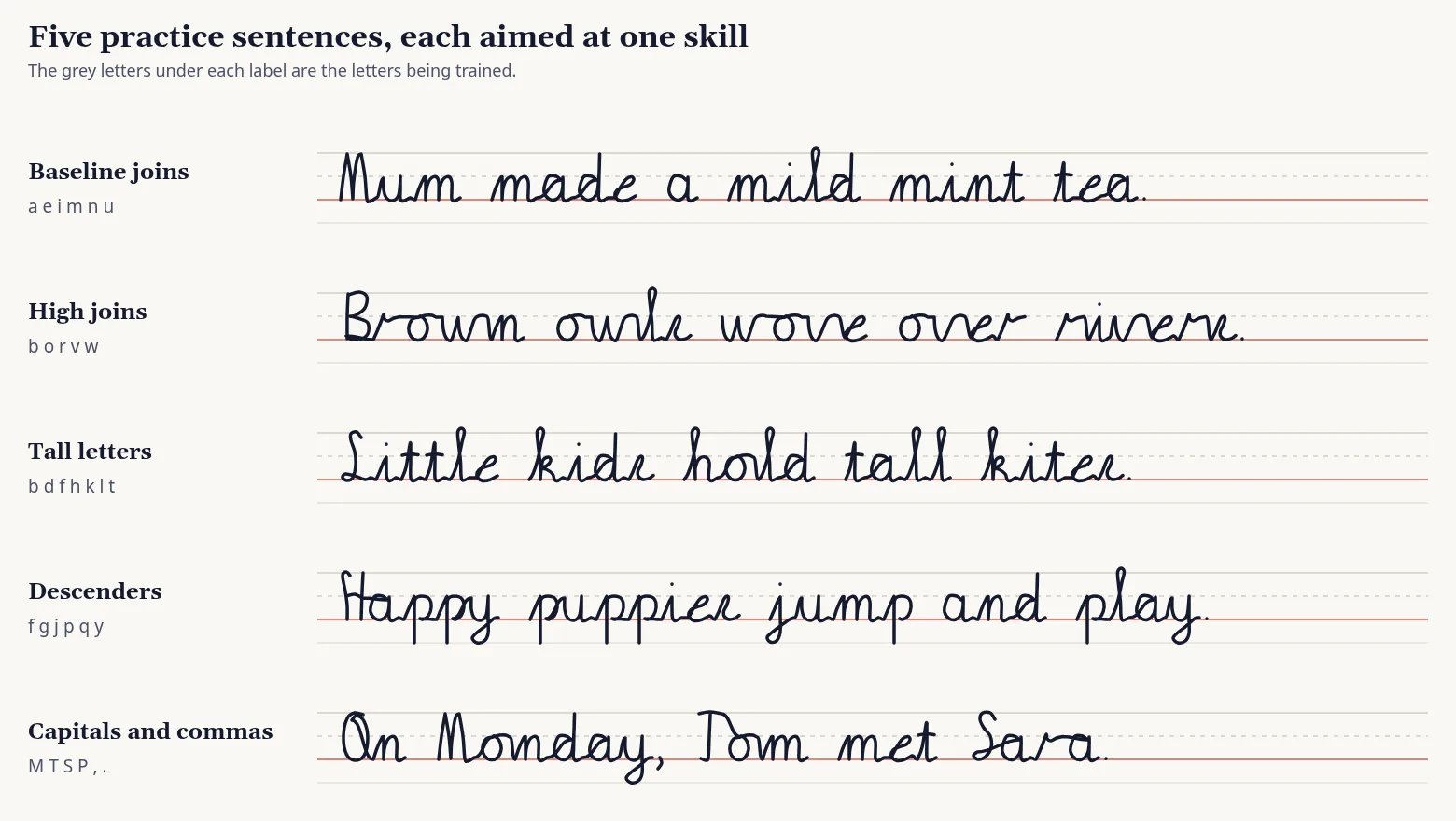
- Baseline joins: “Mum made a mild mint tea.” is built from letters that exit at the baseline (a, e, i, m, n, u, l, t). It is the easiest sentence to write smoothly.
- High joins: “Brown owls wove over rivers.” has a b, o, w, v and r in almost every word. Each of them exits at the middle line, so the join into the next letter looks different. The cursive joins page explains why.
- Tall letters: “Little kids hold tall kites.” repeats l, k, d, h, t. The goal is for every tall letter to reach the same top line.
- Descenders: “Happy puppies jump and play.” has p, y, j. Check that the tails drop to the same depth and do not collide with the line below.
- Capitals and commas: “On Monday, Tom met Sara.” needs four capitals and a comma. Slow down at each capital, then restart at normal speed.
Write each sentence three times, slowly. If one of them goes badly, you have found the skill to work on, and the matching section of our alphabet guide or the joins page will show you what to change.
Pangrams: one sentence, every letter
A pangram is a sentence that contains every letter of the alphabet at least once. They are used to test typefaces, keyboards and handwriting, because one line shows all 26 letters. The best-known is “The quick brown fox jumps over the lazy dog” (35 letters). Shorter ones exist, such as “How vexingly quick daft zebras jump!” (30 letters).
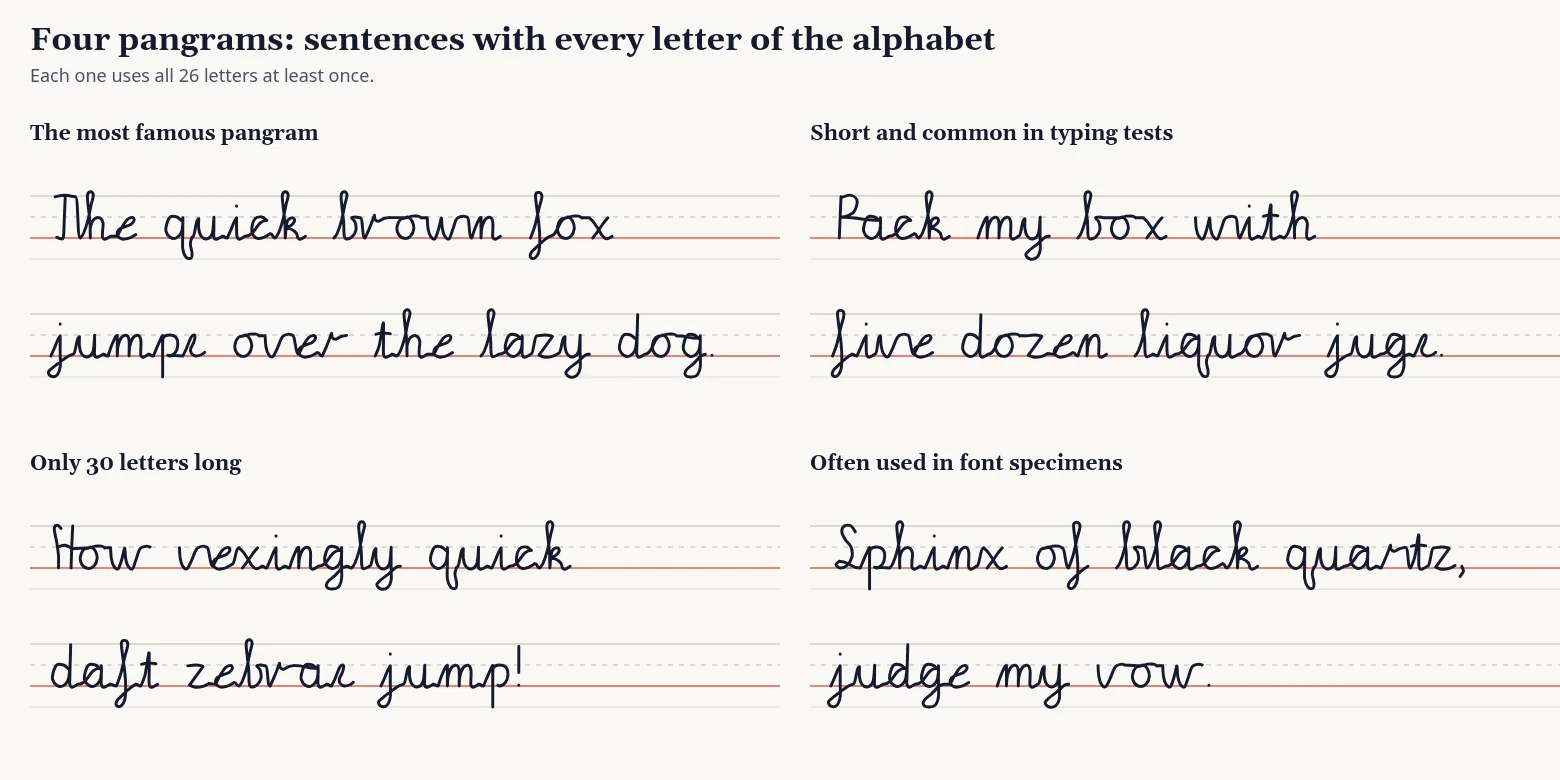
Pangrams are useful for a quick self-check: write one at normal speed, then look for the letters that went wrong. They are less useful for beginners, because they are long and the vocabulary is odd. Use the focused sentences above first, and pangrams once you can write a line without stopping.
One practical note: our cursive translator previews the first 28 characters of what you type, so for a long pangram, type one half at a time, as the examples above are split.
Spacing between words
A common rule of thumb is to leave a gap about the width of a lowercase o between words. It is a guide, not a law: some programs teach a slightly wider gap for younger children. The point is consistency, because uneven gaps are the quickest way for a line of writing to look untidy.
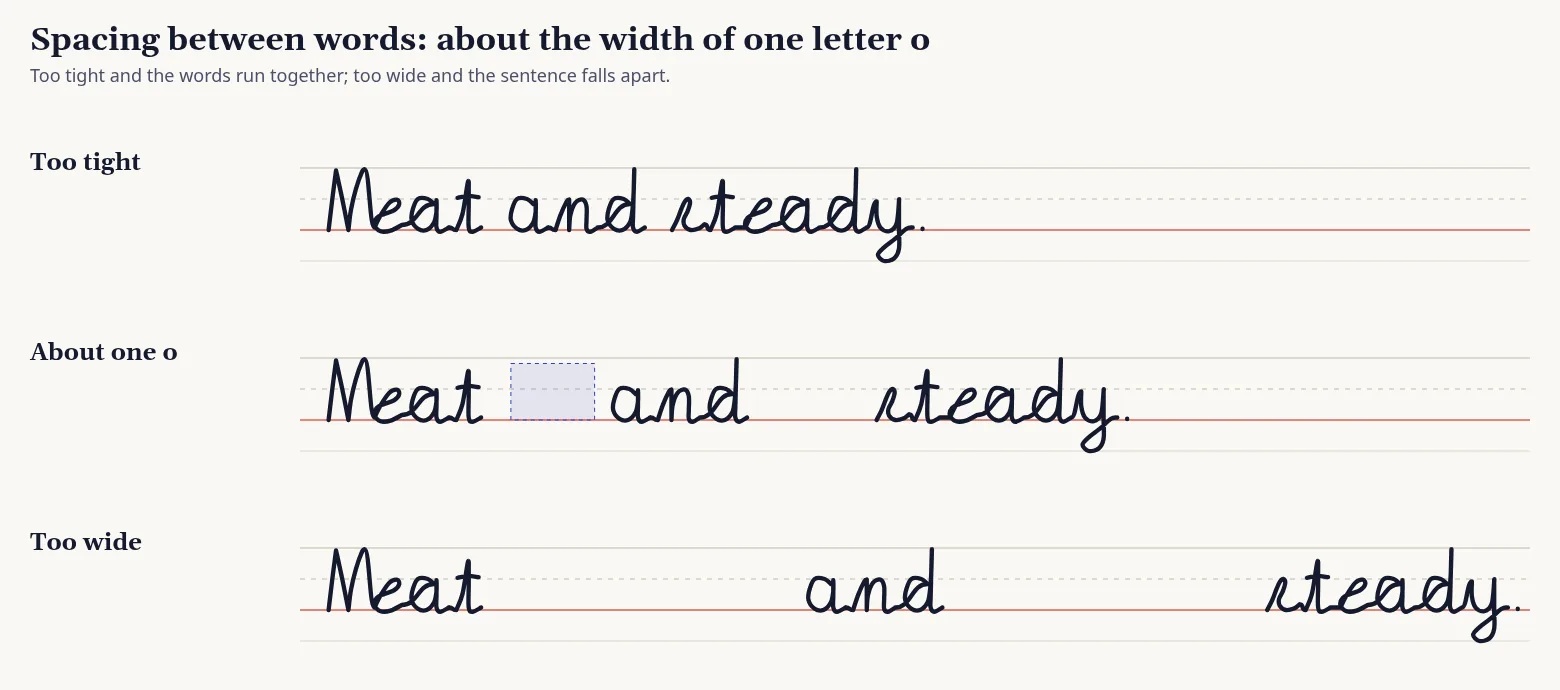
Two habits help. First, lift the pen and place it, rather than drifting along the baseline. Second, look at the gaps, not the words: if the white spaces between words are about the same, the line will look steady even if individual letters are imperfect.
Capitals, punctuation and the finishing touches
- Capitals: start every sentence with a capital, and capitalize names, days and months. In many programs the capital is not joined to the next letter, so lift the pen after it. Follow whatever your school model shows.
- Full stops and commas: add them as soon as you finish the word, with the pen lifted. Do not stop in the middle of the word for them.
- Dotting i and crossing t: wait until the word is complete, then go back and add all the dots and crossbars in one pass from left to right. This keeps the flow of the word unbroken.
- Apostrophes and question marks: make the apostrophe a small slanted tick at the top line, in the same slant as the letters.
- Quotation marks: use two matching ticks and keep them small, so they do not compete with tall letters.
For capitals specifically, the cursive alphabet lists each uppercase letter with its stroke order.
The three-pass method
Copying a sentence once and moving on teaches very little. This method takes about ten minutes and makes the practice count.
- Trace. Use the grey sentence in the PDF below, or write over a sentence you have printed. Concentrate on the movement and the joins.
- Copy. Write the sentence on the empty line under it, with the model in view. Check spacing as you go.
- Recall. Cover the model and write the sentence from memory on a fresh line of lined paper. Then compare the two lines: which words are the most different from your model?
Repeat with the word that went worst. Short, specific corrections beat long, vague practice sessions.
A two-week sentence plan
| Days | Focus | Sentences to write |
|---|---|---|
| 1 to 3 | Baseline joins and spacing | Mum made a mild mint tea. · The sun is up. · We like warm rain. |
| 4 to 6 | High joins | Brown owls wove over rivers. · I can write. |
| 7 to 9 | Tall letters and descenders | Little kids hold tall kites. · Happy puppies jump and play. |
| 10 to 12 | Capitals and punctuation | On Monday, Tom met Sara. · Dear Grandma, · See you on Friday. |
| 13 to 14 | Pangram self-check | The quick brown fox / jumps over the lazy dog. |
Ten minutes a day is enough. If you are teaching a child, see how to teach kids cursive for age-appropriate pacing, and if you are an adult returning to the skill, cursive for adults has a gentler schedule.
Free printable: cursive sentences
The PDF has three pages on US Letter paper. Page one has six short sentences, page two has seven everyday sentences such as thank-you lines and greetings, and page three has the four pangrams from this page, split into two lines each. Every sentence appears in grey to trace, with an empty line under it to copy it. Print at 100 percent so the lines keep their intended size.
The older words and sentences sheet is a two-page mix of words and one sentence; this set is all sentences. If you want blank paper instead, see the lined paper page, and the worksheets hub lists everything else.
Writing your own sentences
Once the practice sentences feel easy, switch to material that means something to you. A line of a poem, a short quote, a recipe step, a letter to a friend: anything you would honestly write by hand. If you want ideas for meaningful words, the pages for love, family and thank you are a good starting point, and if you want to preview how a new sentence will look, paste it into the cursive generator.
Frequently asked questions
What is a good sentence to practice cursive?
A short one that suits the skill you are working on, for example a sentence full of baseline joins for beginners, one with many b, o, r, v and w for high joins, or one with tall letters and descenders. The examples on this page are written for exactly that.
What is a pangram?
A pangram is a sentence that uses every letter of the alphabet at least once. The quick brown fox jumps over the lazy dog is the best-known one. They are useful for checking all 26 letters in one line.
How much space should I leave between words in cursive?
A common guide is about the width of a lowercase o. Consistency matters more than the exact size, so look at whether the gaps between words are about the same.
When should I dot the i and cross the t in cursive?
Finish the whole word first, then go back and add all the dots and crossbars in one pass. Doing it letter by letter breaks the rhythm of the word.
Do I join the capital letter to the next letter?
It depends on the program. In many school models the capital is written on its own and the pen is lifted before the next letter. Follow the model your teacher or your workbook shows.
How many times should I copy a sentence?
Three times, with a change each time: trace it, copy it with the model visible, and write it from memory. Repeating the same sentence ten times without checking tends to repeat the same mistakes.
Is there a free printable sentence worksheet?
Yes. The three-page PDF on this page contains short sentences, everyday sentences and four pangrams, each with a grey model and an empty line to copy it on.
Keep going
Cursive words
Single words to trace before you move on to sentences.
Cursive lined paper
Blank printable lines for writing your own.
Cursive joins
Fix the connections that spoil a line of writing.
Printable worksheets
All the free cursive PDFs in one place.
How we write and check pages: editorial policy.