Cursive for everyday writing
Days of the Week and Months in Cursive
Days and months are the words people write by hand most often: on calendars, in diaries, on cards, at the top of a school page and in the date on a letter. This page shows all seven days and all twelve months in cursive, explains the capital-letter and abbreviation rules, shows how to write a full date, lists which letters in each word join high or hang below the line, and ends with a free tracing PDF. If you are working on the numbers in the date, pair it with the cursive numbers 1 to 100 chart.
By Salah eddine · Last updated October 29, 2026 · Editorial policy
The one rule that matters: always start with a capital
In English, the names of days and months are proper nouns, so each one starts with a capital letter, in print and in cursive: Monday, October, Saturday, March. That is the one rule to remember. Seasons are different: spring, summer, autumn (or fall) and winter are lowercase unless they start a sentence.
This is not true in every language. Spanish, French, Italian and Portuguese write days and months in lowercase (lunes, janvier), while German, like English, capitalizes them. If you write in several languages, the habit of capitalizing is the one most likely to follow you into the wrong language.
The capitals are also the hardest letters in these words. Ten different capitals are needed to write all of them: M, T, W, F, S, J, A, O, N and D. Capital shapes differ more between handwriting programs than lowercase shapes do, so if you are learning for school, copy the capitals from the model your teacher uses. If you want to see ours, the cursive capital letters table lists the whole set.
The seven days of the week in cursive
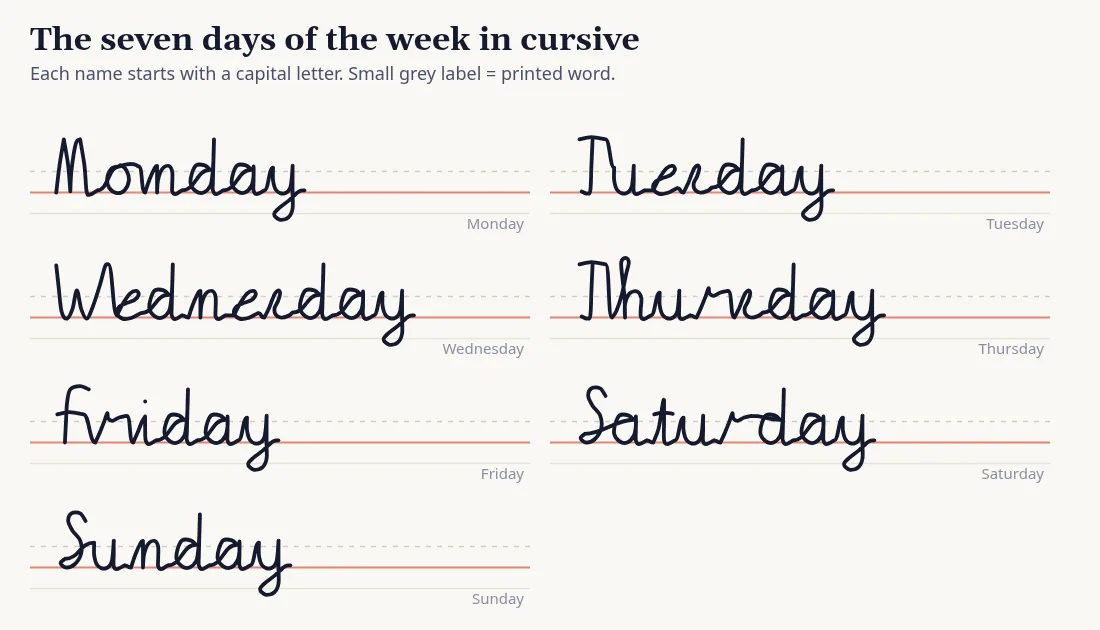
All seven days end in the same three letters, -day, so practicing the ending once pays off seven times. The d is a tall letter: it begins with an a-shaped oval and then rises to the top line. After the d, the a joins at the baseline, and the y finishes with a descender.
The word that causes most trouble is Wednesday. It has nine letters, a capital W that is wide, and a d in the middle that is silent when you say the word but must still be written. Slow down on the first half, Wed, and then the rest of the word is the same rhythm as the other days.
Here is what each word asks of your pen. "High joins" are the letters from b, o, r, v, w, which exit at the middle line and swing into the next letter instead of dropping to the baseline. The cursive joins page explains why. The capital letter is listed separately and is not counted in these columns.
| Word | Capital | High joins | Tall letters | Descenders |
|---|---|---|---|---|
| Monday | M | on | d | y |
| Tuesday | T | none | d | y |
| Wednesday | W | none | d | y |
| Thursday | T | rs | d, h | y |
| Friday | F | ri | d | f, y |
| Saturday | S | rd | d, t | y |
| Sunday | S | none | d | y |
Notice Saturday, where an r is followed by a d: the r exits high and the d begins low, so that join is the place to slow down. Thursday has a similar high join from the r into the s.
The twelve months of the year in cursive
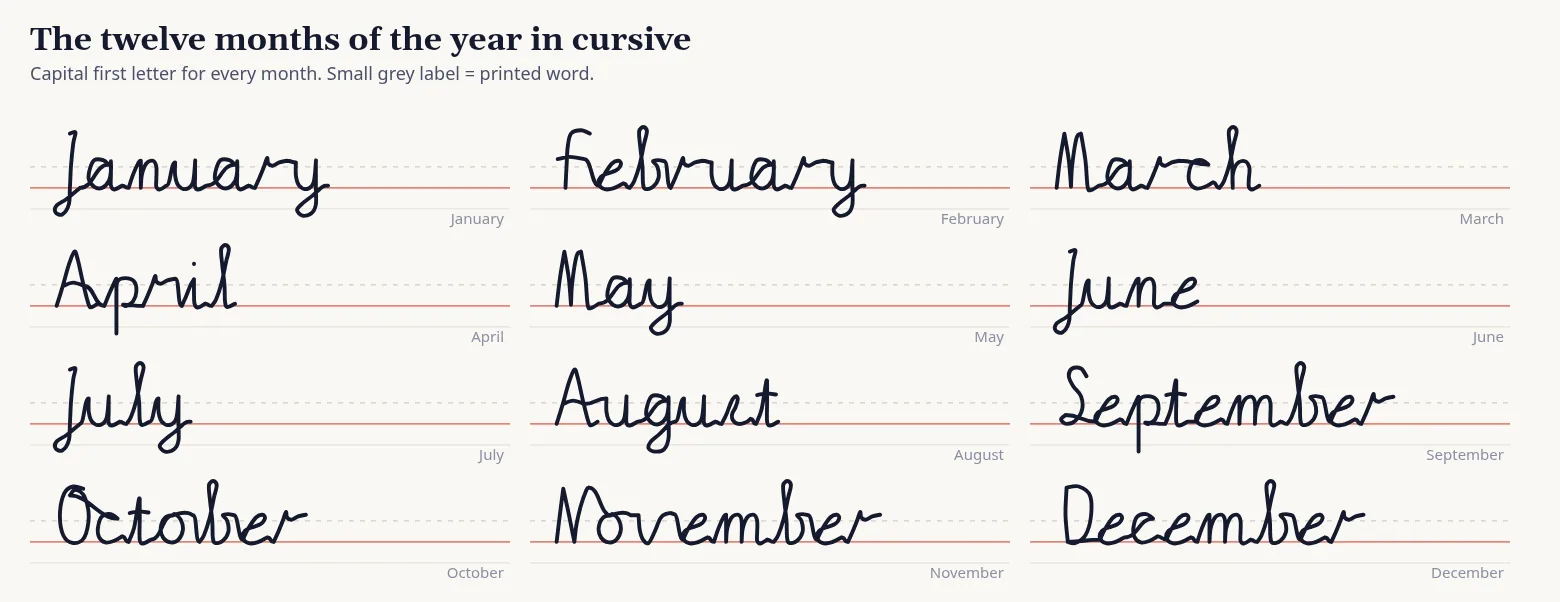
Months vary much more in length and shape than days. May and June are short, September and November have nine letters. Four months, September, November and December, share the ending -ember, and October ends in -ber. Practice those endings as units.
| Word | Capital | High joins | Tall letters | Descenders |
|---|---|---|---|---|
| January | J | ry | none | j, y |
| February | F | br, ru, ry | b | f, y |
| March | M | rc | h | none |
| April | A | ri | l | p |
| May | M | none | none | y |
| June | J | none | none | j |
| July | J | none | l | j, y |
| August | A | none | t | g |
| September | S | be | b, t | p |
| October | O | ob, be | b, t | none |
| November | N | ov, ve, be | b | none |
| December | D | be | b | none |
Two things to notice in the table. First, February has an r in the middle that people often skip in speech and in writing: say it as Feb-ru-ary when practicing. Second, August and April begin with the same A, and the p in April and the g in August are your only descenders, so keep them clear of the line below.
Abbreviations for days and months
Abbreviations are handy for calendars and notes. Style guides disagree on details, so what follows are the common forms. If you are writing for a school, a publisher or an organization, use the style they ask for.
| Day | Common abbreviations | Month | Common abbreviations |
|---|---|---|---|
| Monday | Mon. | January | Jan. |
| Tuesday | Tue., Tues. | February | Feb. |
| Wednesday | Wed. | March | Mar. |
| Thursday | Thu., Thur., Thurs. | April | Apr. |
| Friday | Fri. | May | May (not abbreviated) |
| Saturday | Sat. | June | Jun. (often written in full) |
| Sunday | Sun. | July | Jul. (often written in full) |
| August | Aug. | ||
| September | Sep., Sept. | ||
| October | Oct. | ||
| November | Nov. | ||
| December | Dec. |
In cursive, an abbreviation keeps its capital and ends with a full stop, which you add last, after lifting the pen. Do not dot the full stop while the pen is still travelling, or the next letter will start from the wrong place.
Writing a full date in cursive
A date combines a month word, numbers and punctuation. There are three layouts you will meet:
- US style: October 29, 2026. Month, day, comma, year. The comma is part of the date.
- UK and most of Europe: 29 October 2026. Day, month, year, usually with no comma.
- All-number dates: 10/29/2026 in the US, 29/10/2026 elsewhere. These are ambiguous for days from 1 to 12: 03/04/2026 is 4 March in one country and 3 April in another. When it matters, write the month as a word.
Ordinal endings, the small st, nd, rd, th, follow a pattern: 1st, 2nd, 3rd, 4th, and then th until 21st, 22nd, 23rd. The exceptions are 11th, 12th and 13th, which all take th. In cursive the ending is usually written smaller and slightly raised, and it should not touch the digit.
For the digits in the date, see the cursive numbers page. Write them separately, not joined, and leave a clear space between the day and the year.
Where the names come from, and why that helps spelling
Knowing the origin of a word is a useful memory aid for the letters that do not sound like they look. These are the well-established ones:
- Sunday and Monday come from the Sun and the Moon.
- Tuesday, Wednesday, Thursday and Friday are named after Germanic gods, Tiw, Woden (Odin), Thor and Frigg in the usual account. That is why Wednesday keeps the d from Woden.
- Saturday is named after the Roman god Saturn.
- January is traditionally linked to Janus, March to Mars, July to Julius Caesar and August to Augustus.
- September, October, November and December come from the Latin numbers seven, eight, nine and ten, from the time when the Roman year began in March. That is why Oct- looks like octopus and Dec- like decade.
The origins of some other months, such as April and June, are debated, so this page does not take a position on them.
Practice plan: one week, five minutes a day
- Day 1: trace the ending -day ten times on a lined sheet, then write Monday and Tuesday.
- Day 2: write Wednesday, Thursday and Friday twice each. Focus on the W and the silent d.
- Day 3: write Saturday and Sunday, then the full week in order.
- Day 4: write January to June once each. Keep the capitals the same height as the tall letters.
- Day 5: write July to December, then your birthday as a full date.
After the first week, add a real use: write the date at the top of every page you handwrite. It is the easiest way to keep the habit going.
Free printable: cursive days and months
The PDF has three pages on US Letter paper: one for the seven days, one for January to June and one for July to December. Each word appears in grey to trace, with a second empty line under it to write it on your own. Print at 100 percent so that the ruled lines keep their size.
Want the rest of the set? The worksheets hub lists every free sheet, and cursive words has more everyday words to trace.
Frequently asked questions
Do days and months have capital letters in cursive?
Yes. In English, days of the week and months of the year are proper nouns, so each starts with a capital letter in print and in cursive. Seasons are lowercase.
How do you write Wednesday in cursive?
Write a capital W, then e, d, n, e, s, d, a, y. Slow down at the d, a tall letter that is silent in speech but must be written, and keep the first part, Wed, at the same height as the rest of the word.
What is the abbreviation for each month?
Common forms are Jan., Feb., Mar., Apr., Jun., Jul., Aug., Sep. or Sept., Oct., Nov. and Dec. May is not abbreviated. Style guides differ, so follow the one your school or publisher asks for.
How do you write the date in cursive?
In the US, write the month as a word, then the day, a comma and the year: October 29, 2026. In the UK and much of Europe the usual order is day, month, year: 29 October 2026.
Which months are hardest to write in cursive?
September, November and December are long and share the ending -ember, so many people struggle with the spacing. February is difficult because of the r. Practice the endings as units.
Are cursive days and months the same in other languages?
No. Spanish, French, Italian and Portuguese use lowercase for days and months, while German capitalizes them like English. The letters themselves are the same Latin alphabet.
Is there a printable worksheet?
Yes. The free three-page PDF on this page has all seven days and twelve months to trace and copy. It prints on US Letter paper.
Keep going
Cursive numbers 1 to 100
The digits and number words for the date.
Cursive lined paper
Print blank lines for your own dates and notes.
Cursive words
More everyday words to trace and copy.
Printable worksheets
All the free cursive PDFs in one place.
How we write and check pages: editorial policy.