Number chart
Cursive Numbers 1 to 100
This page gives you every number from 1 to 100 in cursive handwriting, two clean charts you can read at a glance, the number words from one to one hundred, notes on the digits that most often go wrong, and a free printable PDF for tracing. If you only need the single digits 0 to 9 with stroke-by-stroke guidance, start with the cursive numbers page. This page picks up where that one stops.
By Salah eddine · Last updated October 29, 2026 · Editorial policy
Is there such a thing as a cursive number?
Honestly, mostly not. In the style taught in most English-speaking schools, the digits 0 to 9 are written with essentially the same shapes in print and in cursive. What changes in cursive is the writing around the numbers: dates, number words and the letters next to them. Some handwriting traditions add small variations, such as a flag on the 1 or a bar through the 7, and individual teachers vary, so if you are practising for a class, follow your teacher's model.
That is why these charts show clean, continuous-stroke digits, drawn with the same engine that produces the letters on this site. The digits are written one at a time and are not joined to each other, which is how almost everyone writes them. The difference you will notice compared with print is mainly rhythm: a steady slant, even height and even spacing.
Cursive numbers 1 to 50
Each cell has the printed number in small grey type, so you can check which number you are looking at. The dashed line is the middle of the writing space and the red line is the baseline. All digits sit on the baseline and are the same height as the tall letters, which is why they look larger than lowercase letters if you write them in the same line.
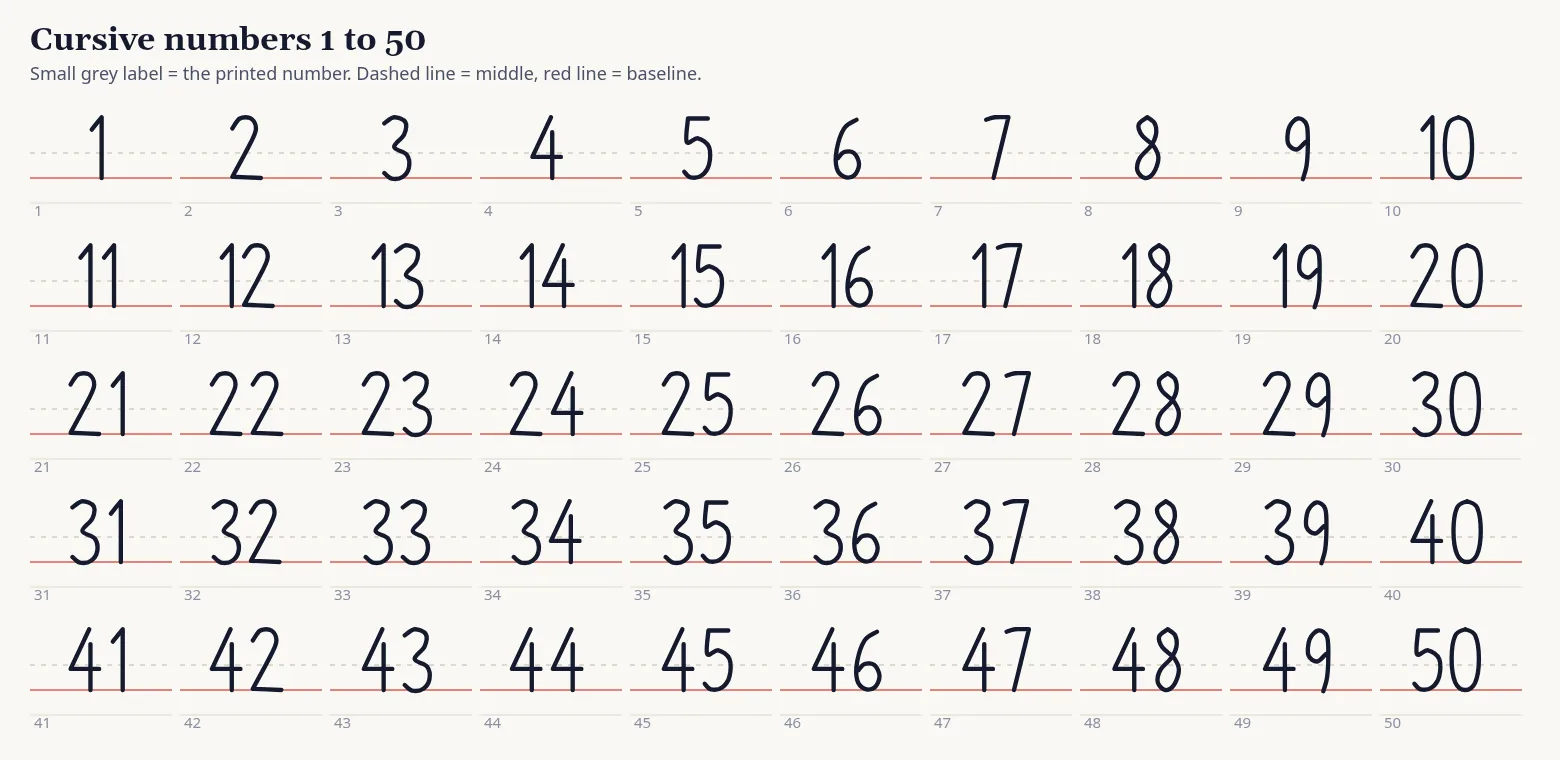
Notice how consistent the height is. In the teens and twenties, the first digit is a 1 or 2 and the second digit changes, so the main skill is keeping the width of the pair steady. Practice each decade as a row.
Cursive numbers 51 to 100
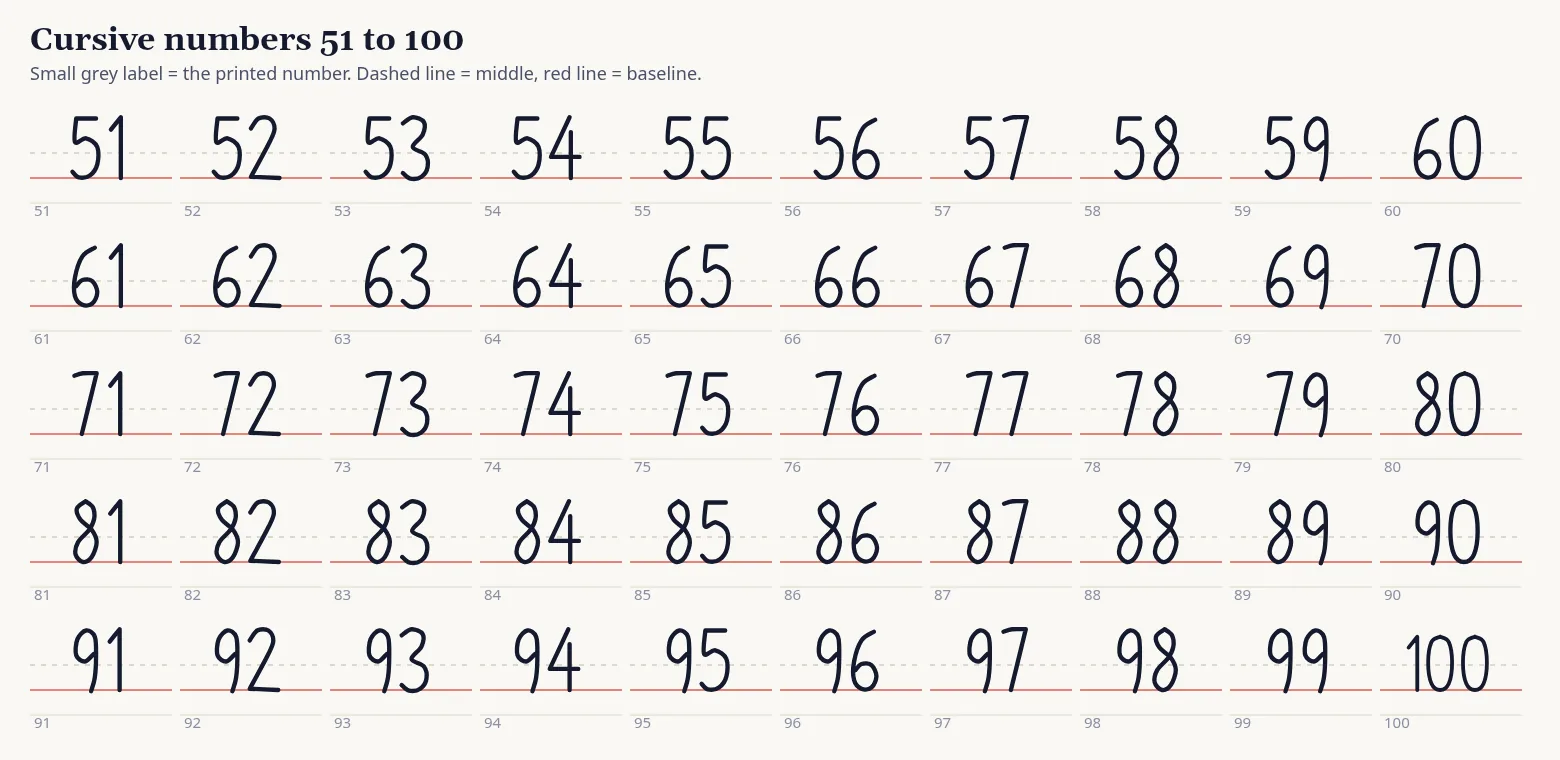
From 51 onwards the digits are all ones you have already met, but the pairs that include 5, 6, 8 and 9 are easier to confuse when written quickly. Slow down on 56, 65, 68, 86, 69 and 96. These are the numbers where a tidy 6 or 9 matters most.
The last entry, 100, is the only three-digit number on the page. Write the 1 first, then two 0s of equal size and with a small space between them. If you join the zeros into a figure of eight, the result reads as 1 and an 8.
Digits that cause most mistakes
| Digit | Common mistake | How to fix it |
|---|---|---|
| 1 | Looks like a small l or a 7 when the flag is too long | Keep the flag short; make the stem straight and slanted |
| 2 | The bottom curve is missing or the base is round | Finish with a flat base stroke so it cannot be read as a Z or a 3 |
| 4 | Open top written like a u, or closed top that looks like a 9 | Choose one style and stay with it; make the crossbar clear |
| 5 | Top bar drawn first and detached, or belly too small | Draw the belly in one stroke, then add the top bar at the end |
| 6 and 9 | Look the same upside down | Give the 6 a long rising stroke and the 9 a clear straight tail |
| 7 | Confused with 1 | Add a small crossbar through the middle; many people do this to avoid confusion |
| 0 | Open at the top so it reads as a 6 | Close it, and keep it as tall as the other digits |
The reason digits get misread is that, unlike letters, they have no surrounding word to give a clue. The number 1 100 or 1 000 could be anything if the digits are ambiguous. That is why dates, phone numbers and amounts on forms are the most important place to write clearly.
Number words in cursive
Writing out numbers is where cursive actually changes things. Twenty-three is a word, and joins like any other. The figure shows every number word you will need up to one hundred: the units, the teens and the tens.
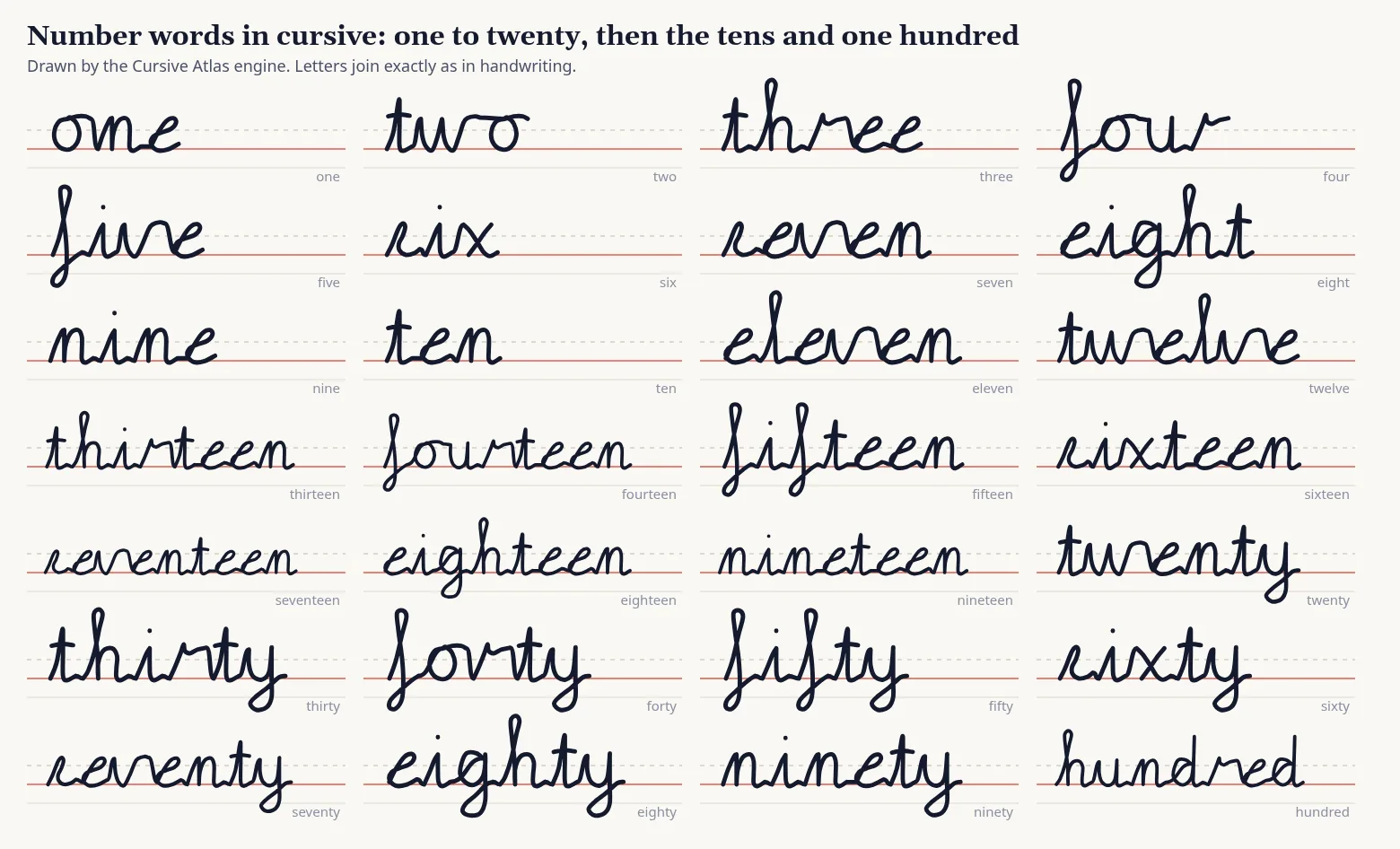
- Hyphens: two-digit numbers from 21 to 99 are written with a hyphen, as in forty-two or ninety-nine. Write the hyphen as a short horizontal line at mid-height.
- Spelling: forty has no u (unlike four and fourteen). Eighteen and eighty keep the silent gh before the t. Ninety keeps the e that nine loses in ninth.
- Capital letters: number words are lowercase unless they begin a sentence.
- Teens vs tens: thirteen/thirty, fourteen/forty, fifteen/fifty are different words with similar shapes. In cursive the difference is mostly the ending teen versus ty.
When words get longer, such as seventeen and seventy-seven, watch your spacing. The v and e need a clear high join, and the double e needs two clean loops. If you are unsure, the cursive joins page explains the exits of v and e.
When writing numbers in words actually matters
Handwriting numbers in words is common on cheques, formal letters, greeting cards and school exercises. On a cheque, banks ask for the amount in both digits and words so that a single misread digit does not change the value. If you are filling in a legal or bank document, follow the instructions printed on the form. For notes and diaries, digits are usually fine.
Dates are a special case. Writing "October 29, 2026" in cursive uses the month name and digits for the day and year. Our days and months page covers the month names, abbreviations and capitals.
Free printable: cursive numbers 1 to 100
The PDF below has four pages: two tracing charts (1–50 and 51–100) with grey digits to trace and a ruled line to copy them on, and two pages of number words from one to one hundred with a trace line and an empty line. It prints on US Letter paper at 100 percent. For the single digits only, use the existing 0 to 9 worksheet.
Print at "actual size" or 100 percent. If your printer is set to "fit to page", the ruled lines may shrink and the tracing guides will not match.
Can I copy and paste cursive numbers?
This is a common question, and the answer is no, not in a script style. Unicode includes bold, double-struck, sans-serif and monospace digits, but there is no script or cursive set of digits, so cursive text generators leave the numbers as they are. If you see numbers that look cursive in a social media bio, they are usually ordinary digits in a script-like font, or an image. For a decorative number, use an image like the ones on this page, or the cursive translator to produce stroke-based digits.
A ten-minute practice routine
- Warm up (2 min): draw rows of ovals and downstrokes at a steady slant.
- Single digits (2 min): write 0 to 9 across a line, twice.
- Decades (4 min): pick one row of the chart, such as 31 to 40, and write it three times.
- Words (2 min): write five number words with the tens, such as thirty, forty, fifty, sixty and seventy.
Do this on alternate days for two weeks and the shapes become automatic. If your numbers keep slanting differently from your letters, work through the letter slant drills at the same time.
Frequently asked questions
Are cursive numbers different from regular numbers?
For most school programs, no: digits are written with the same shapes in print and cursive. What changes in cursive is the way surrounding letters and number words are written. Some teachers or countries add small variations such as a flag on the 1 or a bar through the 7.
How do you write 100 in cursive?
Write a 1, then two 0s at the same height, leaving a small gap between each one. The digits are not joined to each other. To write it as a word, write "one hundred", which is two words and no hyphen.
How do you write 21 to 99 in words?
Use the tens word, a hyphen and the units word, for example twenty-one, forty-two or ninety-nine. 100 in words is "one hundred".
Can I copy and paste cursive numbers into a bio or message?
Unicode has no cursive or script digits, so copy and paste generators cannot convert numbers. They remain ordinary digits. You can insert an image, or use a font that has script-style numerals in a design tool.
Why does my 1 look like a 7?
The flag on the 1 is too long, or the 7 has no crossbar. Shorten the flag on the 1 and add a small crossbar to the 7. That is a common convention for avoiding confusion.
Is there a printable cursive 1 to 100 chart?
Yes. The free PDF on this page contains two tracing charts and number words. It is meant for home and classroom use and prints on US Letter paper.
Should I join the digits in a number?
No. Digits are written one at a time with a small gap. Joining digits, as in a signature, makes numbers hard to read.
Keep going
Cursive numbers 0 to 9
Stroke-by-stroke digits with a tracing pad.
Printable worksheets
All the free cursive PDFs in one place.
Days and months
Write dates in cursive with the right capitals.
Cursive joins
Make number words connect smoothly.
How we write and check pages: editorial policy.