Name · copy · trace
Charlotte in Cursive
Charlotte in cursive has nine letters and two high joins: the r leaves at the middle line into the l, and the o leaves at the middle line into the first t. Copy it, trace it, or print the practice sheet.
By Salah eddine · Last updated October 29, 2026 · Editorial policy
Charlotte in cursive at a glance
Before you start, here is what is in the name. These facts come from the letters themselves, using the same school-style cursive model as the drawing above.
Charlotte in cursive fonts
Pick a style and ink color, then download a transparent PNG.
Formal script
Invitations and certificates
CharlotteCasual script
Friendly, everyday lettering
CharlotteElegant script
Light, flowing, upscale
CharlotteSignature
Thin, signature-style line
CharlotteSchool cursive
Closest to classroom handwriting
CharlotteClassic engraved
Traditional, wedding stationery
Charlotte
Copy and paste
Cursive-style text for captions and messages. These are special characters, not a font, so appearance varies by app.
Script
𝒞𝒽𝒶𝓇𝓁ℴ𝓉𝓉ℯ
Bold script
𝓒𝓱𝓪𝓻𝓵𝓸𝓽𝓽𝓮
Old English (blackletter)
ℭ𝔥𝔞𝔯𝔩𝔬𝔱𝔱𝔢
Bold blackletter
𝕮𝖍𝖆𝖗𝖑𝖔𝖙𝖙𝖊
Trace Charlotte in cursive
Follow the dotted pen path with a finger, stylus or mouse. Then print a practice sheet to write it on paper.
Trace over the dotted guide with your finger, mouse or stylus.
Letter by letter: how Charlotte is built
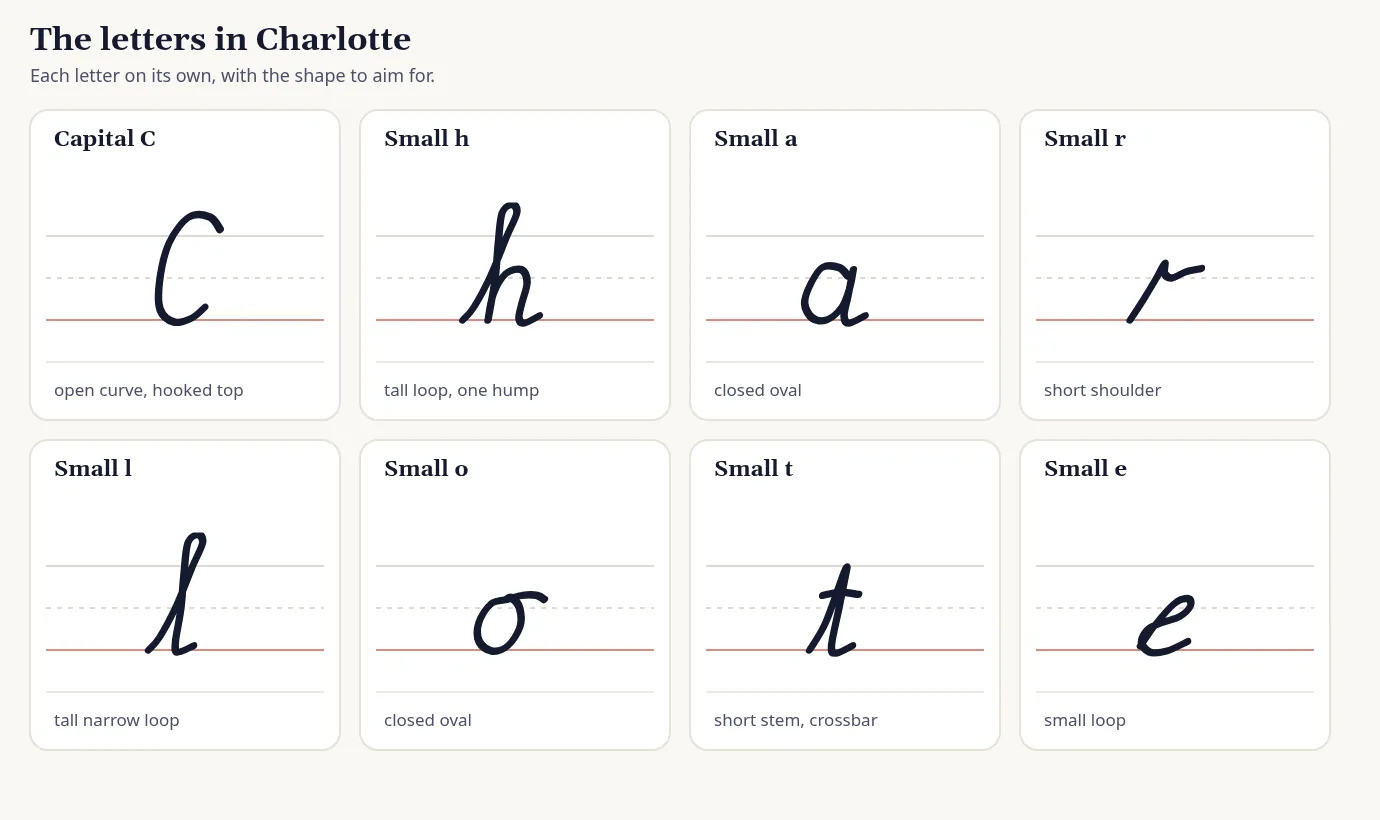
Charlotte is written with 9 letters: C, h, a, r, l, o, t, t, e. The picture shows each different letter on its own, with the shape to aim for. The table below it lists every join in order, so you can see where the pen has to travel between letters.
The joins, one by one
A join is the connecting stroke between two letters. Where it starts depends on the letter you just finished, and where it ends depends on the letter coming next. This table follows the school-style model used for the drawings on this site; some programs use slightly different joins.
| Pair | Leaves at | Next letter starts at | What the pen does |
|---|---|---|---|
| C → h | The baseline | The baseline | A short, nearly flat link |
| h → a | The baseline | The middle line | Rises to the middle line |
| a → r | The baseline | The baseline | A short, nearly flat link |
| r → l | The middle line | The baseline | Drops down to the baseline |
| l → o | The baseline | The middle line | Rises to the middle line |
| o → t | The middle line | The baseline | Drops down to the baseline |
| t → t | The baseline | The baseline | A short, nearly flat link |
| t → e | The baseline | The baseline | A short, nearly flat link |
| e (last letter) | The baseline | – | Finish with a short flick, then lift the pen |
The capital C
The capital C is a big open curve. Start a little below the top line, swing left and down in one round stroke, and finish near the baseline with a small flick that leads into the h. Do not close the C into a circle; the opening is what makes it a C. Make it about twice the height of the small letters so the name has a clear start.
r into l, then o into t: the two high joins
Most letters leave the pen on the baseline, but r and o leave at the middle line. In Charlotte that happens twice. After the r the pen has to travel down to the baseline to start the tall l, and after the o it has to dive to the baseline for the t. The joins are short, so the common failure is to lift the pen and start the next letter fresh, which breaks the line. Practise the pairs rl and ot on their own first. The joins guide explains why these letters behave differently.
One crossbar for two t letters
Charlotte has a double t. Write both stems, finish the whole name, then cross them with one straight stroke that runs through both stems at the same height. This is faster, neater and matches how most people write the name. If you cross each t separately the bars rarely line up. Keep the crossbar about two thirds up the stem and slightly longer than the pair.
How to write Charlotte in cursive by hand
- 1Write the capital C as one open curve and finish it on the baseline with a short flick.
- 2Join into the h: climb to the top line, come down the stem and make one hump that ends on the baseline.
- 3Write a round a, then go straight into the r with a small pointed shoulder that exits at the middle line.
- 4Drop from the r into a tall narrow l, then climb up to the middle line to write a closed o.
- 5Exit the o at the middle line and dive down into the two t stems, then the final e. Cross both t stems with one stroke.
Common mistakes when writing Charlotte in cursive
These are the slips that show up most often with this name. Check your own lines against the list before you move on.
- Opening the a. Close its oval or it will read as a u.
- Cutting the r short so it looks like a v. The r needs a pointed shoulder and a high exit.
- Crossing the t stems at two different heights. One stroke across both keeps them even.
- Leaving a gap between o and t. The join is short but it must connect.
How to practice Charlotte
Break the name into three chunks: Cha, rlo, tte. Write each chunk five times on its own line, then join all three. The rlo chunk carries both high joins, so give it extra rows. Practise at a size where the l loop is comfortable, then shrink. A name this long is also a good test of spacing: the gap between the letters should stay the same from C to e. The common mistakes guide has a spacing check.
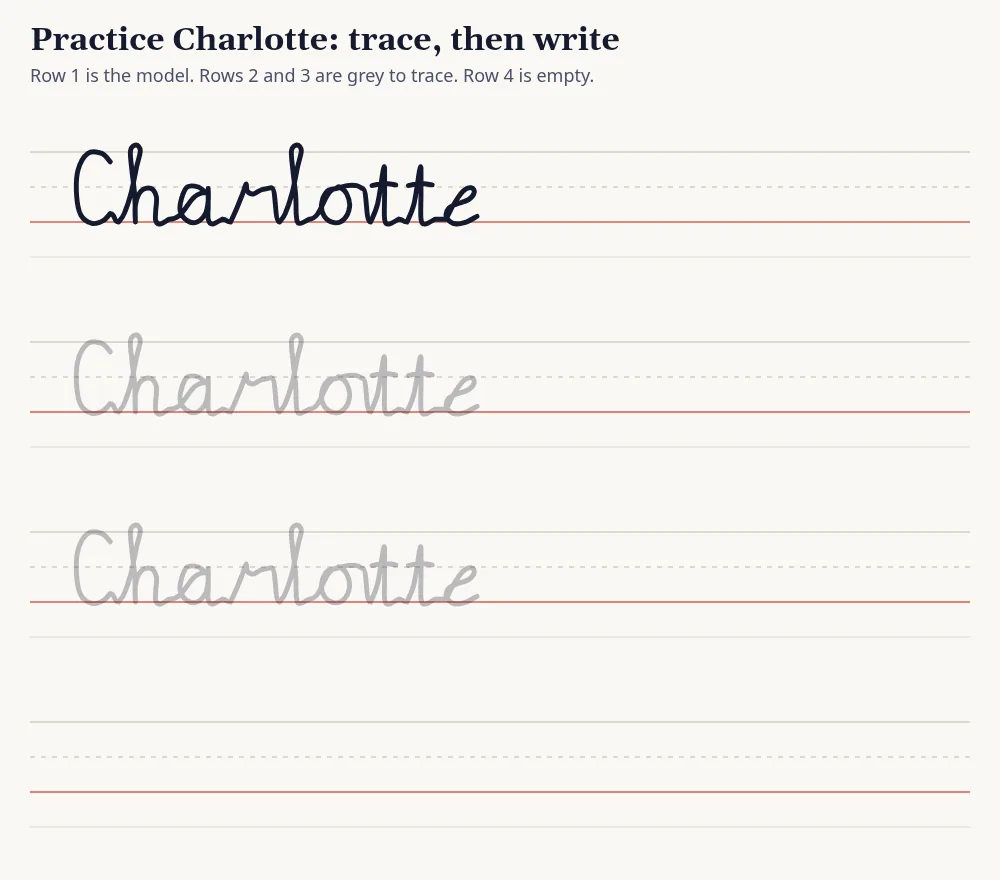
The one-page PDF has the name once in black as a model, two grey rows to trace, a blank ruled row and the short forms of Charlotte to trace underneath. It prints on Letter or A4. For another name or a full class set, use the worksheet generator, and for blank ruled paper see cursive lined paper.
Short forms of Charlotte in cursive
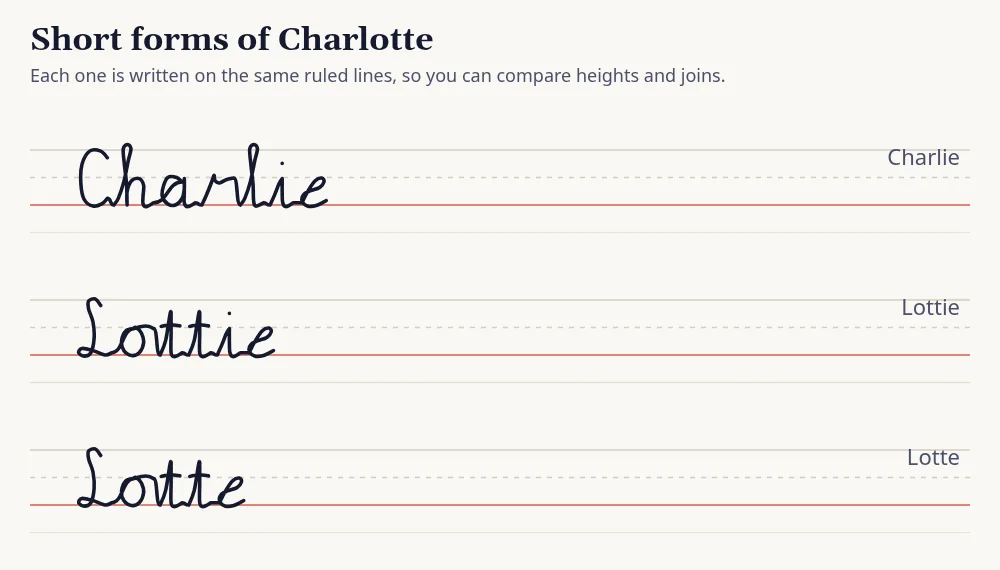
Charlie, Lottie and Lotte are the usual short forms. Charlie keeps the C and h and ends with the tall l, i and e, so it removes the double t. Lottie and Lotte start with a tall l and keep the double t, so they are useful if you only want to practise that part of the name. None of them has the r to l join.
Ways to use Charlotte in cursive
Long signature
Nine letters are a lot for a signature. Many people keep the capital C and the h in full, then let the rest flatten into a line.
Wedding and event stationery
Charlotte is a popular name for place cards and signs. A formal font with a decorative capital C works well.
Kids name labels
Because the name is long, give it a full line on a label and keep the letters at the same height.
Tattoo and jewelry
Two thin joins and a double t make this name delicate. Pick a medium weight and read the tattoo guide.
About the name Charlotte: meaning and origin
Charlotte is the French feminine form of Charles, a name from a Germanic word usually glossed as free man. It came into English from French, and it spread after Queen Charlotte, the wife of George III, whose name is honored in the city of Charlotte, North Carolina.
Charlotte Brontë wrote Jane Eyre, published in 1847, and Charlotte is also the name of the spider in E. B. White’s children’s book Charlotte’s Web (1952). The name is often shortened to Charlie or Lottie.
Questions about Charlotte in cursive
How do you write Charlotte in cursive?
Start with an open capital C, join into h and a, then write r, l, o, t, t and e. Cross both t stems with one stroke at the end.
Which joins are tricky in Charlotte?
The r to l and o to t joins. The r and o leave at the middle line, so the pen has to drop to the baseline for the next letter.
Do you cross both t letters separately?
You can, but a single stroke across both stems is faster and keeps them level. Do it after finishing the word.
How many times do you lift the pen in Charlotte?
Once, if you cross both t letters with a single stroke. There are no dots in the name.
Can I use Charlotte in cursive for a tattoo?
Yes. Check the thin r to l join and the double t at the final size. See the tattoo guide for size and weight advice.
Is there a printable Charlotte cursive worksheet?
Yes. The Charlotte practice sheet has the name to trace and blank lines. Use the worksheet generator for other names.
Keep going
Another name
Olivia in cursive
A capital O, a high v join and two dotted i shapes.
Another name
Chloe in cursive
Two tall loops and a high o-to-e join.
Letter lesson
Cursive C
Capital C and lowercase c, stroke by stroke.
Tool
Cursive signature
Turn any name into a signature style.
Guide
Cursive tattoo fonts
Size, line weight and design tips if the name is going on skin.
All names
Cursive names
See every name on the site.
How we write and check pages: editorial policy.