Name · copy · trace
William in Cursive
William in cursive starts with a wide capital W that exits at the top line, then runs i, l, l, i, a, m. Seven letters and two dots. Copy it, trace it, or print the practice sheet.
By Salah eddine · Last updated October 29, 2026 · Editorial policy
William in cursive at a glance
Before you start, here is what is in the name. These facts come from the letters themselves, using the same school-style cursive model as the drawing above.
William in cursive fonts
Pick a style and ink color, then download a transparent PNG.
Formal script
Invitations and certificates
WilliamCasual script
Friendly, everyday lettering
WilliamElegant script
Light, flowing, upscale
WilliamSignature
Thin, signature-style line
WilliamSchool cursive
Closest to classroom handwriting
WilliamClassic engraved
Traditional, wedding stationery
William
Copy and paste
Cursive-style text for captions and messages. These are special characters, not a font, so appearance varies by app.
Script
𝒲𝒾𝓁𝓁𝒾𝒶𝓂
Bold script
𝓦𝓲𝓵𝓵𝓲𝓪𝓶
Old English (blackletter)
𝔚𝔦𝔩𝔩𝔦𝔞𝔪
Bold blackletter
𝖂𝖎𝖑𝖑𝖎𝖆𝖒
Trace William in cursive
Follow the dotted pen path with a finger, stylus or mouse. Then print a practice sheet to write it on paper.
Trace over the dotted guide with your finger, mouse or stylus.
Letter by letter: how William is built
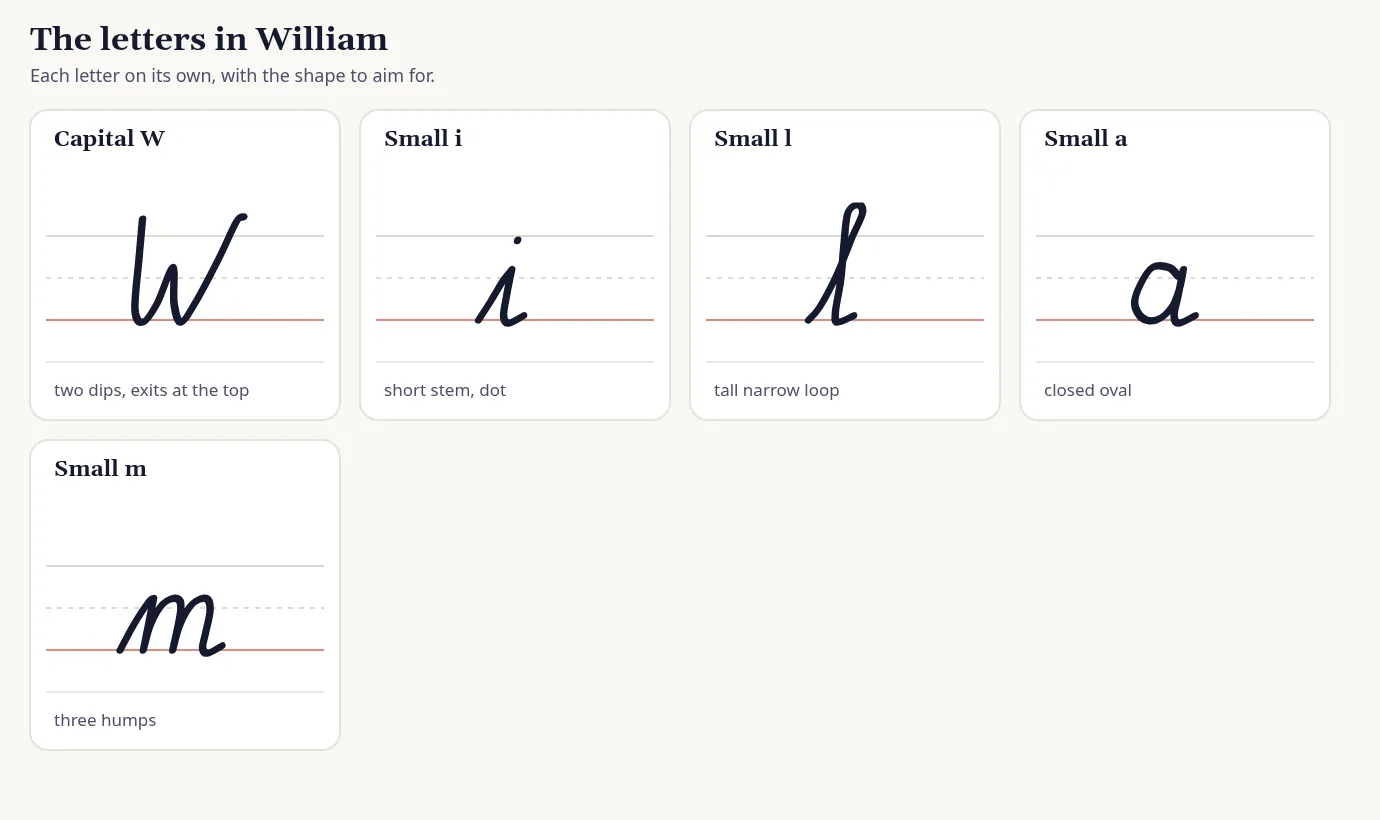
William is written with 7 letters: W, i, l, l, i, a, m. The picture shows each different letter on its own, with the shape to aim for. The table below it lists every join in order, so you can see where the pen has to travel between letters.
The joins, one by one
A join is the connecting stroke between two letters. Where it starts depends on the letter you just finished, and where it ends depends on the letter coming next. This table follows the school-style model used for the drawings on this site; some programs use slightly different joins.
| Pair | Leaves at | Next letter starts at | What the pen does |
|---|---|---|---|
| W → i | The top line | The baseline | Falls from the top line to the baseline |
| i → l | The baseline | The baseline | A short, nearly flat link |
| l → l | The baseline | The baseline | A short, nearly flat link |
| l → i | The baseline | The baseline | A short, nearly flat link |
| i → a | The baseline | The middle line | Rises to the middle line |
| a → m | The baseline | The baseline | A short, nearly flat link |
| m (last letter) | The baseline | – | Finish with a short flick, then lift the pen |
The capital W
The capital W is wide: two downstroke-and-upstroke pairs, finishing with a stroke that leaves from the top line. From there the pen slides down to the baseline to start the i. Keep the W about twice the height of the small letters and leave space after it.
i, l, l, i: four narrow letters
The middle of William is a run of four narrow letters. The i is short; the l is tall. Written quickly they blur into a row of uprights. Make the l loops clearly taller than the i, give the two l loops the same height, and keep the gaps even. Count: short, tall, tall, short. If you cannot see the pattern in your own handwriting, slow down.
Two dots, added at the end
There are two i letters, so two dots. Write the entire name first, then go back and place both dots directly above the stems, at the same height. Do not put them early; the pen would stop twice in the middle of the word. The final letters a and m are round and humped, so end with a clean m of three humps.
How to write William in cursive by hand
- 1Write the capital W as two down-and-up strokes, finishing with a stroke that rises to the top line.
- 2Drop to the baseline and write a short i.
- 3Join into two tall l loops of equal height.
- 4Write another short i, then climb to the middle line for a closed a.
- 5Finish with an m of three even humps, then add the two i dots.
Common mistakes when writing William in cursive
These are the slips that show up most often with this name. Check your own lines against the list before you move on.
- Making the W narrow and pointed like a print W.
- Uneven l loops: one reaching the top line, one falling short.
- Dots drifting to the right of the i stems.
- Writing a two-hump m at the end.
How to practice William
Write illi ten times first, since it contains the hardest rhythm. Then write iam ten times. Add the W last, on a separate line, because it is the widest letter. Finally write the whole name and add both dots. The common mistakes guide shows how to check spacing, which matters in a seven-letter name.
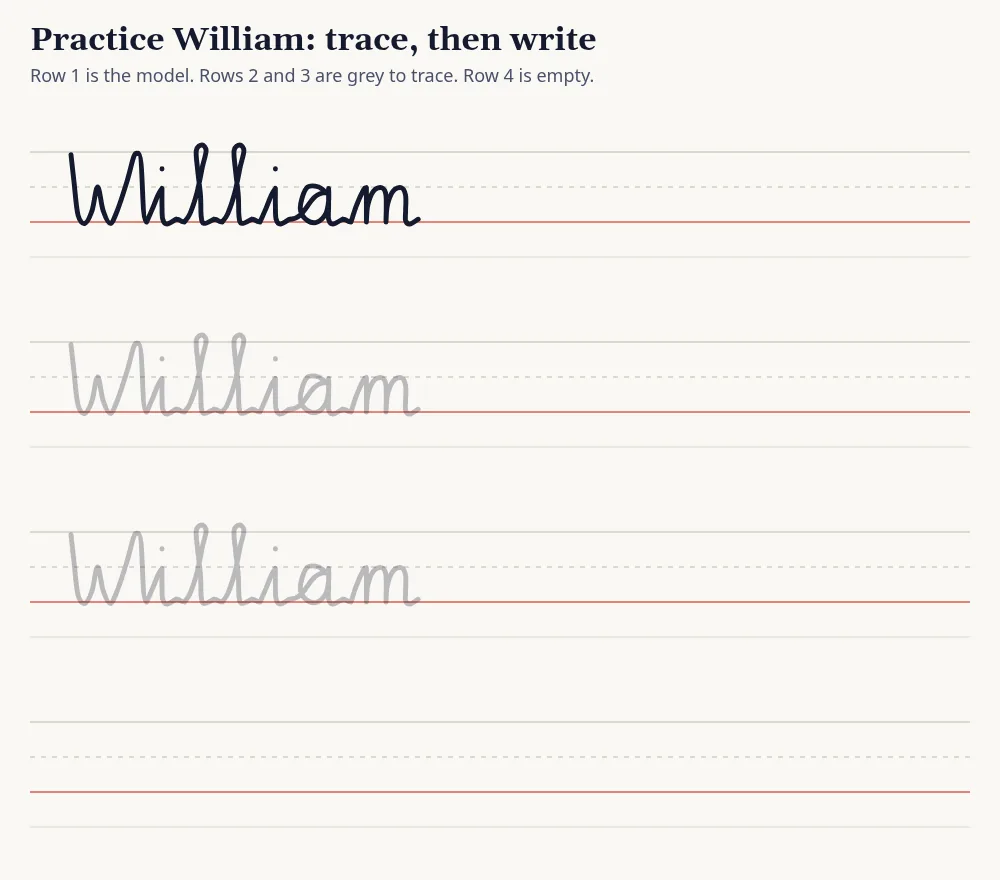
The one-page PDF has the name once in black as a model, two grey rows to trace, a blank ruled row and the short forms of William to trace underneath. It prints on Letter or A4. For another name or a full class set, use the worksheet generator, and for blank ruled paper see cursive lined paper.
Short forms of William in cursive
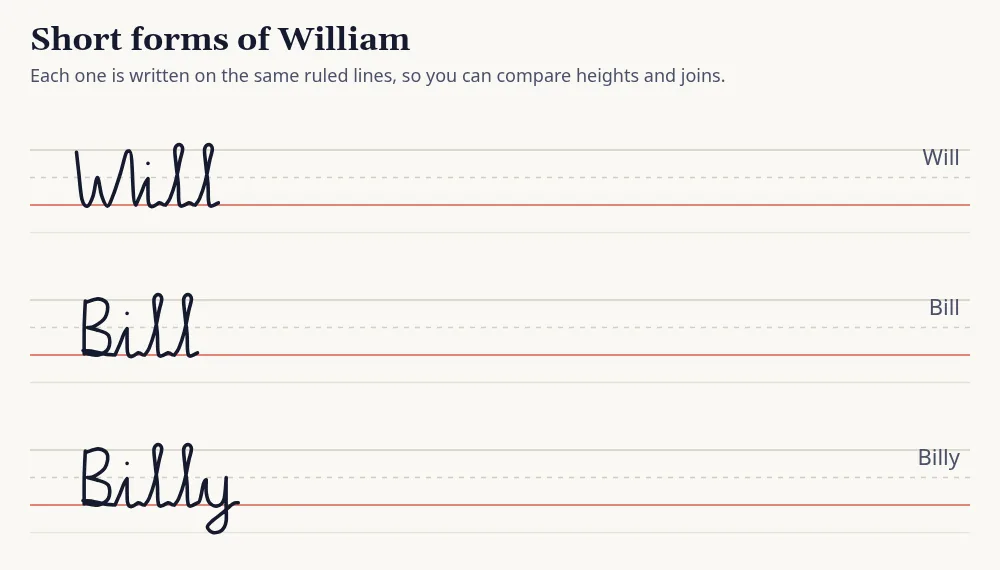
Will, Bill and Billy are the usual short forms. Will keeps the W and the narrow i, l, l run, which is the hardest part of the full name. Bill and Billy swap the W for a B. They are good practice pieces for a quick signature.
Ways to use William in cursive
Signature
William is often shortened to Will or Bill, but the full name makes a more formal signature. Keep the W large and let the letters after it flatten.
Certificates and formal cards
A formal font and a decorative W suit certificates.
Groomsmen gifts and keepsakes
The long name fits well on a wide item like a wallet or pen.
Tattoo
The narrow i-l-l-i run needs more space between letters at small size; see the tattoo guide.
About the name William: meaning and origin
William comes from a Germanic name, Wilhelm, built from elements usually glossed as will or desire and helmet or protection, giving the sense of resolute protector. It was carried to England by the Normans after 1066, when William the Conqueror became king, and it quickly became one of the most common English names.
Short forms include Will, Bill, Billy and Liam. The Irish name Liam is a short form of the Irish William, Uilliam, so the two names are related.
Questions about William in cursive
How do you write William in cursive?
Write a wide capital W, then i, l, l, i, a and m. Add both dots at the end.
How do you write a capital W in cursive?
Make two rounded dips and finish with a stroke that rises toward the top line before sliding down into the next letter.
Do you lift the pen in William in cursive?
Only for the two i dots. Every letter joins.
Is Liam a short form of William?
Yes. Liam is an Irish short form of Uilliam, the Irish version of William.
Can I use William in cursive for a tattoo?
Yes. Leave enough space in the i-l-l-i run so it does not turn into a row of lines. See the tattoo guide.
Is there a printable William cursive worksheet?
Yes. The William practice sheet has the name to trace and empty lines. Use the worksheet generator for other names.
Keep going
Another name
James in cursive
A capital J with loops above and below the line, then a, m, e, s.
Another name
Liam in cursive
A looped capital L joined into i, a and m, with one dot.
Letter lesson
Cursive W
Capital W and lowercase w, stroke by stroke.
Tool
Cursive signature
Turn any name into a signature style.
Guide
Cursive tattoo fonts
Size, line weight and design tips if the name is going on skin.
All names
Cursive names
See every name on the site.
How we write and check pages: editorial policy.