Name · copy · trace
Emily in Cursive
Emily in cursive is a looped capital E, an m with three humps, a short i and l, and a y whose tail drops below the line. Five letters, one dot, no crossbars. Copy it, trace it, or print the practice sheet.
By Salah eddine · Last updated October 29, 2026 · Editorial policy
Emily in cursive at a glance
Before you start, here is what is in the name. These facts come from the letters themselves, using the same school-style cursive model as the drawing above.
Emily in cursive fonts
Pick a style and ink color, then download a transparent PNG.
Formal script
Invitations and certificates
EmilyCasual script
Friendly, everyday lettering
EmilyElegant script
Light, flowing, upscale
EmilySignature
Thin, signature-style line
EmilySchool cursive
Closest to classroom handwriting
EmilyClassic engraved
Traditional, wedding stationery
Emily
Copy and paste
Cursive-style text for captions and messages. These are special characters, not a font, so appearance varies by app.
Script
ℰ𝓂𝒾𝓁𝓎
Bold script
𝓔𝓶𝓲𝓵𝔂
Old English (blackletter)
𝔈𝔪𝔦𝔩𝔶
Bold blackletter
𝕰𝖒𝖎𝖑𝖞
Trace Emily in cursive
Follow the dotted pen path with a finger, stylus or mouse. Then print a practice sheet to write it on paper.
Trace over the dotted guide with your finger, mouse or stylus.
Letter by letter: how Emily is built
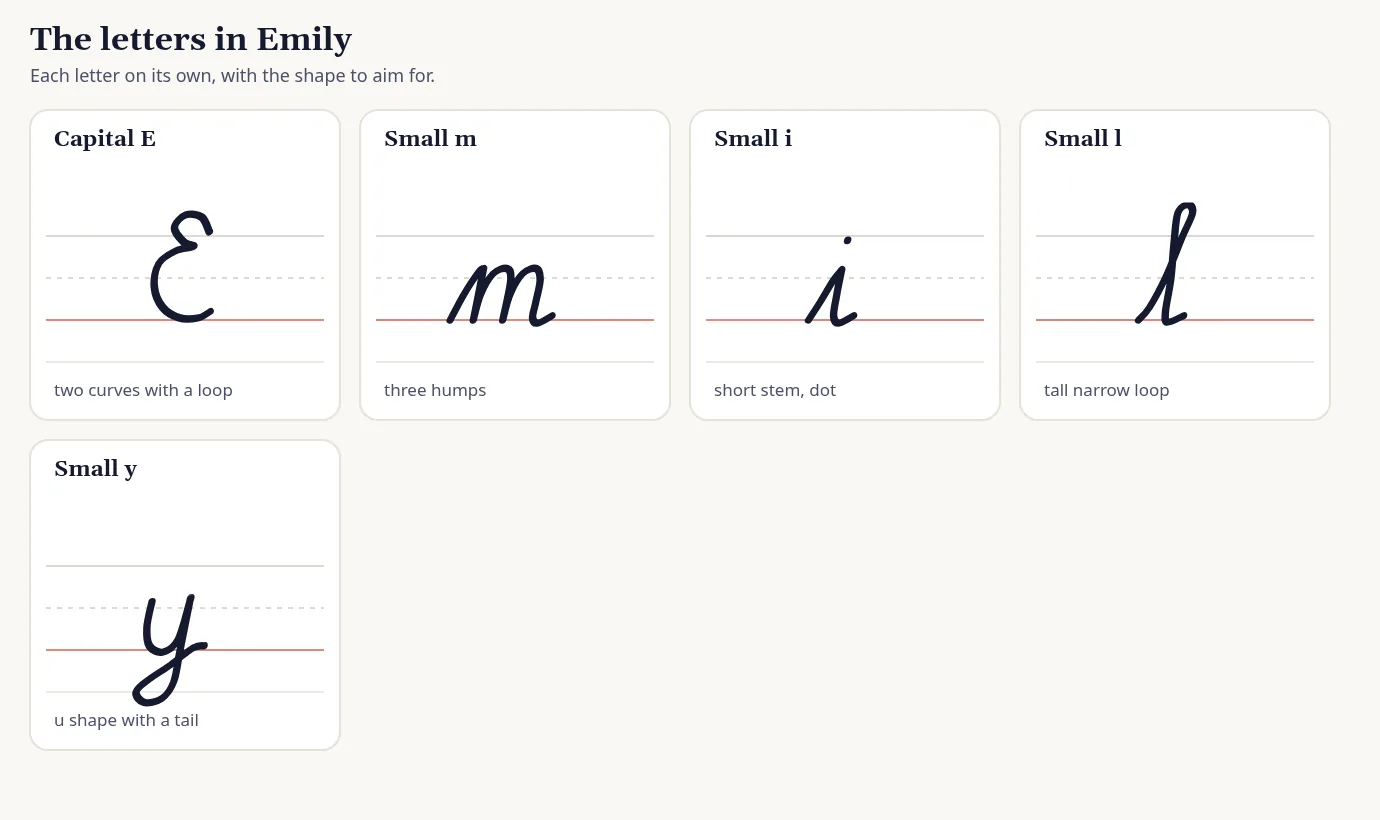
Emily is written with 5 letters: E, m, i, l, y. The picture shows each different letter on its own, with the shape to aim for. The table below it lists every join in order, so you can see where the pen has to travel between letters.
The joins, one by one
A join is the connecting stroke between two letters. Where it starts depends on the letter you just finished, and where it ends depends on the letter coming next. This table follows the school-style model used for the drawings on this site; some programs use slightly different joins.
| Pair | Leaves at | Next letter starts at | What the pen does |
|---|---|---|---|
| E → m | The baseline | The baseline | A short, nearly flat link |
| m → i | The baseline | The baseline | A short, nearly flat link |
| i → l | The baseline | The baseline | A short, nearly flat link |
| l → y | The baseline | The middle line | Rises to the middle line |
| y (last letter) | The baseline | – | Finish with a short flick, then lift the pen |
The capital E
The capital E is two stacked curves, like a backward 3, with a small loop where they meet. Make the lower curve a little larger than the upper one and finish it on the baseline, because that finishing stroke is what carries you into the m. If your E ends in the air, the join to the m will look like a separate stroke.
The m has three humps, not two
Emily has an m with three humps. The humps should be the same width and the same height, and each one should come down to the baseline before it climbs again. A quick check is to count: up-over, up-over, up-over, then the pen slides into the i. Two humps turns the m into an n, and four turns it into a wave.
i, l and y are three narrow letters in a row
After the m the name runs i, l, y. The i is a short stroke with a dot, the l is a tall narrow loop, and the y is a round letter whose tail loops under the line. The usual problem is that the loop of the l gets too short and looks like an e, or too fat and looks like a b. Keep the l two to three times as tall as the i and about as narrow as a pencil lead on its side.
How to write Emily in cursive by hand
- 1Write the capital E as two stacked curves with a small loop between them, ending the lower curve on the baseline.
- 2Slide straight into the m without lifting. Make three humps of the same height, each reaching the middle line.
- 3Finish the m on the baseline and continue into a short i. Leave the dot for later.
- 4Join into the l with a narrow loop that touches the top line, then climb up to the middle line to start the y.
- 5Write the y as a round left side, then let the tail drop below the baseline and loop back. Lift once to add the dot over the i.
Common mistakes when writing Emily in cursive
These are the slips that show up most often with this name. Check your own lines against the list before you move on.
- Writing a two-hump m. Count three before you leave the letter.
- An l that is too short. If it does not reach the top line it will be read as an e.
- A y with no loop in the tail. A straight tail is fine in print but breaks the flow in cursive.
- Placing the i dot too early. Add it after the whole name so the pen does not stop in the middle of a word.
How to practice Emily
Start with the middle of the name. Write the string mi on its own ten times, then ily, then the whole name. Do the capital E separately on a full line, because it is the only letter that is larger than the others. When the name feels steady, shrink it to half size, since small Emily is where the y tail tends to collapse. For a longer run, the 30-day plan has a week for names.
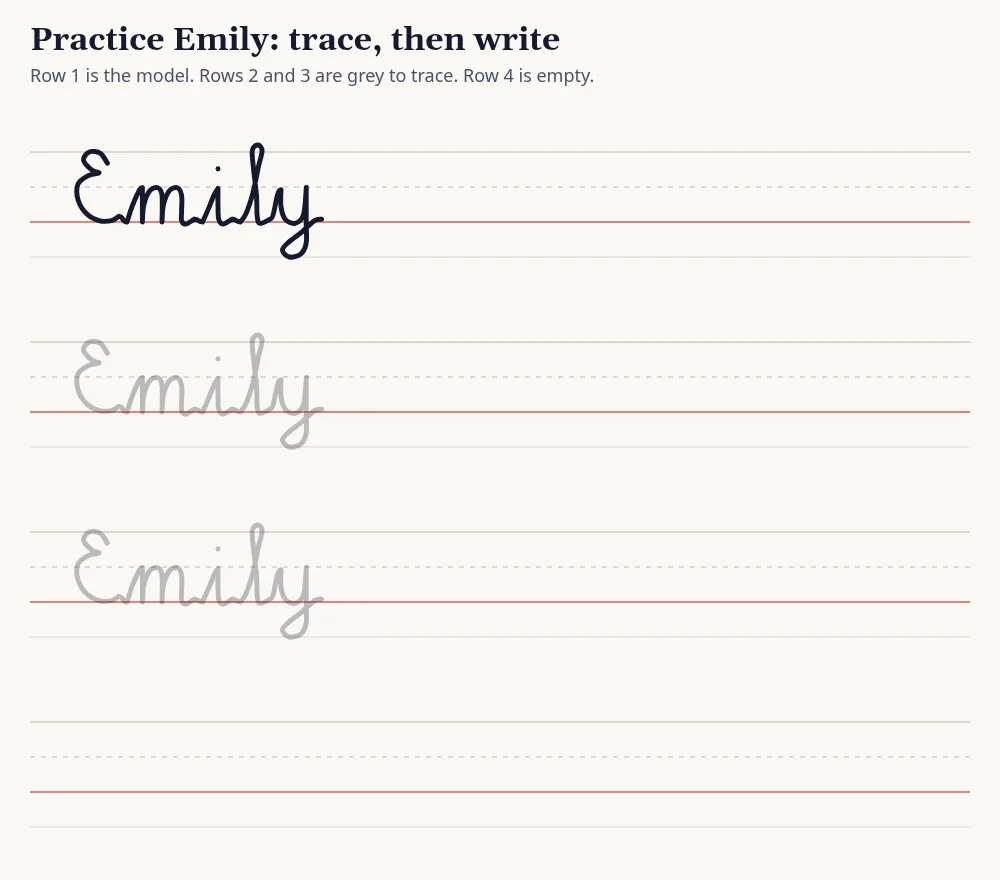
The one-page PDF has the name once in black as a model, two grey rows to trace, a blank ruled row and the short forms of Emily to trace underneath. It prints on Letter or A4. For another name or a full class set, use the worksheet generator, and for blank ruled paper see cursive lined paper.
Short forms of Emily in cursive
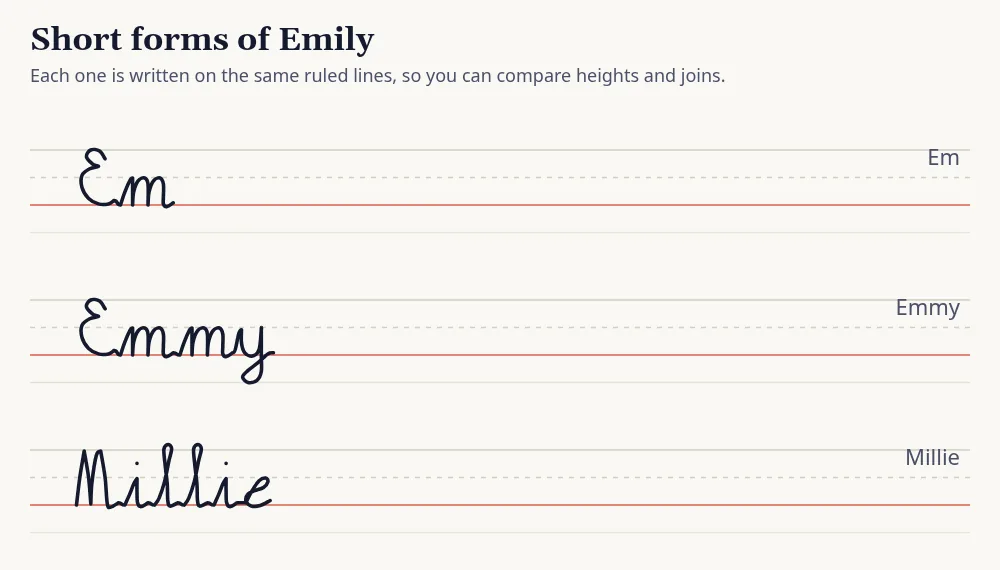
Em, Emmy and Millie are the common short forms. Em is only a capital E and an m, so it is the quickest way to practise the first join. Emmy brings back the m shapes and ends in a y, which makes it a small version of the full name. Millie swaps the E for an M and adds a tall l and i, so it is a good second target once Emily feels steady.
Ways to use Emily in cursive
Signature test
The long tail on the y gives Emily a natural flourish. Try ending the signature on that tail instead of the dot.
Notebook and journal covers
Five letters fit well on a cover at large size. Keep the y tail inside the margin.
Cards and gift tags
Use the formal font for cards and keep the capital E oversized; it is the most recognizable shape in the name.
Small tattoo or jewelry
Look closely at the l and y at actual size. See the tattoo guide for line weight and size advice.
About the name Emily: meaning and origin
Emily is usually traced to the Latin family name Aemilius, with Aemilia as its feminine form. Some sources connect it with a Latin word for rivalry, but that link is debated and nobody should treat it as settled. The name became common in English-speaking countries long ago and has never fully gone out of use.
Two well-known bearers are the poet Emily Dickinson (1830 to 1886) and the novelist Emily Brontë, whose Wuthering Heights appeared in 1847. Both wrote in an era when cursive was the standard hand, so seeing the name in a flowing script suits it.
Questions about Emily in cursive
How do you write Emily in cursive?
Write a looped capital E, join into an m with three humps, add a short i, a tall narrow l and a y with a looped tail. Dot the i at the end. The steps above show each join.
Do you lift the pen when writing Emily in cursive?
Only once, for the dot over the i. The E joins the m at the baseline, and m, i, l and y are all connected by baseline or short rising joins.
Why does my y look like a g?
A cursive y and g both have a descender loop. The g starts with a round bowl closed like an a, while the y has an open left side and a straight-ish right side. In Emily the y comes after the l, so it starts on a rising join.
Is Emily harder than Emma in cursive?
Slightly. Emma is all humps and one oval. Emily adds a third hump, a tall l and a descender, so it uses more of the line.
Can I use Emily in cursive for a tattoo?
Yes, but check the y tail and the l loop at the size you plan to print. Thin loops that are open at 8 cm can close up on skin over time; the tattoo guide covers size and weight.
Is there a printable Emily cursive worksheet?
Yes. The Emily practice sheet has the name to trace and empty lines to write it. For other names, use the worksheet generator.
Keep going
Another name
Emma in cursive
A looped capital E joined into two m shapes and an a, in one stroke.
Another name
Amelia in cursive
A rounded capital A and a loop-heavy middle.
Letter lesson
Cursive E
Capital E and lowercase e, stroke by stroke.
Tool
Cursive signature
Turn any name into a signature style.
Guide
Cursive tattoo fonts
Size, line weight and design tips if the name is going on skin.
All names
Cursive names
See every name on the site.
How we write and check pages: editorial policy.